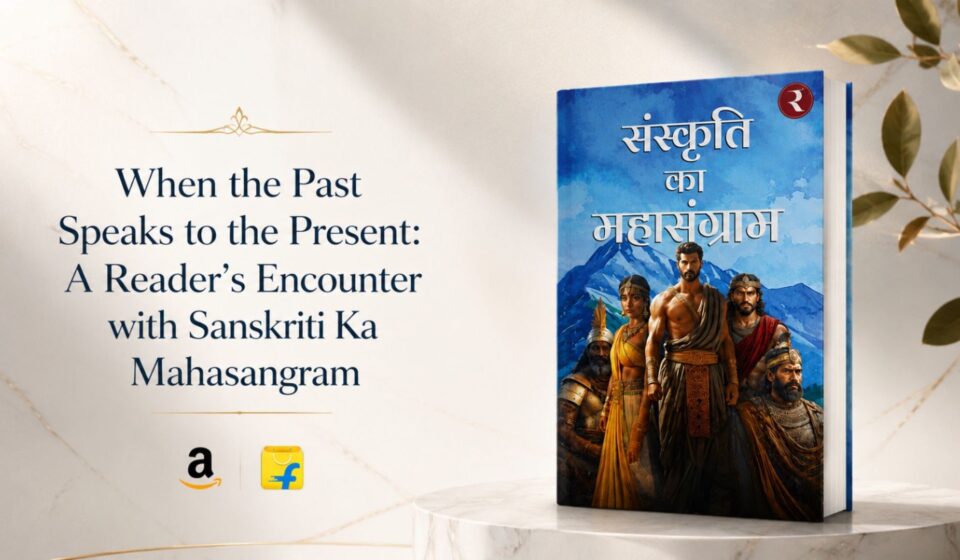
Sanskriti ka Mahasangram by Author Panigrahi Bethi & Translated by Asha Seth, is more Relevant Today than it was Centuries ago.

There are books that entertain and books that endure. Sanskriti Ka Mahasangram — the Hindi translation of Panigrahi Bethi’s celebrated novel The Greatest Battle of Culture — belongs firmly in the second category. This is a work that does not merely reconstruct the ancient world but inhabits it from the inside.
At its heart, Sanskriti Ka Mahasangram is a novel about what happens when two fundamentally different ways of being human collide. Set at the twilight of the Harappan Civilisation, it stages a meeting between the settled, introspective urban world of Harappa and the mobile, energy-driven culture of the Aryans. But Panigrahi Bethi is far too nuanced a storyteller to reduce this encounter to a simple clash of good and evil. What emerges instead is a narrative of breathtaking complexity; one that invites us to sit with the discomfort of ambiguity and to find beauty even in the midst of cultural transformation.
A City as a Character
The most immediate and lasting achievement of the novel is its evocation of Harappa itself. Cities in fiction too often serve as mere backdrops — stage sets against which human dramas unfold. In this novel, Harappa is something altogether different: it is a living entity with a personality, a philosophy, and a fate.
Through meticulously researched detail, Panigrahi Bethi presents the Harappan world in its full sophistication. The standardised weights and measures, the extraordinary water management systems, the absence of monumental royal structures that would suggest a cult of personality — all of this is woven organically into the fabric of the story without ever feeling like a lecture. Walking the grid streets of this ancient city alongside its inhabitants, the reader begins to understand that the Harappans had encoded their values into their very architecture: collective welfare over individual glory, civic responsibility over martial display, order over spectacle.
This is particularly striking because it challenges the widespread assumption that ancient equals primitive. The Harappan world in this novel is not a world waiting to be civilised. It is already civilised — in ways that speak directly to our own unresolved questions about how to live together, how to distribute resources, and how to build institutions that outlast any single generation.
The Aryan World: Motion, Energy, and Transformation
Set against this measured, contemplative urban world is the Aryan tradition — dynamic, kinetic, and charged with the energy of peoples on the move. The horse rides, the evolving rituals, the warrior spirit: all of these are rendered with equal care and respect. And crucially, the novel does not frame the Aryan world as a threat to be defeated or a force to be celebrated. It is simply another way of being human — with its own wisdoms, its own blindnesses, and its own internal tensions.
The philosophical dialogue between Ashwin and Varun is one of the novel’s intellectual highlights. Their debates about the nature of knowledge, governance, and the proper relationship between a people and their past carry genuine weight. These are not historical characters designed to illustrate a predetermined thesis; they are thinkers wrestling with real questions, and their disagreements illuminate the fault lines running through both civilisations.
Purush, Armita, and the Bridge Between Worlds
The emotional centre of the novel is the relationship between Purush, a young man shaped by the Aryan world, and Armita, a woman who embodies the values and knowledge of Harappa. Their connection — tentative, earnest, and alive with mutual curiosity — is the novel’s most generous achievement. It refuses to be merely a love story. Instead, it becomes a meditation on what it means to genuinely encounter another human being from a different world: to set aside assumption and superiority and to learn, slowly and humbly, that there are truths one does not yet possess.
Purush’s transformation as he spends time in Harappa is handled with extraordinary emotional intelligence. There is no dramatic conversion, no sudden epiphany. Instead, there is an accumulation of small moments — a glimpse of how a city can be planned for the dignity of all its inhabitants, a conversation about water and memory, a shared silence beside the Great Bath — that gradually reshape how he sees the world. It is the kind of writing that earns its emotional payoff because it trusts in the patience of its readers.
Armita, meanwhile, is one of the most fully realised female characters in recent Indian historical fiction. Her love for her city is not sentimental; it is embodied and specific. She knows the grain stores and the civic assemblies; she understands the web of relationships that hold a civilisation together. When that civilisation comes under pressure, her grief is not abstract — it is the grief of someone who understands, in precise detail, what is being lost.
The Translation: A Bridge Across Languages
Any review of Sanskriti Ka Mahasangram would be incomplete without specific attention to the translation. The challenges of rendering a work so deeply embedded in the cultural specificities of two ancient civilisations into Hindi — while preserving the emotional register, the atmospheric density, and the philosophical depth of the original — are considerable. Asha Seth (the translator) meets them with apparent effortlessness.
The Hindi prose never reads as translated. It has an organic quality, a sense of rightness in its rhythms and diction, that suggests not mere linguistic transfer but genuine creative re-imagination. Readers who encounter the novel in Hindi are not receiving a second-hand experience; they are receiving the novel as it was meant to feel. This is a rare achievement and deserves to be recognised as such.
Why This Novel Matters Now
Sanskriti Ka Mahasangram arrives at a moment when the world is actively renegotiating its relationship with cultural identity, diversity, and the meaning of heritage. In that context, this novel’s central insight — that cultures do not merely clash when they meet but also exchange, adapt, and create something new — feels urgently relevant.
The novel does not offer easy comfort. It does not promise that meetings between different worlds are always harmonious or that transformation is painless. What it offers instead is something more valuable: the example of a narrative that refuses to simplify, that holds contradictions in careful balance, and that insists on the full humanity of everyone in its pages. In a literary landscape that too often favours either nostalgia or polemic, that is a considerable achievement.
Final Verdict
Sanskriti Ka Mahasangram is required reading for anyone interested in Indian history, the Indus Valley Civilisation, or the art of historical fiction. It is a novel of quiet power and lasting resonance — one that will reward re-reading and that will stay with you long after the final page. Panigrahi Bethi has written a landmark work. Asha Seth has given it wings.
Rating: ★★★★★ (5/5)
Available in paperback and e-book on Amazon (https://www.amazon.in/dp/9349988852), Flipkart, and at all major online retailers worldwide.