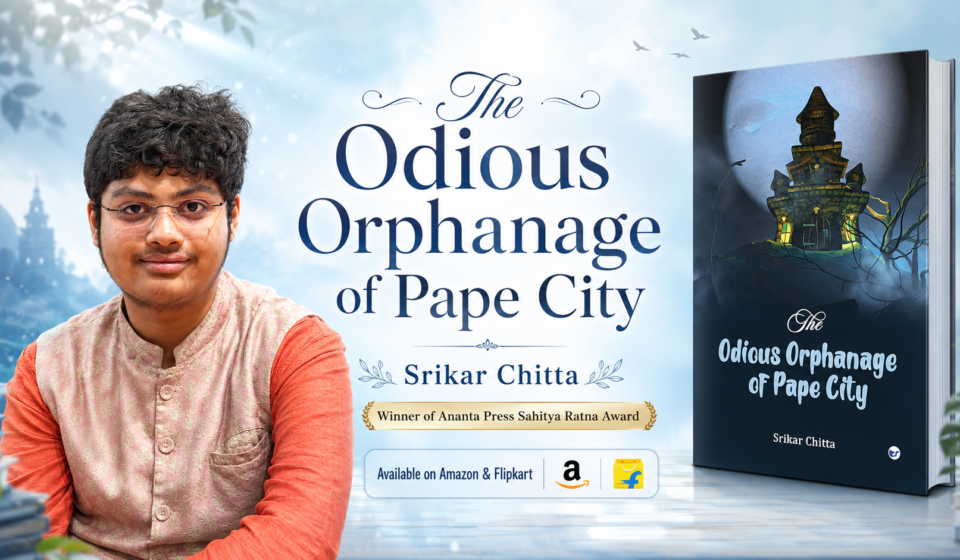

The Odious Orphanage of Pape City by Srikar Chitta is the kind of book that wastes no time making an impression. From its very premise, it promises dread, danger, and a sense of mystery, and it delivers all three with an energy that feels immediate and compelling. The novel introduces readers to Chris, a young boy who enters an orphanage called the “House of Victory,” only to discover that the title is bitterly ironic. Rather than finding shelter, safety, or care, he is thrust into a world controlled by an oppressive warden, frightening punishments, unkind children, and a harsh routine that reduces daily life to anxiety and survival. What follows is a tightly paced, suspense-filled story that invites readers into a nightmare setting while also celebrating courage, persistence, and the refusal to give up.
One of the strongest qualities of this book is its pace. In just a concise number of pages, Srikar Chitta creates an atmosphere of tension that begins early and rarely weakens. This is not a novel that lingers too long on backstory or over-explanation. Instead, it moves with quick purpose, which suits the emotional reality of the story. Chris does not have the luxury of slowly studying his environment; he is living through it in real time, and readers feel that pressure with him. Every new detail about the orphanage deepens the unease. The result is a reading experience that feels urgent, as if the reader too is searching for answers, watching for danger, and hoping for a way out.
The setting is particularly effective. The “House of Victory” is one of the most memorable elements in the book because it represents a cruel contradiction. A place that should offer comfort to vulnerable children becomes instead a site of fear and suffering. That ironic contrast gives the story one of its core emotional and thematic strengths. Institutions are often associated with order, protection, and responsibility, but this orphanage hides darkness behind its official name. By framing the setting this way, the author taps into a powerful and unsettling idea: sometimes what appears safe from the outside can conceal the deepest harm. This tension gives the book a gothic edge while keeping it grounded in emotions that young readers can understand—fear of unfair adults, fear of being trapped, and fear of not being believed.
Chris is a strong protagonist precisely because he feels vulnerable. He is not introduced as someone naturally powerful or unusually heroic. He is a child placed in an unbearable situation, and that makes his journey more engaging. Readers root for him because his fear feels real, and his courage emerges gradually through necessity. This is one of the book’s finest achievements. Instead of presenting bravery as the absence of fear, the novel presents bravery as action despite fear. Chris does not become compelling because he never worries; he becomes compelling because he keeps going when everything around him seems designed to break his spirit.
The cruel warden serves as an effective antagonist. In children’s and middle-grade fiction, villainous authority figures often symbolize the way young people experience power when they have little control over their circumstances. Here, the warden becomes the embodiment of tyranny. The bizarre punishments and rigid atmosphere help create a constant sense of threat. Yet what makes the character work is not only cruelty, but the system of fear surrounding him. Chris is not simply fighting one bad person; he is trapped within an environment shaped by that person’s dominance. That broadens the stakes of the story and makes Chris’s resistance feel more meaningful.
Another notable strength is the book’s accessibility. For many young readers, especially those who are still building the habit of reading, a fast-moving story can be the difference between feeling intimidated and feeling excited. The Odious Orphanage of Pape City is highly approachable without being simplistic. Its compact form and direct storytelling make it ideal for readers who enjoy quick momentum, suspense, and clear emotional stakes. At the same time, the book never feels empty. Beneath the speed, it explores important ideas about resilience, authority, cruelty, and the longing for freedom. That balance—readability combined with substance—is one reason the book stands out.
Srikar Chitta’s youth as an author also adds an interesting and valuable dimension to the work. Because the novel is written by a young writer, it carries an immediacy that often feels authentic to younger readers. The emotional priorities of the story—unfairness, humiliation, fear of hostile peers, disgust at bad food, anger at meaningless punishment—are all rendered with a clarity that suggests a strong understanding of how children experience powerlessness. Rather than writing down to young readers, the book speaks in a mode that respects their emotional reality. It understands that childhood is not a trivial state. It can be filled with very serious feelings, and literature that recognizes those feelings can be deeply engaging.
The language of the book supports its thriller qualities well. The story is designed to keep readers turning pages, and its narrative energy reflects that goal. There is a cinematic quality to the way the danger escalates, the mysteries unfold, and Chris’s desperation intensifies. Young readers who enjoy horror-lite, eerie institutions, and escape-driven plots will find much to appreciate. Parents and educators, meanwhile, may value the book’s ability to engage children with a story that is entertaining while also inviting discussions about moral courage and oppressive systems.
Importantly, the novel does not use darkness for its own sake. Although the atmosphere is frightening and the situations Chris faces are unpleasant, the story ultimately draws meaning from endurance. The darkness exists to sharpen the light of resistance. Chris’s struggle matters because it demonstrates that even when a child is denied comfort, fairness, and control, inner strength can still survive. That message is never forced, but it emerges naturally from the plot. It gives the story emotional purpose beyond suspense.
The title itself deserves appreciation. The Odious Orphanage of Pape City is memorable, rhythmic, and evocative. It immediately signals an imaginative, sinister experience, and the book lives up to that promise. The cover and title together create curiosity, but the content sustains it. Readers are not simply lured by a dramatic premise; they are rewarded with a story that is focused, atmospheric, and hard to put down.
What makes this book unique is not just that it is suspenseful, but that it combines suspense with an accessible format and a youthful creative voice. In an age when many young readers are competing with fast digital distractions, books like this matter. They demonstrate that reading can still provide adrenaline, imagination, and emotional investment in a compact and satisfying form. Srikar Chitta shows real talent in knowing how to grip attention and maintain momentum.
Overall, The Odious Orphanage of Pape City is a gripping middle-grade thriller that succeeds through atmosphere, speed, and emotional clarity. It offers readers an intense journey into a place of fear while never losing sight of hope and courage. Chris’s story is suspenseful, unsettling, and ultimately inspiring. The novel’s biggest achievement lies in how efficiently it builds a vivid world of danger and then places resilience at its center. For young readers who enjoy mystery, survival, and dark adventure, this book is a compelling pick. For adults observing emerging literary talent, it is also a reminder that strong storytelling can come from remarkably young voices. Srikar Chitta has created a book that is exciting, readable, and memorable—and that combination makes it truly stand out.
Amazon Link: https://www.amazon.in/Odious-Orphanage-Pape-City/dp/9394437614/