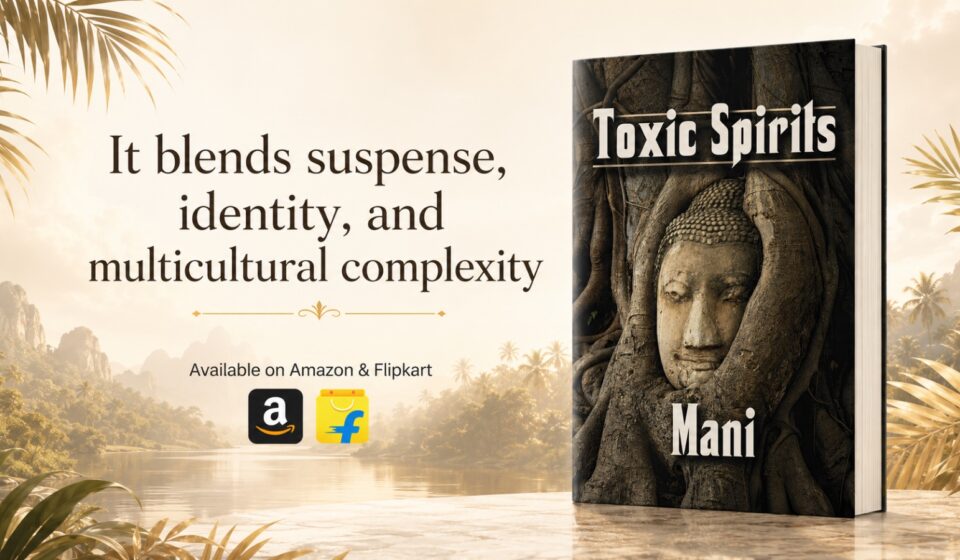

Behind the disappearances and genetic transformations, Mani’s thriller asks a direct question: what is innovation worth when the people carrying its risks have no real power?
The most frightening figure in a science thriller is not always a mad scientist. Sometimes it is a respected expert with excellent credentials, a persuasive explanation, and access to people who cannot easily refuse. Toxic Spirits understands this. Mani builds a story of genetic drugs, secret trials, and bodily transformation, but the novel’s real terror comes from the structures that make abuse possible. The laboratory is dangerous because it is protected by money, expertise, social distance, and the belief that progress excuses almost anything.
A mystery rooted in unequal power
Benton, a widowed former intelligence analyst, comes to Thailand seeking a quieter life. His plans are totally disrupted after he meets Siri, a tribal singer who has been speaking out about harmful side effects from drug trials conducted on her hill-tribe. Her disappearance turns the novel into an investigation, but it also introduces an important asymmetry. The people being tested do not possess the same information, legal protection, mobility, or public credibility as the people directing the research. Their suffering can be hidden and erased because the world has already decided that their voices are peripheral.
Pierre, the doctor at the centre of the trials, embodies the corruption of expertise. He is brilliant enough to make his project appear visionary, yet disturbed enough to treat any resistance to his goals as a kind of ignorance. He breaks rules because he has constructed an ethical theory in which his actions are all urgent and necessary. In his mind, the future is far more important than any beings harmed in the present. Mani’s portrait is effective because many historical abuses have been enabled by precisely this logic: vulnerable bodies are described as opportunities, collateral damage, or unavoidable costs.
Consent is more than a signature
The novel’s medical trial invites readers to think about consent in a serious way. A signed form cannot be meaningful when participants do not understand the risks, when information is withheld, or when economic and social pressure makes refusal unrealistic. Toxic Spirits dramatizes the gap between procedural permission and genuine autonomy. Siri’s protest matters because it restores language to people who have been reduced to data.
Benton’s fate sharpens this concern. As he moves closer to the truth, he becomes an unwilling guinea pig in the same genetic programme. The sleuth is transformed into experimental material. This reversal makes the ethical violation impossible to view from a comfortable distance. Benton is no longer asking what happened to others; he is forced to experience what it means for another person to claim authority over his body. The novel turns scientific exploitation into a crisis of ownership: does a person still belong to himself when his body is ‘rewritten’?
The body as a battlefield
Many thrillers depend on the fear of death. Toxic Spirits adds the fear of alteration. Genetic engineering threatens not only to end life but to change its terms. Benton’s transformation destabilizes his sense of self, while the expanding effects of the drugs suggest that biological interventions can escape their intended boundaries. The body becomes a battlefield where scientific ambition, trauma, love, ancestry, and survival compete.
This is where the novel’s interest in identity becomes inseparable from its medical plot. Genes can reveal connection, but they can also be misused to create fantasies of purity and control. Pierre’s work treats biological complexity as something to master. Benton, by contrast, embodies mixed ancestry and lived multicultural experience. He represents the opposite idea: human identity is not a problem to be cleaned up. It is layered, contradictory, and historically shaped.
Traditional healing and high-tech medicine
The book places tribal healing traditions beside advanced biotechnology, but it does not reduce the conflict to a simple contest between old and new. The deeper issue is the relationship between knowledge and community. Traditional healers are accountable to people whose lives they share. Pierre’s laboratory is accountable primarily to its own ambition. One system may lack the authority of modern institutions, while the other possesses authority without humility.
The novel therefore challenges the assumption that technological sophistication automatically produces moral superiority. High-tech medicine can save lives, but it can also magnify harm when controlled by people who view consent and culture as obstacles. Traditional knowledge can contain insight, but it is not romanticized as magical perfection. The most hopeful moments emerge when care, observation, and responsibility are combined rather than when one tradition simply defeats another.
The environmental dimension
Mani extends the consequences of genetic manipulation beyond human subjects. As the experiments spiral out of control, the botanical treasures of Thailand’s Golden Triangle are threatened. This expansion is crucial. The novel links the exploitation of marginalized communities to the exploitation of nature. Both are treated as resources available for extraction by outsiders who assume they can take, alter, and profit without lasting consequences.
The lush descriptions of jungle, vegetation, heat, water, and biodiversity make environmental damage emotionally visible. Nature is not a neutral container around the human drama. It is part of the same living system. When genetically engineered substances spread, the boundary between medical crime and ecological disaster disappears. The book suggests that an ethic willing to sacrifice poor people will eventually sacrifice forests, species, and entire regions as well.
Why the Thailand setting matters
Thailand gives Toxic Spirits a specific social landscape: tourist pleasure beside local inequality, spiritual imagery beside commercial appetite, expatriate freedom beside communities with limited choices. Prajawan, the fictional seaside town, is crowded with people who have come to reinvent themselves. For some, Thailand offers genuine renewal. For others, it offers anonymity and access. The expat bar becomes a meeting place where stories are exchanged, identities are performed, and danger can hide inside casual conversation.
The movement between Thailand, Washington, DC, and Auroville also prevents the novel from presenting exploitation as a uniquely local problem. Pierre’s project belongs to a global network of science, capital, and migration. Benton’s intelligence career links him to Western systems of power even as he becomes their critic and victim. The book’s geography shows how ideas and technologies travel faster than responsibility.
A villain who believes in progress
Pierre is compelling because he is not motivated only by money or cruelty. His self-belief gives him energy. He can interpret every objection as proof that ordinary people are too fearful to understand genius. This type of villain creates a more unsettling conflict than a simple criminal mastermind. The reader is asked to recognize how easily technical confidence can become moral blindness.
At the same time, the novel does not make Benton morally perfect. He brings the habits of an intelligence analyst, the wounds of racism, grief after his wife’s death, and the privileges of an expatriate. He is capable of insight and also of emotional withdrawal. His imperfect perspective prevents the book from becoming a sermon in which one good man explains ethics to everyone else. He must learn through risk, failure, and unwanted transformation.
Thriller energy and intellectual weight
Despite the serious themes, Toxic Spirits remains a thriller. Siri’s disappearance, Benton’s investigation, Pierre’s menace, Mimi’s arrival, the expanding biological danger, and the threat of wider catastrophe keep the narrative moving. Mani uses macabre violence and dark humour to stop the ethical material from becoming dry. The reader is entertained, but never allowed to forget that the entertainment grows from disturbing possibilities.
Some readers may find the number of themes crowded. The book moves among medical ethics, genetics, race, multiculturalism, romance, expatriate satire, environmental damage, and tribal knowledge. A longer novel might have given each strand more space. Yet the compression also creates urgency. Events feel as though they are mutating faster than the characters can understand them, which suits a story about technology escaping control.
Final verdict
Toxic Spirits is most powerful when it shows that unethical science is not created by knowledge alone. It requires inequality, secrecy, and a story that makes victims seem less important than discovery. The novel’s warning is therefore broader than the pharmaceutical world. Any institution can become dangerous when it values results more than consent and treats those with the least power as the most convenient place to test risk.
Readers who enjoy thrillers with moral depth will find much to discuss here. The novel is vivid, fast, strange, and troubling. It demands that science remain connected to humanity. Its central lesson is simple and urgent: scientific brilliance without accountability is not progress, but merely power draped in a lab coat.
Buy the book: Toxic Spirits on Amazon India