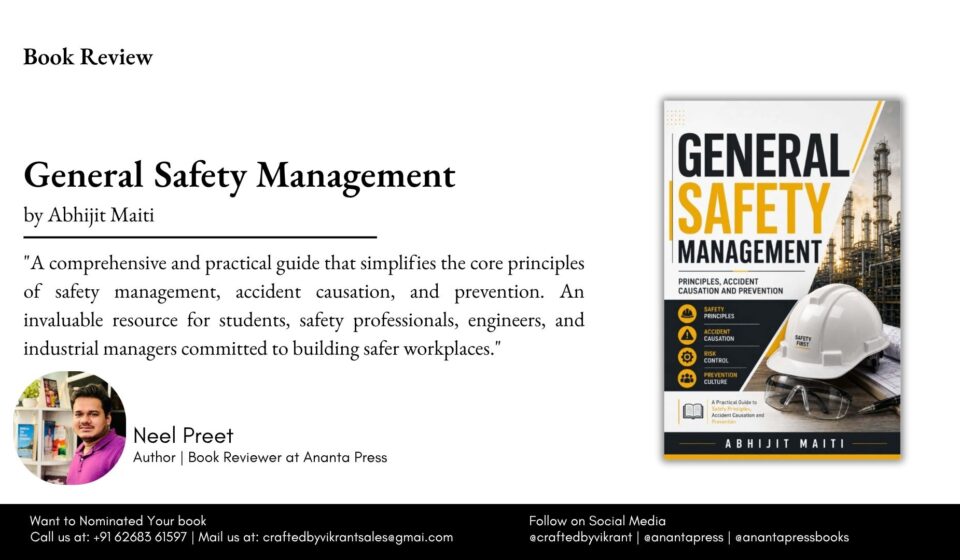
General Safety Management: Principles, Accident Causation and Prevention by Abhijit Maiti

In today’s industrial world, where technological advancement, complex manufacturing systems, and high-risk operations have become an integral part of organizational growth, workplace safety is no longer a matter of compliance alone—it is a strategic necessity. General Safety Management: Principles, Accident Causation and Prevention by Abhijit Maiti successfully addresses this need by presenting a comprehensive, practical, and highly structured guide to modern safety management. Combining theoretical foundations with practical industrial applications, the book serves as both an academic textbook and a valuable professional reference for anyone involved in occupational health and safety.
One of the book’s greatest strengths lies in its systematic organization. Rather than presenting safety as a collection of isolated rules, the author introduces it as an integrated management philosophy that influences every aspect of organizational performance. Beginning with the fundamentals of safety management, the book gradually builds the reader’s understanding by exploring the evolution of workplace safety, the importance of safety culture, the objectives of safety management, and the role of leadership in accident prevention. This logical progression enables readers from diverse educational backgrounds to understand complex safety concepts with ease.
The writing style is one of the book’s most commendable features. Safety management literature often becomes excessively technical, making it difficult for beginners to grasp important concepts. However, Abhijit Maiti adopts a clear, straightforward, and reader-friendly approach that balances technical accuracy with accessibility. Each chapter begins with well-defined objectives and proceeds through organized explanations supported by examples, practical observations, and concise conclusions. This structured presentation makes the book equally suitable for university students, safety trainees, engineers, supervisors, and experienced safety professionals seeking a reliable reference.
A particularly impressive aspect of the book is its emphasis on developing a positive safety culture. Rather than viewing safety merely as a legal obligation, the author consistently highlights that effective safety begins with leadership commitment, employee participation, continuous learning, and organizational responsibility. The discussion demonstrates that sustainable safety performance depends not only on equipment and procedures but also on attitudes, communication, and shared accountability across all levels of an organization. This broader perspective reflects the realities of modern industrial environments where behavioural safety plays a crucial role in preventing accidents.
The chapters devoted to accident causation theories are among the strongest sections of the book. Classical concepts such as Heinrich’s Domino Theory, Frank Bird’s Loss Causation Model, Multiple Causation Theory, Human Factors Theory, and Root Cause Analysis are presented in a practical and understandable manner. Instead of limiting the discussion to historical descriptions, the author explains how these theories remain relevant in identifying hazards, analysing incidents, and designing preventive strategies in contemporary workplaces. Readers gain not only theoretical knowledge but also an appreciation of how these models influence real-world safety decision-making.
Another noteworthy strength is the book’s practical orientation. Throughout the text, industrial examples and well-known accident case studies help connect theoretical concepts with actual workplace situations. References to major industrial disasters such as the Bhopal Gas Tragedy, Flixborough Disaster, and Piper Alpha Disaster reinforce the importance of systematic safety management and illustrate the devastating consequences of management failures, inadequate risk assessment, and poor emergency preparedness. These examples transform abstract concepts into meaningful learning experiences, making the lessons memorable and applicable.
The author also demonstrates a comprehensive understanding of modern safety systems by covering a broad spectrum of topics essential to occupational safety management. Hazard identification, risk assessment, hierarchy of controls, permit-to-work systems, fire safety, emergency preparedness, safety audits, accident investigation, root cause analysis, and continuous improvement are all discussed within a coherent framework. This integrated approach allows readers to understand how various safety processes interact to create an effective safety management system rather than functioning as independent activities.
One of the most valuable contributions of this book is its focus on prevention rather than reaction. The author repeatedly emphasizes that accidents are not random events but predictable outcomes arising from unsafe conditions, unsafe acts, management deficiencies, and organizational weaknesses. This proactive philosophy encourages readers to identify risks before incidents occur and to develop preventive systems instead of relying solely on post-accident investigations. Such an approach aligns with internationally accepted safety principles and reflects best practices followed by leading industrial organizations.
The educational value of the book is equally impressive. Students preparing for careers in industrial safety, occupational health, engineering, construction management, and environmental management will find the material highly relevant. The logical sequencing of topics, clear explanations, and structured chapter organization make the book an effective learning resource for classroom teaching, competitive examinations, and professional certification programmes. At the same time, experienced practitioners can use it as a practical handbook for reviewing established safety concepts and implementing effective workplace safety programmes.
The author’s extensive professional experience is evident throughout the text. Instead of relying exclusively on academic theory, the explanations reflect real industrial practices and practical challenges encountered in construction sites, manufacturing facilities, petrochemical industries, and other high-risk workplaces. This combination of academic knowledge and field experience enhances the credibility of the book and ensures that its recommendations remain relevant to contemporary industrial environments.
Another admirable feature is the emphasis on continuous improvement. The book clearly communicates that safety management is an ongoing process requiring regular monitoring, employee involvement, periodic audits, corrective actions, and organizational learning. This reinforces the understanding that achieving a “Zero Accident” culture requires sustained commitment rather than isolated safety initiatives. The discussion encourages organizations to integrate safety into everyday decision-making and long-term business strategy instead of treating it merely as a compliance requirement.
From a presentation perspective, the book maintains excellent consistency. Chapters are logically arranged, technical terminology is explained clearly, and important concepts are supported by practical examples. This organized format enhances readability and allows readers to revisit specific topics whenever required. The inclusion of checklists, investigation procedures, safety management concepts, and practical guidance further increases the book’s usefulness as a workplace reference manual.
Perhaps the most significant achievement of General Safety Management: Principles, Accident Causation and Prevention is its ability to demonstrate that safety management extends beyond preventing injuries. The book effectively illustrates how robust safety systems improve productivity, protect organizational assets, strengthen legal compliance, safeguard the environment, and enhance overall operational excellence. By presenting safety as an essential component of sustainable business success, the author encourages readers to adopt a broader and more strategic understanding of workplace safety.
Overall, this book stands as a valuable contribution to the field of occupational health and safety. Its balanced combination of theory, practical application, industrial case studies, and accessible language makes it suitable for both academic study and professional practice. Whether the reader is a student beginning a career in safety management or an experienced practitioner responsible for industrial operations, the book provides meaningful insights that can be applied immediately in real workplaces.
In conclusion, General Safety Management: Principles, Accident Causation and Prevention is a thoughtfully written, informative, and highly practical resource that successfully bridges the gap between safety theory and industrial application. It reinforces the importance of proactive risk management, strong safety culture, continuous improvement, and responsible leadership in preventing workplace accidents. By equipping readers with both conceptual understanding and practical knowledge, the book contributes meaningfully to the development of safer workplaces and more resilient organizations. It is undoubtedly a recommended addition to the libraries of students, engineers, safety officers, industrial managers, educators, and every professional committed to achieving excellence in workplace safety.