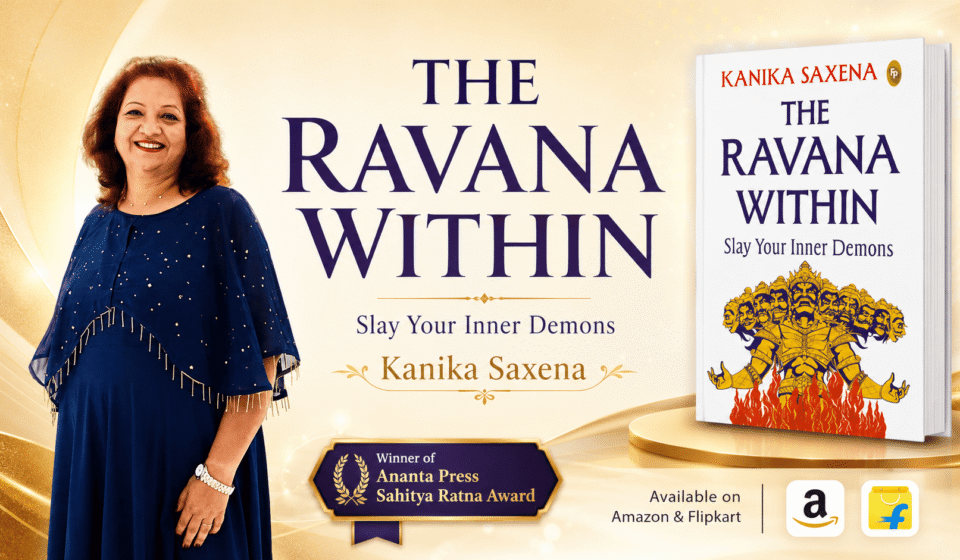

The most compelling idea at the heart of The Ravana Within: Slay Your Inner Demons is that the decisive battles of life are rarely fought against people, circumstances, or external enemies. They are fought within the mind, where ego, anger, greed, jealousy, procrastination, self-doubt, and attachment quietly influence our choices. Kanika Saxena takes the familiar figure of Ravana from the Ramayana and transforms him into a psychological mirror. Instead of treating Ravana only as a distant mythological antagonist, she invites readers to recognize the smaller versions of his destructive tendencies operating inside ordinary human behaviour. That interpretive choice gives the book both cultural familiarity and contemporary relevance.
Many self-help books speak about success, confidence, discipline, and positive thinking in broad terms. This book appears to begin at a more fundamental level: before a person can build a purposeful life, that person must identify the habits and impulses that repeatedly weaken it. The metaphor of an “inner Ravana” is effective because it turns abstract emotional problems into something visible and memorable. Ego is no longer merely a definition from psychology; it becomes a head that must be noticed before it controls a conversation. Anger is not simply a passing mood; it becomes a force that can burn relationships and judgment. Procrastination is not an innocent delay; it becomes an internal adversary that slowly steals opportunity. By giving these tendencies a symbolic identity, Saxena helps readers observe them with greater clarity.
The book’s central strength lies in its refusal to place all responsibility outside the self. Modern life makes external blame very easy. A disappointing workplace can be blamed on colleagues, an argument on the other person, poor progress on lack of time, and unhappiness on circumstances. The Ravana Within redirects attention toward personal agency. This does not mean that social realities or difficult circumstances are unimportant. Rather, it suggests that inner freedom begins when individuals examine how they respond to what happens. That shift from blame to responsibility is one of the most valuable lessons any motivational book can offer because it returns power to the reader. When responsibility is understood not as guilt but as the ability to choose a better response, it becomes empowering.
Another admirable quality is the book’s emphasis on awareness before transformation. People often try to eliminate anger, jealousy, fear, or self-doubt through willpower alone. Yet an emotion that has not been understood tends to reappear in a different form. A person may suppress anger but become sarcastic. Someone may deny jealousy but constantly compare achievements. A reader may call procrastination “waiting for the right time” and remain stuck for years. The approach described in this book encourages honest self-observation. Such observation is uncomfortable, but it is also liberating. We cannot change what we refuse to name.
The inclusion of relatable examples and self-reflection exercises adds practical value. A concept becomes useful only when readers can connect it to their own routines, relationships, and decisions. Reflection exercises create a pause between reading and action. They encourage the reader to ask questions such as: Where does my ego make me defensive? What fear is hidden underneath my anger? Which attachment prevents me from accepting change? What task am I postponing because I am afraid of failure? These questions can convert a chapter into an intimate conversation with oneself. In this sense, the book is not merely something to finish; it is something to work through.
The Ramayana-inspired framework also makes the message accessible to readers who may not be drawn to academic psychology. India’s epics have always survived because their characters represent more than historical or religious figures; they embody recurring human dilemmas. Ravana is brilliant, powerful, learned, and accomplished, yet his destructive traits overpower his gifts. This complexity makes him an especially suitable symbol for self-help. The lesson is not that flawed people lack ability. Often, talented people are defeated by their inability to govern themselves. Intelligence without humility can become arrogance. ambition without ethics can become greed. confidence without restraint can become domination. Through the Ravana metaphor, the book reminds readers that outer achievement cannot compensate for inner disorder.
The book’s message is equally relevant to professional and personal life. In the workplace, ego can prevent feedback, anger can damage collaboration, jealousy can create unhealthy competition, and procrastination can limit growth. In families, attachment can become control, self-doubt can lead to emotional dependence, and unresolved resentment can shape communication. In personal development, the same tendencies can prevent consistency even when goals are clear. By treating these traits as interconnected inner demons, the book offers a framework that can be applied across multiple areas rather than to one narrow problem.
There is also an encouraging moral tone in the idea that victory is possible. The purpose of identifying an inner Ravana is not to shame the reader. It is to awaken the reader. Every person carries contradictions: generosity and selfishness, courage and fear, patience and anger. Personal growth does not require pretending that the darker side does not exist. It requires becoming conscious enough to choose which side receives nourishment. This is where discipline enters the discussion. Awareness shows us the pattern; discipline helps us interrupt it; repeated better choices gradually create character.
Kanika Saxena’s own journey gives added credibility to the book’s focus on inner limitations. Her professional life has included engineering, teaching, consultancy, marketing, full-time motherhood, a long career break, a return to education, content writing, freelancing, technology writing, life coaching, public speaking, and authorship. The difficulty of restarting a career after years away from the workplace, especially with limited computer skills and repeated rejection, reflects the kind of inner struggle the book addresses. Her story demonstrates that self-doubt and uncertainty need not have the final word. This lived experience likely contributes to the practical and humane quality of her motivational perspective.
The Ravana Within stands out because it does not promise that a perfect life will appear once a few positive affirmations are repeated. Its premise is more demanding and more honest. The reader must become willing to see personal weaknesses without excuses. Yet the book also suggests that these weaknesses are not permanent identities. Anger is a pattern, not a destiny. Procrastination is a habit, not a personality. Jealousy is a signal, not an unchangeable truth. Ego can be observed, attachment can be loosened, and self-doubt can be challenged.
For readers interested in self-help, Indian wisdom traditions, emotional intelligence, or personal responsibility, this book offers a meaningful meeting point. It can be especially valuable for those who understand their goals but repeatedly feel blocked by their own reactions. Its core message deserves to be remembered long after the final page: conquering others may bring temporary satisfaction, but conquering the forces that misuse our own potential brings lasting freedom. The greatest Lanka to be won is not a kingdom outside us; it is the ungoverned territory of our own mind.Buy the book on Amazon: https://amzn.in/d/0cVDtzND