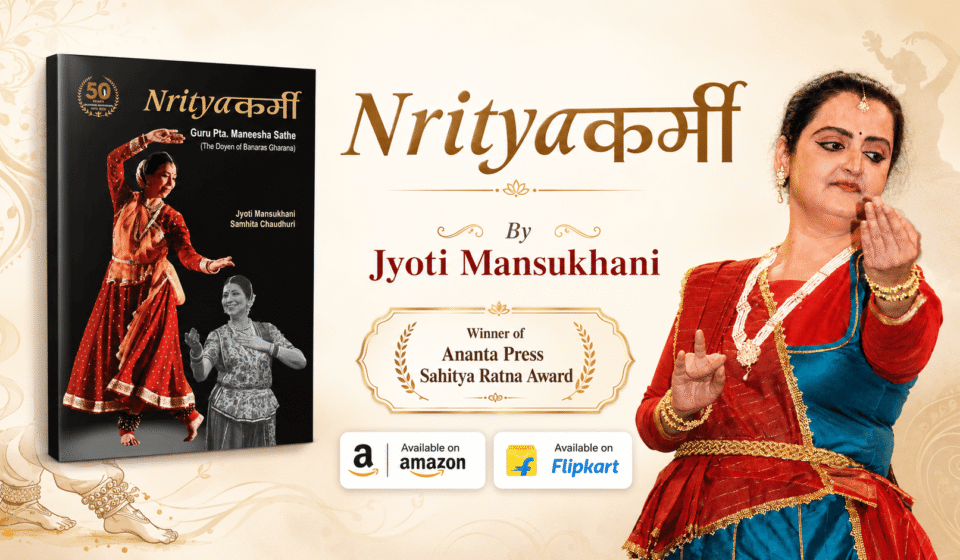

Some books record a life; others preserve a tradition through the life of one extraordinary individual. Nrityaकर्मी belongs unmistakably to the second category. Written by Jyoti Mansukhani and co-authored by Samhita Chaudhury, this English-language biographical compilation presents the six-decade journey of Guru Pta. Maneesha Sathe ji, one of the most respected figures associated with Kathak. It is not merely an account of achievements arranged in chronological order. Instead, it appears as a carefully constructed portrait of an artiste whose personal discipline, artistic philosophy, teaching practice and human relationships have become inseparable from the cultural world she has helped shape.
The title itself is meaningful. “Nritya” evokes dance, while “karmi” suggests a committed worker or practitioner – someone who does not simply perform an art but dedicates an entire life to its service. This idea provides a powerful key to understanding the book. Maneesha Sathe ji is presented not only as a celebrated performer, but as a person who has worked continuously for Kathak: learning it, practising it, interpreting it, teaching it, guiding others and sustaining its values across generations. That makes the biography valuable even for readers who may not possess specialised knowledge of classical dance. The book is ultimately about what happens when talent is supported by discipline and when admiration for an art form grows into lifelong responsibility.
The three-part structure gives the book clarity as well as emotional range. The first section traces Maneesha ji’s journey from childhood and early training to her development as a performer, teacher, Guru and eventually a legend. Such a progression could easily have become a simple list of dates, institutions and honours. However, the inclusion of photographs from childhood to the present, images of parents and Gurus, photographs of solo performances, moments with students and family pictures gives the narrative a sense of movement. Readers are invited to see not only the public figure on stage but also the person formed by family, mentorship, effort and time. The visual record strengthens the impression that artistic greatness is not produced in a single dramatic moment; it is built through countless rehearsals, corrections, decisions and acts of perseverance.
The inclusion of performance videos is another distinguishing quality. Dance is an embodied art. A written description can explain its history, technique or emotional effect, but it cannot fully reproduce rhythm, gesture, stance, expression and the relationship between sound and movement. By incorporating access to selected performances, Nrityaकर्मी reduces the distance between biography and experience. A reader can move from reading about Maneesha ji’s artistic intensity to witnessing something of that intensity. This multimedia element makes the project more than a conventional biography. It becomes an archive that combines narrative, memory, photography and performance documentation.
The second section broadens the biography through thirty-two contributions from senior Gurus, artistes, musicians, technicians and other close associates. This is one of the book’s most important strengths. The life of a major artiste cannot be understood from a single viewpoint, because art develops through collaboration, dialogue, accompaniment, criticism and shared experience. Kathak may place the dancer at the visual centre of the stage, but a performance is also shaped by musicians, teachers, organisers, technicians and fellow artistes. By giving these people space to reflect, the book acknowledges the larger ecosystem within which an artistic career becomes possible.
The contributors include respected names such as Taalyogi Pt. Suresh Talwalkar ji, Pt. Rajendra Gangani ji, Pt. Jai Kishan Maharaj ji, Shama Bhate ji, Dr. Sucheta Chapekar ji and Pt. Nandkishore Kapote ji, among others. Their presence gives the section historical and artistic weight, but the real value lies in the personal nature of their recollections. Anecdotes often reveal qualities that formal biographies overlook: how a person behaves during rehearsal, responds to difficulty, supports colleagues, maintains standards, or communicates with younger artistes. The unique tagline attached to each contribution suggests thoughtful editorial organisation. It allows every voice to retain its individuality while still contributing to the larger portrait.
The third section focuses on senior students from different decades, described as the strong pillars of Maneesha Nrityalaya. This section completes the biography in a particularly meaningful way because the true legacy of a Guru is visible in the people she has trained. Performances may be remembered through recordings and reviews, but pedagogy lives through students – through their movement vocabulary, values, confidence, discipline and ability to transmit knowledge further. By featuring representatives from multiple decades, the book demonstrates continuity. It shows that Maneesha ji’s influence is not limited to a single generation or one phase of her career.
The students’ reflections are described as honest, heartfelt and deeply moving. This honesty matters. A tribute becomes more credible when affection is expressed through specific memories rather than exaggerated praise. Students often know dimensions of a Guru that audiences do not see: insistence on detail, patience during training, uncompromising standards, care during personal struggles and the subtle ways in which a teacher shapes character. Their accounts likely help readers understand that classical dance training is not simply the acquisition of steps. It involves the formation of attention, humility, resilience and respect.
Nrityaकर्मी is also significant because it documents a living artistic legacy with the participation of people who have directly experienced it. Too often, cultural histories are written only after memories have faded, archives have been scattered and crucial witnesses are no longer available. This book takes a more responsible approach. It gathers voices, images and experiences while the community around the artiste can still contribute actively. In doing so, it preserves not only facts but atmosphere – the emotional texture of relationships and the shared culture surrounding a distinguished Guru.
Jyoti Mansukhani’s own background makes her especially suited to such a project. She is a Kathak dancer, a cultural organiser and the founder-member and Chairperson of Prerana Foundation. For more than two decades, she has organised competitions in Indian classical and folk dance, helped institute awards honouring Late Pt. Lachchu Maharaj and Late Acharya Parvati Kumar, and created performance opportunities such as Ekal Nritya Utsav. Her earlier DVD project, My Journey with Kathak Maestros, shows a longstanding commitment to documentation. She therefore approaches Maneesha ji’s life from within the world of dance, with an understanding of its vocabulary, discipline and relationships.
Her vision for Nrityachakra, the 2024 event in which 1,188 Kathak dancers performed together and created recognised records, further demonstrates her ability to bring a community together around a cultural idea. This experience is relevant to the book because Nrityaकर्मी also depends on collective participation. It gathers many people, decades and forms of memory into one coherent tribute. Jyoti’s personal bond with Maneesha ji gives the project warmth, while her organisational experience gives it structure.
Perhaps the book’s greatest achievement is that it does not separate the artiste from the human being. It promises to present Maneesha ji as a sensitive person as well as an outstanding performer and Guru. This balance prevents the biography from turning its subject into a distant monument. Readers can admire her stature while also recognising the relationships, choices and emotions that shaped her journey. Such humanisation does not diminish greatness; it makes greatness more understandable and inspiring.
For students of Kathak, the book offers a valuable source of artistic history and lineage. For teachers, it provides insight into the long responsibilities of mentorship. For researchers and cultural institutions, it serves as a layered archive. For general readers, it is a story about purpose, discipline and the cumulative power of devotion. Its uniqueness lies in the integration of biography, oral history, visual documentation, performance material and student testimony.
Nrityaकर्मी deserves to be read slowly, not merely for information but for reflection. It reminds us that a classical tradition survives because individuals choose, day after day, to practise, teach, organise, encourage and preserve. Through the life of Guru Pta. Maneesha Sathe ji, the book celebrates this quiet, sustained labour. It is both a heartfelt tribute and a meaningful cultural document – one that honours a remarkable dancer while offering future generations a path into the world she has enriched.