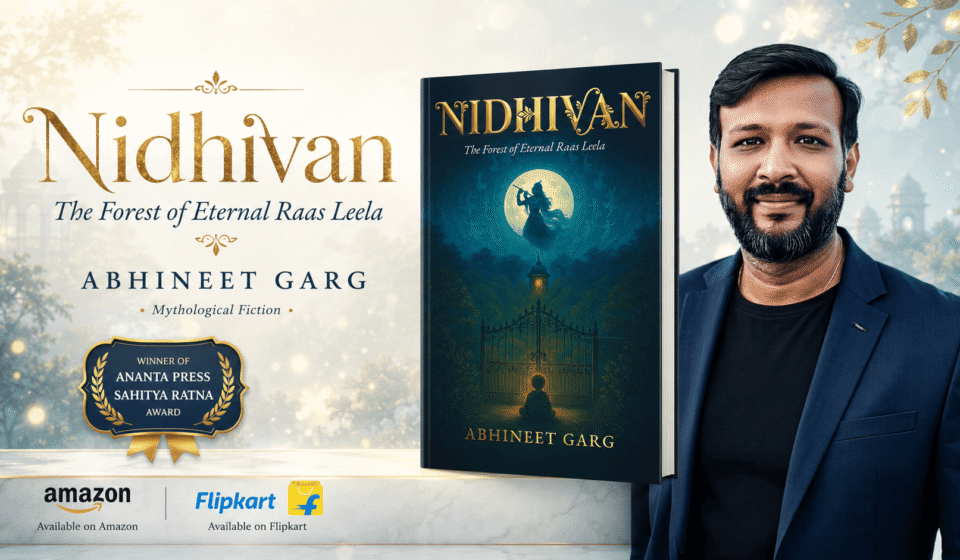

Some novels begin by asking the reader to believe. Nidhivan: The Forest of Eternal Raas Leela begins with a more unsettling invitation: it asks the reader to consider the possibility that belief may exist independently of proof. Abhineet Garg’s mythological fiction thriller is built around one of India’s most evocative sacred spaces, the forbidden grove of Nidhivan in Vrindavan, and it uses that setting not merely as a backdrop but as a living presence. The result is a novel that occupies an unusual and compelling space between spiritual fiction, investigative mystery, psychological suspense, and supernatural awe.
The central attraction of the book is immediately clear. Nidhivan is surrounded by legends that have survived not because they were neatly documented, but because generations of devotees have treated them as living truths. The belief that Radha and Krishna continue to perform the eternal Raas Leela after sunset gives the story an atmosphere that conventional horror fiction cannot manufacture. There is no need for artificial monsters or exaggerated violence. The grove itself, the rituals around Rang Mahal, the seven locks, the untouched offerings, the prohibition against remaining inside after nightfall, and the silences of those who refuse to speak become the instruments of suspense. Garg understands that the most powerful fear often grows not from what is shown, but from what a culture has collectively chosen to protect from ordinary sight.
The novel unfolds through three seekers in three different timelines: Anirudh Narayan in 1985, Radha in 1988, and Meera in 1990. This structure gives the book intellectual range and emotional depth. Each character approaches the same mystery from a different position. Anirudh is a journalist and an NRI, armed with skepticism, professional ambition, and the confidence that every legend can be converted into a story. He represents the modern appetite to investigate, expose, classify, and publish. His journey is therefore more than an encounter with the supernatural. It is a slow dismantling of certainty. As the evidence refuses to fit within his rational categories, his confidence hardens into obsession, and his search for an explanation becomes a confrontation with the limits of his own worldview.
Radha enters the mystery differently. Her connection to Nidhivan is emotional and devotional. She does not approach the forest solely to prove or disprove a claim; she seeks meaning. This distinction gives her narrative a different texture. Through Radha, the novel explores the intimate danger of longing. Devotion can be pure, but the desire to witness the divine can also contain ego. The wish to see what is meant to remain unseen may appear spiritually motivated while still carrying a hidden demand: reveal yourself to me, answer me, prove that my faith is justified. Garg’s portrayal of this tension is one of the novel’s strongest qualities. Nidhivan does not merely frighten those who enter its orbit. It tests the emotional burden they carry into it.
Meera, the historian, becomes the most balanced of the three seekers. She neither dismisses the legends nor accepts them without inquiry. Her discipline allows the book to engage with sacred geography, oral tradition, temple customs, Swami Haridas’s legacy, the Ashta Sakhi tradition, Rang Mahal, Lalita Kund, and the devotional landscape of Vrindavan without reducing these elements to decorative mythology. Through her, the reader encounters history not as a weapon against faith but as a method of approaching it with humility. Meera’s strength lies in recognizing that documentation can take a person close to truth while still failing to contain it. Her journey creates the bridge between the investigative and devotional dimensions of the novel.
The present-day frame adds another layer of resonance. A five-year-old boy receives fragments of Meera’s experience and grows into a forty-year-old narrator who attempts to assemble the incomplete records of all three seekers. This choice turns the book into an intergenerational mystery. The story is not only about what happened inside or around Nidhivan; it is also about how unresolved experiences survive in memory. Documents, testimonies, fears, impressions, and spiritual residues pass from one person to another. Truth becomes something inherited rather than simply discovered. The narrator’s task is therefore emotionally charged. He is not an outsider examining old evidence. He is a child of the mystery, shaped by fragments he was too young to understand.
Garg’s storytelling is particularly effective in its use of atmosphere. The book’s premise lends itself to cinematic imagery: temple corridors dimming at sunset, locks being fastened, offerings arranged for unseen guests, twisted trees leaning toward one another, whispered warnings, devotional music lingering in the distance, and a forest becoming inaccessible not because of a physical wall alone but because of centuries of reverence. The suspense emerges slowly. Instead of rushing toward revelation, the narrative allows dread and wonder to gather. This slow-burn method suits the subject because sacred mystery cannot be treated like a conventional puzzle whose value ends once the solution is announced.
The novel’s greatest thematic achievement is its treatment of faith and proof. It does not argue that reason is useless. Nor does it romanticize blind belief. Rather, it asks whether human knowledge has boundaries and whether a sacred experience can remain true even when it refuses public verification. Anirudh, Radha, and Meera together form a spiritual progression: arrogance, longing, inquiry, humility, and surrender. Their different fates suggest that intention matters. Nidhivan is not presented as a supernatural trap that indiscriminately punishes curiosity. It is portrayed as a place that reflects and intensifies what a seeker brings into it.
This is also what makes the novel unique within mythological fiction. Many books in the genre retell familiar episodes from epics or reimagine gods as characters in large-scale adventures. Nidhivan takes another path. It begins with a living tradition, a real sacred landscape, and a belief that continues to shape contemporary behavior. Myth here is not placed safely in the past. It breathes in ritual, geography, memory, caution, and devotion. By setting the story in the late twentieth century and connecting it to a present-day narrator, Garg shows that mythology is not a closed archive. It remains active in the lives of people who approach it.
The horror element is equally distinctive. The fear does not come from ghosts, blood, or spectacle. It comes from the possibility that the divine is real, present, and beyond human control. That idea is far more disturbing than a conventional haunting because it reverses the usual relationship between observer and mystery. The seekers assume they are studying Nidhivan. Gradually, it appears that Nidhivan may be studying them. Their questions become mirrors. Their methods reveal their weaknesses. Their desire for truth exposes the deeper reasons they cannot leave the mystery alone.
Readers who enjoy spiritual thrillers will find much to admire, but the book also appeals to those interested in psychology, folklore, history, and philosophical fiction. It works as a mystery because the timelines generate questions and connections. It works as a spiritual novel because its deepest concern is transformation rather than explanation. It works as mythological fiction because it treats the legends of Vrindavan with emotional seriousness. Most importantly, it respects the reader enough not to reduce every mystery to a single mechanical answer.
Nidhivan: The Forest of Eternal Raas Leela stands out as a novel of atmosphere, cultural rootedness, and spiritual tension. It asks the reader to enter a place where curiosity has consequences, where devotion can become desire, and where knowledge must eventually confront humility. Its final power lies not in making the unknown less frightening, but in making it worthy of reverence. Abhineet Garg has created a story that does not simply invite readers to solve a mystery. It asks them to examine why they need the mystery to be solved at all.
PURCHASE THE BOOK