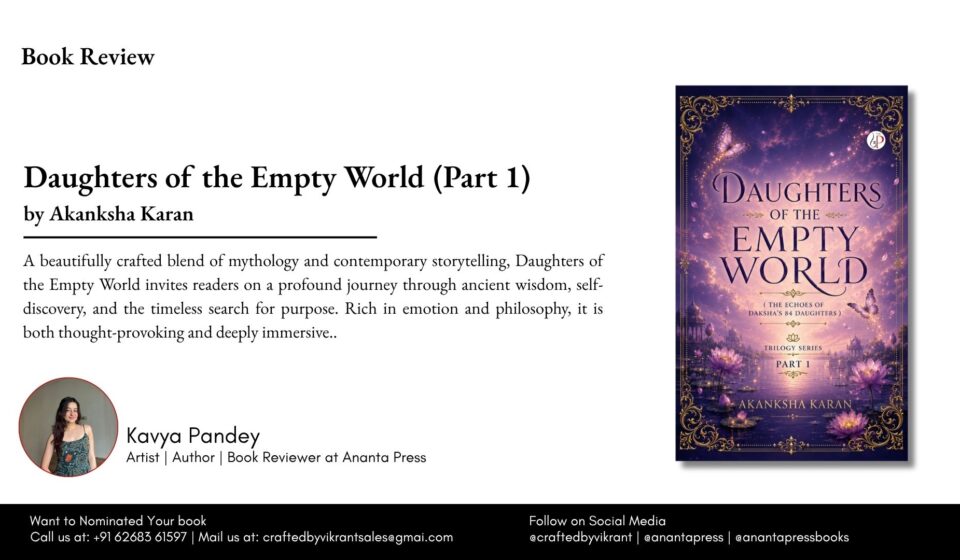

Daughters of the Empty World (Part 1) by Akanksha Karan is an ambitious and deeply imaginative novel that successfully bridges the timeless wisdom of Indian mythology with the emotional complexities of contemporary life. Rather than presenting mythology as a collection of ancient tales, the author reimagines it as a living tradition—one that continues to influence human emotions, relationships, identity, and purpose. The result is a thought-provoking work that is as philosophical as it is emotionally engaging.
From its opening pages, the novel establishes a unique narrative style by weaving together two parallel timelines. One unfolds in the sacred landscape of Satya Yuga, where the origins of creation, Manu, Prasuti, and Daksha are explored with reverence and depth. The other follows Krish, a modern young man whose reluctant journey to Anantam gradually transforms into a journey of self-discovery. These two worlds are not merely placed side by side; they mirror and enrich one another, allowing readers to experience ancient wisdom through a contemporary lens.
One of the book’s greatest strengths lies in its storytelling. Akanksha Karan writes with remarkable patience and elegance, allowing scenes to unfold naturally without rushing the narrative. The descriptive passages are vivid and immersive, painting serene images of rain-soaked landscapes, ancient temples, quiet courtyards, and peaceful learning spaces. Every chapter feels carefully crafted, creating an atmosphere that invites readers to slow down and absorb the beauty of both the physical setting and the philosophical conversations taking place within it.
The characters are another highlight of the novel. Krish begins as a skeptical, modern teenager disconnected from his cultural roots. His gradual transformation never feels forced; instead, it develops organically through meaningful interactions, quiet reflection, and exposure to a different way of life. Keisha, on the other hand, represents discipline, innocence, and hidden aspirations. Her internal conflict between duty and personal dreams makes her one of the most relatable and emotionally compelling characters in the story. Supporting characters such as Pahi, Rishvika, John, Elena, and Kalyani enrich the narrative by bringing diverse perspectives while maintaining the novel’s central focus on growth, learning, and cultural heritage.
The mythology presented throughout the book deserves special appreciation. Instead of overwhelming readers with complex scriptures or historical references, the author introduces philosophical concepts in a structured and accessible manner. Discussions about creation, Brahma, the Manus, cosmic cycles, and Sanatana philosophy are seamlessly integrated into the story, making them engaging even for readers who may be unfamiliar with Hindu mythology. Rather than feeling like lectures, these sections become meaningful conversations that encourage curiosity and reflection.
What makes this novel particularly distinctive is its emotional intelligence. Beneath its mythological framework lies a deeply human story about identity, belonging, family expectations, dreams, friendship, and personal transformation. The conversations between the characters often carry subtle emotional depth, reminding readers that the greatest journeys are often internal rather than external. Themes such as self-discovery, tradition versus modernity, responsibility, and the search for purpose resonate throughout the narrative without becoming overly preachy.
The pacing of the novel is intentionally gentle, allowing readers to immerse themselves fully in the atmosphere of Anantam. While readers seeking fast-paced action may initially find the progression slow, those who appreciate reflective and character-driven storytelling will likely find the experience rewarding. Every chapter contributes to the larger narrative, gradually building anticipation for the unfolding trilogy while carefully laying the philosophical and emotional foundation for future developments.
Akanksha Karan also deserves recognition for presenting Indian philosophy with authenticity and respect. The novel celebrates the richness of Sanatana traditions without becoming dogmatic. Instead, it invites readers to ask questions, reflect upon ancient wisdom, and discover how timeless ideas remain relevant in the modern world. This balanced approach makes the book appealing not only to mythology enthusiasts but also to readers interested in spirituality, philosophy, and literary fiction.
The language throughout the novel is graceful, expressive, and accessible. Descriptions are rich without becoming excessive, and dialogues feel natural and purposeful. The transitions between mythology and contemporary events are handled smoothly, ensuring that the narrative remains coherent despite its dual timelines. The author’s ability to maintain consistency while exploring profound philosophical concepts is particularly impressive.
Perhaps the most remarkable achievement of Daughters of the Empty World (Part 1) is its ability to make readers think beyond the story itself. It encourages reflection on questions of existence, purpose, memory, knowledge, and the invisible threads connecting the past with the present. Rather than providing simple answers, the novel gently invites readers to explore these questions alongside its characters, creating an experience that lingers long after the final chapter.
Overall, Daughters of the Empty World (Part 1) is an exceptional beginning to what promises to be an unforgettable trilogy. It is a beautifully written fusion of mythology, philosophy, culture, and coming-of-age fiction that offers both intellectual depth and emotional warmth. Readers who enjoy thoughtful storytelling, richly developed characters, and narratives that combine ancient wisdom with contemporary relevance will find this book deeply rewarding. It is more than a novel—it is an invitation to rediscover timeless truths through the eyes of a new generation, making it a memorable and meaningful literary journey that deserves a place on every mythology lover’s bookshelf.