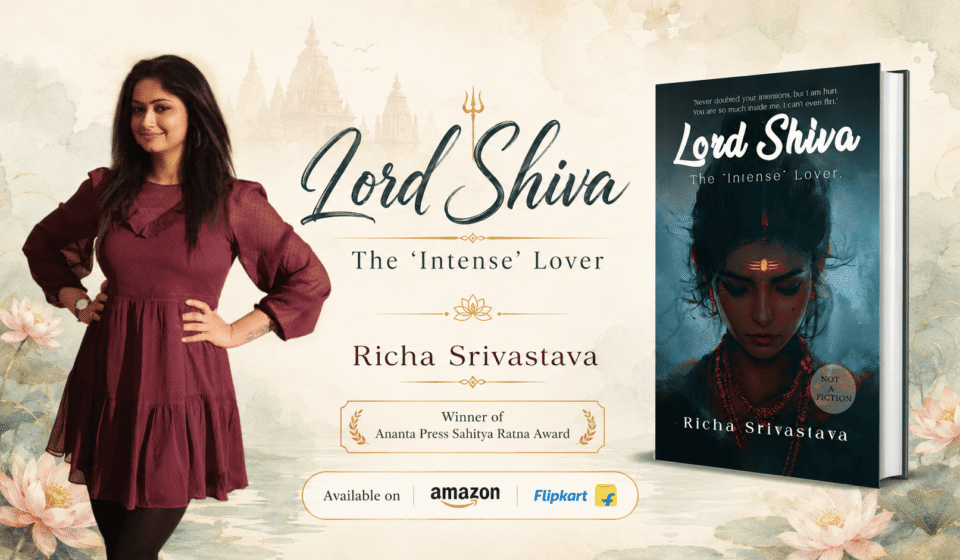

Some books are written to entertain, some to inform, and some to preserve a part of the author’s life that could not remain unspoken. Lord Shiva – The “Intense” Lover by Richa Srivastava belongs firmly to the third category. Presented as an autobiography shaped by supernatural experiences and real incidents, the book invites the reader into a deeply personal space where devotion, emotional pain, faith, uncertainty, and spiritual interpretation meet. It is not positioned as fiction, and that distinction changes the way one approaches it. Instead of asking whether a plot is believable, the reader is encouraged to consider what the experiences meant to the person who lived through them.
The title immediately creates curiosity. Lord Shiva is often associated with stillness, destruction, transformation, detachment, compassion, and immense spiritual power. The phrase “The Intense Lover” gives this familiar divine image a strikingly intimate dimension. It suggests a relationship with the sacred that is not distant, ritualistic, or merely philosophical. Rather, the book appears to explore devotion as an emotionally consuming bond. The intensity implied by the title is central to the book’s appeal. It promises an account of faith not as a quiet background belief but as a living force that influences choices, feelings, fears, and moments of personal awakening.
One of the strongest qualities of the book is the vulnerability of its premise. Writing about one’s own life always requires courage, but writing about supernatural encounters demands an additional kind of bravery. Such experiences are often difficult to explain because they exist at the intersection of memory, intuition, emotion, coincidence, and belief. A writer who shares them risks being misunderstood by readers who do not have the same spiritual framework. Srivastava’s decision to present these experiences as part of her autobiography therefore gives the work a confessional strength. The value of the book lies not only in what happened, but in the author’s willingness to show how those incidents affected her inner world.
The autobiographical form also gives the narrative emotional immediacy. A conventional spiritual guide often speaks in principles, instructions, or interpretations. This book, by contrast, is rooted in lived experience. Readers are not simply told what faith means; they are invited to witness how faith can emerge through personal events. This approach can make spiritual ideas more accessible. Instead of remaining abstract, devotion becomes connected with ordinary life, moments of hurt, unanswered questions, unexpected signs, and the need to find meaning during emotionally intense periods.
Another notable aspect is the book’s blending of the personal and the supernatural. The supernatural is not treated merely as spectacle. In a work of this nature, unusual experiences become meaningful because of the emotional context surrounding them. A sign, dream, intuition, or inexplicable event matters not because it is sensational, but because it arrives at a moment when the author is searching, struggling, or transforming. This gives the narrative a reflective quality. The book asks the reader to look beyond the surface of events and consider how human beings interpret the mysterious when reason alone does not satisfy the heart.
The author’s professional background adds an interesting layer to the work. Richa Srivastava is described as an entrepreneur, counsellor, motivational speaker, writer, and professional with experience in intellectual property and content. She has also received recognition in business, leadership, literature, and motivational speaking. This varied profile creates a productive contrast with the spiritual subject of the book. The author is not introduced only as a mystic or religious commentator. She comes from a world of achievement, enterprise, public communication, and professional discipline. Because of this, her account may appeal to readers who are trying to reconcile ambition and spirituality rather than choosing one over the other.
Her experience as a counsellor and motivational speaker may also influence the emotional language of the book. A person accustomed to listening to others and speaking about resilience often develops a sensitivity to inner conflict. That sensitivity can help an autobiographical narrative move beyond a simple record of events. The deeper question becomes: what did each incident teach the author about herself, her faith, and her relationship with Lord Shiva? When autobiographical writing succeeds, the reader recognizes that the author’s story is specific, but the emotions are universal. Longing, disappointment, hope, fear, surrender, and the desire to feel protected are experiences that many readers understand, regardless of religious background.
The book’s uniqueness lies in its unusual combination of autobiography, spiritual testimony, emotional reflection, and supernatural experience. Many books on Lord Shiva retell mythology, explain symbolism, interpret scriptures, or present philosophical teachings. Lord Shiva – The “Intense” Lover appears to follow a more intimate path. It is not primarily about explaining Shiva to the reader. It is about showing what Shiva means within the author’s own life. This personal orientation separates it from general devotional literature. The divine is approached through relationship rather than through academic analysis.
The phrase “intense lover” can also be understood metaphorically. In spiritual traditions, divine love is often described as demanding because it transforms the devotee. It can remove illusions, challenge attachments, and force a person to confront uncomfortable truths. Shiva, as a symbol of destruction and renewal, is especially suited to this interpretation. To experience Shiva’s love may not mean receiving constant comfort. It may mean being pushed toward growth, truth, and emotional purification. The book’s title therefore carries more complexity than its romantic wording initially suggests.
Readers who enjoy spiritual memoirs may find the book especially engaging because it offers companionship rather than authority. The author is not necessarily standing above the reader as someone who possesses every answer. She is sharing a journey. This creates room for readers to interpret the incidents according to their own beliefs. Some may understand the experiences literally, others symbolically, and still others psychologically. The book’s openness allows these different readings to coexist.
Its reader value is also found in the courage it may offer to people who have had experiences they cannot easily discuss. Many individuals carry private spiritual moments that they hesitate to share for fear of ridicule. An honest autobiographical account can reassure them that the search for meaning is not something to be ashamed of. At the same time, readers should approach the book as one person’s testimony rather than as a universal proof. That respectful distinction makes the reading experience richer and more thoughtful.
Lord Shiva – The “Intense” Lover stands out because it transforms private experience into a public act of faith. It reflects the author’s willingness to place her emotions, questions, and extraordinary incidents before the reader without hiding behind fictional characters. The result is a book that can be appreciated as a spiritual memoir, an emotional confession, and a record of personal transformation. Its greatest strength is sincerity: the sense that the author is sharing something she considers deeply real and deeply important.
For readers interested in Lord Shiva, personal spirituality, supernatural experiences, autobiographical storytelling, and the emotional dimensions of faith, this book offers a distinctive journey. It does not simply describe devotion; it attempts to make the reader feel its intensity. That emotional honesty is what gives the work its identity and makes it memorable.
Amazon Link: https://amzn.in/d/0dpvsP2g