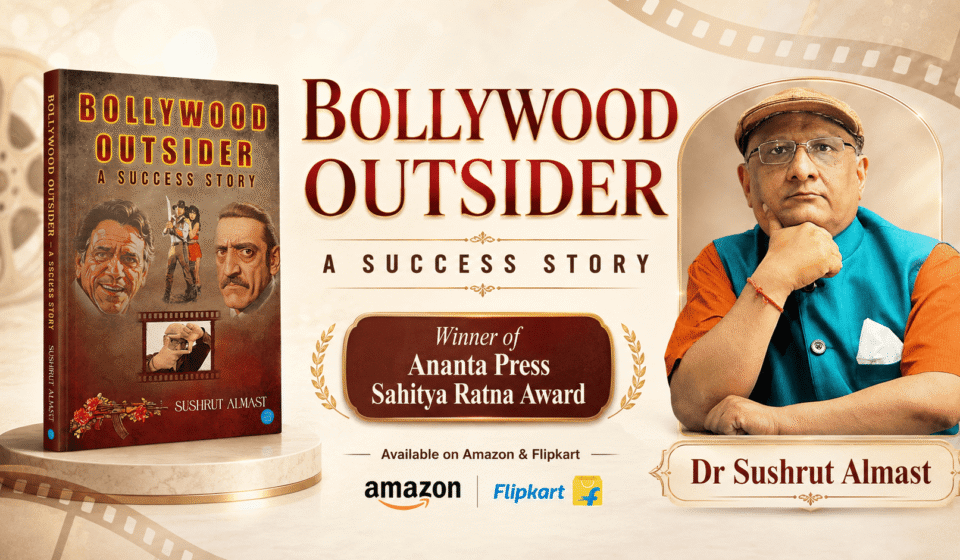

Bollywood Outsider – A Success Story is most compelling when read as a book about permission: who receives it, who waits for it, and who decides to proceed without it. Dr Sushrut Almast enters the world of filmmaking from a profession that appears, at first glance, completely unrelated to cinema. He is a medical doctor trained in radiodiagnosis, not a studio heir, a film-school celebrity, or a member of an established production family. That distance from the conventional routes into Bollywood gives the book its emotional centre. Rather than presenting success as the natural consequence of access, the narrative presents it as the result of persistence under conditions of uncertainty. The reader is invited to observe what happens when an individual with no inherited place in an industry continues to believe that a meaningful project deserves to exist.
The story begins with a film originally titled Vyakul in 1991. It was later rebranded as Nirnayak – The Decider in 1993, yet the new title did not immediately solve the difficulties surrounding its completion and release. The film was shelved and delayed before eventually reaching theatres in 1997–98. That chronology gives the book an unusually honest foundation for a motivational work. The journey is not arranged around instant discovery, overnight recognition, or a single dramatic breakthrough. It stretches across years in which a creative dream could easily have been abandoned. The delay itself becomes part of the subject. Every year between conception and release represents a period in which enthusiasm had to survive without the reassurance of visible success.
This is why the word “outsider” in the title feels meaningful rather than fashionable. In many success narratives, outsider status is mentioned only to make the final achievement appear more impressive. Here, it defines the practical and psychological struggle. The supplied description notes that fewer than five percent of outsiders succeed in the industry. Whether one reads that figure statistically or symbolically, it communicates the scale of discouragement faced by people without networks, familiarity, or institutional protection. Dr Almast’s experience therefore becomes larger than the story of one producer. It reflects the condition of countless writers, actors, technicians, musicians, and independent creators who possess conviction but lack an open door.
The strongest quality of the book is its grounding in a real project. Motivational literature sometimes depends on broad instructions—believe in yourself, remain positive, never surrender—without showing what those phrases demand in practice. Bollywood Outsider – A Success Story has the advantage of a concrete narrative. A film was conceived, renamed, delayed, completed, released, and ultimately discovered by an audience. The reader can trace motivation through decisions rather than slogans. Persistence here means carrying a project across changing circumstances. Confidence means accepting professional risk. Hope means continuing when an unfinished film could become a permanent reminder of failure. These examples give the inspirational message weight because they emerge from lived consequences.
The film at the centre of the book also contributes to its appeal. Nirnayak – The Decider is described as featuring a distinctive “Clash of Titans” between Om Puri and Amrish Puri, two performers remembered for commanding screen presence and exceptional dramatic authority. Their association gives the narrative a strong cinematic anchor. The book is not merely about an anonymous experiment that happened to reach theatres; it concerns a film connected with major acting talent and a production history that later acquired renewed public visibility. The supplied account states that the film became a box-office success and has since attracted more than sixteen million views on YouTube, along with a 7/10 IMDb rating. These later markers give the journey an additional layer: success did not end with the original theatrical run but continued through digital rediscovery.
That afterlife is especially important. A film delayed during the 1990s now reaches audiences through a platform that did not exist when it was made. This shift reminds readers that creative work may travel on a timetable different from the creator’s expectations. An artist can control effort, preparation, and commitment, but rarely controls the moment at which a work finds its largest audience. Nirnayak – The Decider appears to have experienced more than one life: first as Vyakul, then as a redefined production, later as a theatrical release, and finally as an online film watched by millions. The book therefore offers an encouraging idea for anyone whose work has been delayed or overlooked: postponement is not always the same as extinction.
Dr Almast’s multidisciplinary profile strengthens the theme. His background includes medical science, cinema, media arts, finance, Vedic astrology, leadership writing, and involvement in not-for-profit organisations concerned with health and knowledge. Such range could have made the book unfocused, but it instead helps explain the author’s willingness to cross boundaries. A person who has repeatedly entered different fields is well positioned to write about the courage required to become a beginner. His medical education suggests discipline and analytical training, while his work as a producer reflects imagination, negotiation, and risk. These identities do not cancel one another; they demonstrate that professional life can be plural.
Another notable strength is the book’s broad audience. Aspiring filmmakers will naturally be drawn to the production journey, yet the message extends beyond cinema. Entrepreneurs will recognise the experience of sustaining an idea before the market validates it. Authors will understand the vulnerability of presenting work to an indifferent system. Professionals considering a second career will see an example of identity expanding rather than being replaced. Students may discover that a formal degree does not have to define the limits of a lifetime. The story does not suggest that every dream will become commercially successful, but it demonstrates that a dream has no chance of maturing if fear prevents action.
As a self-help and motivational title, the book’s uniqueness lies in its refusal to separate inspiration from industry reality. It acknowledges difficulty, exclusion, delay, and the low probability of outsider success. At the same time, it does not use those realities as an argument for surrender. That balance is valuable. Excessively optimistic books can make readers feel personally defective when success does not arrive quickly. Excessively cynical books can turn realism into paralysis. Bollywood Outsider – A Success Story occupies a more useful middle ground: the path may be unfair and exhausting, but determined action can still create an outcome that once looked improbable.
The book also raises an important question about the meaning of success. Is success the moment a film is released, the moment it earns money, the moment critics acknowledge it, or the moment a later generation discovers it online? Dr Almast’s story suggests that success may be cumulative. It can consist of surviving the years when nothing seems settled, finishing what others assume will remain unfinished, reaching an initial audience, and continuing to reach new viewers decades later. This layered understanding makes the book emotionally durable. Readers are encouraged not to measure their entire journey by one deadline or one gatekeeper’s response.
Ultimately, Bollywood Outsider – A Success Story is an affirmative account of creative independence. Its value comes from the contrast between an unlikely beginning and a hard-earned result. Dr Sushrut Almast does not appear in the story as someone for whom cinema was the obvious next step. He appears as someone who chose to enter a closed and unpredictable world because the project mattered to him. The book honours the years between ambition and achievement—the years usually removed from polished success stories. For readers standing outside their chosen field, that honesty may be more inspiring than glamour. It says that one need not be born inside a system to make a meaningful contribution to it; sometimes the first decisive act is simply to stop waiting for permission.