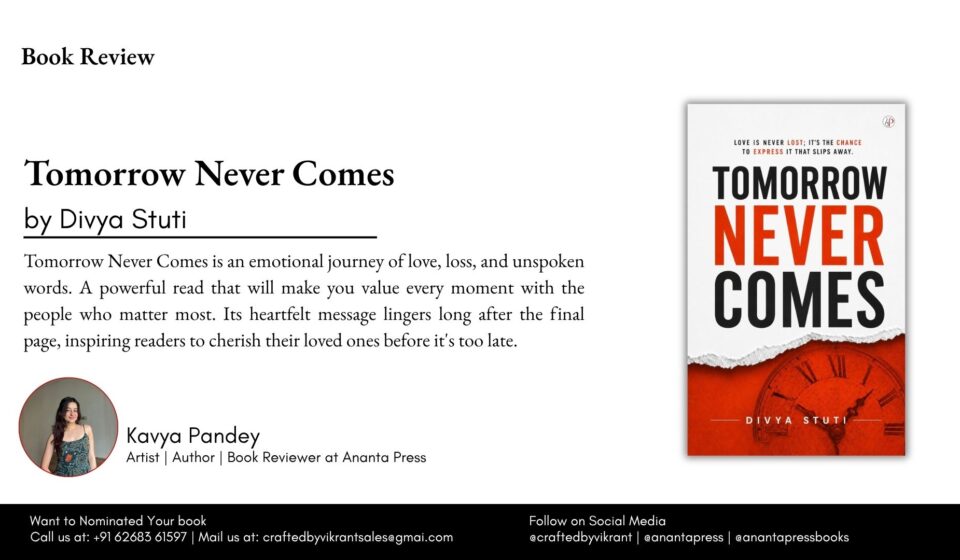

Some books entertain, some educate, and a few quietly change the way we look at our own lives. Tomorrow Never Comes by Divya Stuti belongs to the last category. It is not simply a memoir of grief or a tribute to a beloved mother—it is an honest confession of regret, unconditional love, and the painful realization that the moments we take for granted are often the ones we long to relive.
From the very first pages, the author establishes an emotional connection that feels genuine rather than dramatic. Instead of presenting herself as someone who has all the answers, she opens her heart with remarkable vulnerability. She admits her mistakes, acknowledges her regrets, and allows readers to witness the raw emotions that followed the loss of her mother. This honesty becomes the greatest strength of the book. Readers are not simply observing someone else’s grief; they are invited to reflect on their own relationships, their own unspoken words, and the people they often assume will always be there.
The central message of the book is beautifully simple yet profoundly important: tomorrow is never guaranteed. We often postpone conversations, hugs, apologies, gratitude, and expressions of love because we believe there will always be another opportunity. Divya Stuti reminds us that life rarely follows our expectations. Through deeply personal memories, she illustrates how ordinary days become priceless memories once the people we love are gone.
One of the most touching aspects of the narrative is the portrayal of motherhood. The author’s mother is not presented as an idealized, flawless figure but as a woman whose love was expressed through countless ordinary acts of care. Preparing meals, asking simple questions, worrying about her daughter, sacrificing her own comfort, and quietly carrying the weight of family responsibilities become powerful reminders of how extraordinary everyday love truly is. These moments feel familiar to almost every reader, making the story universally relatable regardless of age or background.
The writing style deserves special appreciation. It is simple, conversational, and emotionally accessible. The author does not rely on complicated language or literary ornamentation to create impact. Instead, she allows sincerity to do the work. Many passages read like private diary entries or heartfelt conversations rather than polished prose, and that authenticity becomes one of the book’s greatest strengths. Every chapter flows naturally, allowing readers to pause, reflect, and often revisit their own memories.
The emotional depth of Tomorrow Never Comes is remarkable because it never feels manipulative. Rather than trying to force tears, the author shares memories exactly as she remembers them—sometimes beautiful, sometimes painful, and often filled with ordinary details that suddenly become heartbreaking in hindsight. The repeated realization that “later” never arrived becomes a haunting reminder throughout the book. Readers cannot help but ask themselves how many conversations they have postponed, how many phone calls they have ignored, or how many expressions of gratitude they have delayed.
Another remarkable element is the author’s willingness to accept responsibility instead of searching for someone to blame. She openly discusses her feelings of guilt, the moments she wishes she could relive, and the conversations she never completed. Whether or not readers agree with every conclusion she reaches, her emotional honesty is impossible to ignore. This openness transforms the book from a personal memoir into a mirror that encourages readers to examine their own lives.
The spiritual undertones add another meaningful dimension to the narrative. References to the Bhagavad Gita offer comfort without becoming preachy or overly philosophical. Rather than providing easy answers about loss, the author acknowledges the tension between spiritual belief and human attachment. She recognizes the eternal nature of the soul while honestly admitting that emotional acceptance is far more difficult than intellectual understanding.
Structurally, the chapters progress naturally from cherished memories to regret, grief, acceptance, and reflection. Each chapter explores a different emotional layer while remaining connected to the central theme of appreciating loved ones before it is too late. The pacing allows readers enough space to absorb the emotional weight without feeling overwhelmed.
Perhaps the greatest achievement of Tomorrow Never Comes is its ability to inspire action. Very few books make readers want to close the final page and immediately call their parents, spend more time with family, or express gratitude to someone they love. This book does exactly that. Instead of merely telling readers to value relationships, it demonstrates the lifelong pain that can arise from assuming there will always be another tomorrow.
Of course, like many deeply personal memoirs, the book occasionally revisits similar emotions multiple times. Some reflections intentionally repeat because grief itself is repetitive. The same memories return again and again, each time carrying a slightly different emotional weight. While some readers may notice this repetition, it ultimately reinforces the authenticity of the author’s experience rather than diminishing it.
The emotional honesty displayed throughout the book is both courageous and compassionate. Divya Stuti does not claim to have healed completely, nor does she present grief as something that simply disappears with time. Instead, she portrays healing as an ongoing journey marked by remembrance, self-forgiveness, and a renewed commitment to expressing love while opportunities still exist.
Readers who have experienced the loss of a parent, family member, or someone deeply loved will likely find the book especially meaningful. At the same time, those fortunate enough to still have their loved ones with them may discover its message even more valuable, as it encourages appreciation before regret replaces opportunity.
By the final chapter, Tomorrow Never Comes leaves readers with far more than sadness. It leaves them with gratitude, awareness, and a renewed understanding of the importance of presence. It reminds us that love should never remain unspoken, kindness should never be postponed, and ordinary moments often become the most extraordinary memories of our lives.
Overall, Tomorrow Never Comes is a deeply moving, sincere, and emotionally powerful memoir that succeeds because of its authenticity. Divya Stuti transforms personal grief into a universal message that resonates across generations and cultures. This is not merely a story about losing a mother—it is a story about learning, often too late, the true value of love, time, family, and human connection.
Rating: ⭐⭐⭐⭐⭐ (5/5)
This is a book that deserves to be read slowly, reflected upon deeply, and shared widely. It is likely to stay in readers’ hearts long after the final page is turned, gently reminding them to express love today rather than waiting for a tomorrow that may never come.