
A psychological reading of obsession, memory, and emotional collapse
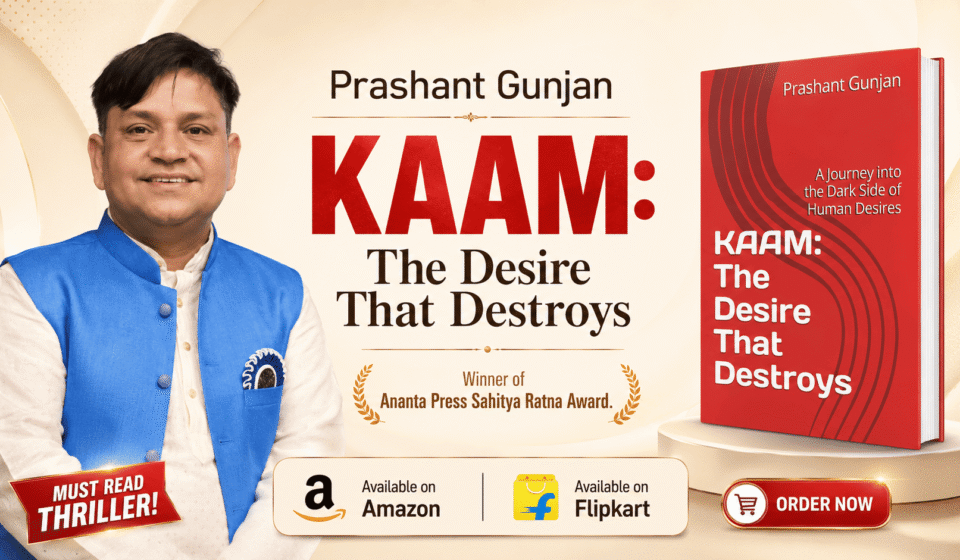
Book: KAAM: The Desire That Destroys | Author: Prashant Gunjan |
Some thrillers depend on an external villain: a calculating criminal, an unknown stalker, or a conspiracy hidden in the shadows. KAAM: The Desire That Destroys takes a more unsettling path. Its central antagonist is not a stranger but an emotion that grows inside ordinary people. Prashant Gunjan builds the novel around desire in its most dangerous form—desire that refuses limits, resents interruption, and gradually converts memory into obsession. The result is a dark psychological premise in which love, lust, humiliation, loneliness, and guilt become inseparable.
At the centre of the story are Suraj and Sonam, two people whose relationship is denied before it can develop freely. Their separation is not presented as a simple romantic misunderstanding. It is enforced by caste, family honour, and rigid social traditions. This foundation matters because it gives their later reunion an emotional history. The attraction between them does not return as something fresh or innocent; it returns carrying years of frustration, resentment, fantasy, and unfinished longing. What might once have been affection has been preserved in a distorted form. The title’s use of “Kaam” therefore feels deliberate. It does not refer only to physical attraction. It points to appetite without discipline—the urge to possess what life, society, or morality has denied.
This psychological transformation gives the book its most distinctive quality. Suraj is not simply a former lover who reappears. He is described as consumed by obsession and loneliness, seeking what was taken from him. Sonam, meanwhile, is trapped in a loveless marriage to Ajay and haunted by memories she attempted to bury. Each character carries a private emptiness. Their secret conversations become dangerous because those conversations offer temporary relief from lives shaped by disappointment. Gunjan’s premise understands how emotional secrecy can create an alternative world: a place where the past appears recoverable and consequences seem distant. Yet that world is unstable. Every hidden exchange strengthens the illusion that desire can correct history.
The novel’s psychological power also comes from its refusal to romanticise the reunion. Many stories about forbidden lovers treat renewed contact as destiny finally defeating society. KAAM turns that expectation inside out. The past does not return to heal the characters; it returns to expose how deeply they have been damaged. The relationship that society once prevented now re-emerges under conditions of marriage, reputation, deception, and emotional desperation. The question is no longer whether Suraj and Sonam deserve love. The question is whether a desire shaped by years of deprivation can remain love at all.
This distinction between love and possession is crucial. Love recognises the other person as an independent human being. Obsession reduces the other person to an answer, a reward, or a cure. Suraj appears to pursue not only Sonam but also the restoration of a stolen past. Sonam appears to seek not only Suraj but an escape from the emotional confinement of her marriage. Their attraction is therefore burdened by expectations no relationship could safely carry. The more they use one another to repair their own unhappiness, the more destructive their bond becomes. This is where the novel moves beyond a conventional affair narrative and enters the territory of psychological tragedy.
Ajay’s presence intensifies the tension. He is described as a man of status and reputation, which makes the discovery of the relationship especially explosive. His rage culminates in murder, and the story crosses decisively from emotional betrayal into crime. Yet the violence does not arrive from nowhere. It is the final eruption of pressures already present: wounded pride, social image, marital failure, suppressed resentment, and the fear of public humiliation. The murder functions as a brutal consequence, but it also reveals how quickly people can treat another life as expendable when ego and desire overwhelm judgement.
One of the strongest ideas in the synopsis is the statement that burying a body does not bury guilt. This sentence captures the novel’s psychological engine after the crime. A physical act may be completed in minutes, but guilt does not obey the same timeline. It repeats, intrudes, and reshapes perception. Once the police begin closing in, the suspense is not only about whether Sonam and Suraj will be caught. It is also about whether they can continue living with what their choices have created. Fear of exposure becomes inseparable from the deeper fear of confronting themselves.
For readers who enjoy thrillers with moral and emotional weight, this is an important strength. KAAM does not appear interested in crime as spectacle alone. The murder is not merely a device to accelerate the plot. It is the point at which private desire becomes irreversible public harm. Before the crime, the characters can still tell themselves stories about love, injustice, and second chances. After it, those narratives collapse. They must face the fact that suffering in the past does not excuse destruction in the present.
Gunjan’s broader author profile helps explain this concern with consequence. His work is described as exploring human emotions, morality, consciousness, ethics, and personal transformation. His professional background in quality engineering also emphasises discipline, accountability, structure, and the results of failure. Those qualities are visible in the conceptual design of KAAM. The story is built like a chain reaction: social prohibition creates separation; separation breeds emotional residue; reunion awakens obsession; secrecy leads to betrayal; betrayal triggers violence; violence produces guilt; guilt invites investigation and collapse. Each stage is connected to the previous one.
The accessible nature of the premise also makes the book suitable for a wide audience. Readers do not need specialised knowledge to understand the emotions at work. Most people recognise regret, loneliness, jealousy, or the temptation to imagine that a different life would have been happier. The novel takes those familiar feelings and pushes them toward an extreme outcome. That movement from the ordinary to the horrifying is a hallmark of effective psychological suspense.
What makes KAAM unique is its insistence that desire can become a character in its own right. It lingers, burns, persuades, and corrupts. It changes how people interpret memory and morality. The characters may believe they are acting freely, but they increasingly behave as servants of an appetite they have failed to examine. In that sense, the book offers more than a cautionary story about an affair. It asks readers to consider how unregulated emotion can become a form of captivity.
KAAM: The Desire That Destroys promises a tense, disturbing journey into the dark side of human longing. Its strength lies in the way it connects social injustice with personal responsibility without treating either as a complete explanation. Suraj and Sonam were wronged by rigid traditions, but their later choices still carry consequences. Ajay may be wounded by betrayal, but rage does not justify murder. Every character stands at the intersection of pain and accountability. That moral complexity gives the thriller depth and makes its warning difficult to dismiss: desire may begin as a private flame, but when it is fed by obsession, secrecy, and wounded pride, it can burn through every life around it.
Purchase on Amazon