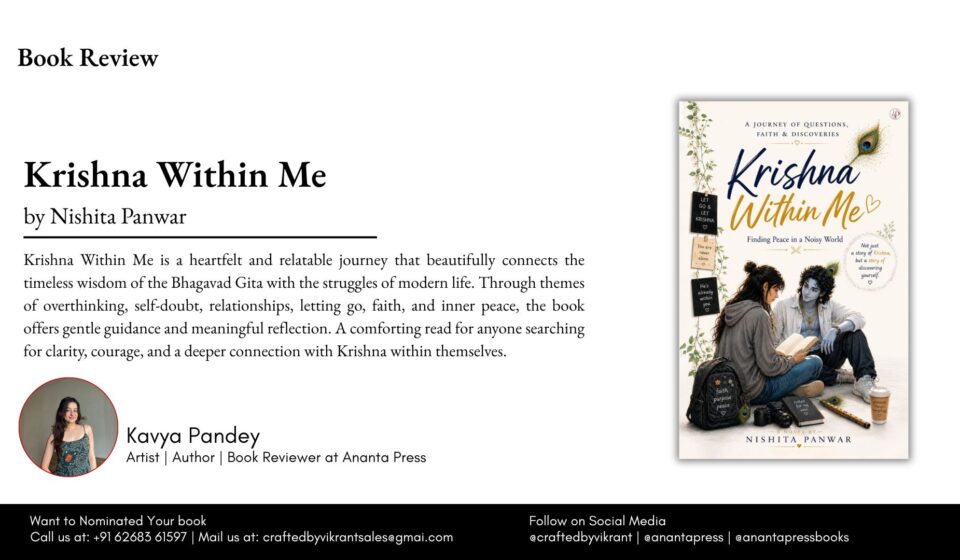
Krishna Within Me – Finding Peace in a Noisy World by Nishita Panwar

Krishna Within Me – Finding Peace in a Noisy World by Nishita Panwar is a deeply personal, reflective, and emotionally engaging exploration of Krishna’s wisdom in the context of modern life. Rather than presenting spirituality as something distant, complicated, or inaccessible, the book brings the teachings associated with Krishna and the Bhagavad Gita closer to the everyday experiences of a young person navigating anxiety, overthinking, comparison, relationships, self-doubt, disappointment, loneliness, and the search for purpose. The book’s central idea is both simple and powerful: perhaps the Krishna we are searching for outside has always been present within our own hearts.
One of the most appealing aspects of this book is its contemporary approach to spirituality. The author does not begin with a traditional, formal explanation of the Bhagavad Gita. Instead, she begins with situations that feel remarkably familiar to today’s generation—late-night overthinking, social-media comparison, career anxiety, heartbreak, uncertainty about the future, and the feeling that everyone else seems to have life figured out. This makes the book immediately relatable. The author recognizes that although technology and lifestyles have changed dramatically, the fundamental struggles of the human mind remain surprisingly similar. Fear, loneliness, self-doubt, attachment, and the desire to be understood are not new problems. The modern battlefield may look different, but the inner Kurukshetra remains.
The book’s treatment of Arjuna is particularly effective. Instead of presenting Arjuna merely as a historical or mythological figure, the author invites readers to see themselves in him. Arjuna becomes an image of the confused individual standing in the middle of life’s own battlefield—uncertain, overwhelmed, emotionally exhausted, and afraid of making the wrong decision. This interpretation gives the Bhagavad Gita a personal dimension. The reader is encouraged to understand that moments of confusion do not necessarily indicate weakness. Even someone who appears strong and capable can experience fear and emotional exhaustion. Krishna’s role then becomes not simply that of a divine figure giving instructions, but of a compassionate guide helping an overwhelmed person find clarity and courage.
A particularly meaningful theme throughout the book is the struggle with overthinking. The author distinguishes between genuine problem-solving and repetitive thinking that simply keeps fear alive. This is an issue that many readers will immediately recognize in themselves. The book connects this modern experience with the wisdom of the Bhagavad Gita, suggesting that peace begins when we stop allowing an uncertain future to dominate the present moment. Instead of attempting to control every possible outcome, the reader is encouraged to focus on the action that can be taken today.
Another strong section deals with personal growth and the pressure to become what the world expects us to be. The book questions the constant comparison that has become so common in contemporary life. Success is often measured through other people’s timelines, achievements, relationships, careers, and lifestyles. Against this mindset, the author presents a more meaningful question: not whether we are ahead or behind others, but whether we are growing. This shift in perspective is one of the book’s most comforting ideas. Growth does not require becoming someone else; it requires becoming more authentically ourselves.
The chapter on letting go is equally relatable. The author recognizes that people are often taught how to love, dream, stay, and fight for what they care about, but rarely taught how to let go. The book presents letting go not as an act of forgetting or emotional indifference, but as a process of remembering oneself again. This is an important distinction. Sometimes peace does not come from changing the past; it comes from accepting that certain endings cannot be rewritten. The discussion is gentle rather than preachy, making it particularly accessible to readers dealing with emotional attachment or difficult transitions.
The book’s discussion of love and attachment is another noteworthy strength. It makes a clear distinction between genuine love and the desire to possess or control another person. Love, as presented through Krishna’s example, gives freedom, while attachment seeks control. This perspective is especially relevant to modern relationships, where expectations, insecurity, fear of abandonment, and emotional dependence can easily become confused with love. The author encourages readers to care deeply without making another person the sole source of their peace. She also emphasizes honesty, respect, forgiveness, growth, and the wisdom of walking away from relationships that repeatedly destroy one’s peace.
The treatment of relationships becomes even more contemporary in the chapter discussing the idea of a “green flag.” Rather than limiting the concept to finding a good partner, the book turns the question inward: Are we ourselves becoming the kind of person we want to have in our lives? Can we listen without judging? Can we respect differences? Can we support another person’s growth? Can our presence bring peace rather than unnecessary stress? This is a refreshing approach because it transforms relationships from a search for the “right person” into an opportunity for personal character development.
Faith is explored with similar honesty. The chapter When God Feels Silent addresses one of the most difficult questions a believer can ask: What happens when we pray sincerely but receive no immediate answer? The book does not pretend that faith eliminates uncertainty or that every prayer receives an instant response. Instead, it explores the possibility that waiting itself can become part of faith. Some prayers may take time, and others may be answered in unexpected ways. This makes the discussion more emotionally believable because it acknowledges doubt and silence rather than ignoring them.
One of the most beautiful ideas emerging from this section is that Krishna does not necessarily remove the battlefield from our lives. Instead, He gives us the courage to stand on that battlefield. The book suggests that perhaps we sometimes pray for the wrong thing—not necessarily for every difficulty to disappear, but for the strength to face difficulty with wisdom and faith. This distinction gives spirituality a practical dimension. Faith does not replace action; rather, it strengthens the ability to act with clarity and courage.
The chapter involving the author’s diary is especially intimate. Here, the reader encounters the hidden side of the narrator—the doubts, jealousy, fear, anger, insecurity, and questions that are often concealed from the outside world. The thought of Krishna reading those private pages becomes a metaphor for the fear of being completely known. Yet the realization that Krishna already knows the authentic self becomes deeply comforting. The book suggests that divine love does not depend upon presenting a perfect version of ourselves. Instead, honesty may be the beginning of genuine spiritual connection.
The discussion of ego is equally insightful. The author points out that ego does not always appear as obvious arrogance. Sometimes it disguises itself as self-respect, confidence, or the desire to protect one’s dignity. It can tell us not to apologize first, not to reach out, or never to admit that we are wrong. Against this voice, Krishna represents humility, understanding, kindness, and the willingness to value relationships more than winning arguments. The book therefore presents the greatest battles not as external conflicts but as internal struggles between pride and humility, fear and wisdom, and self-protection and compassion.
Another recurring theme is patience. The book questions our modern obsession with immediate results. Whether it is academic success, a career, relationships, financial stability, or personal growth, we often want everything to happen immediately. The chapter Why Does Krishna Make Us Wait? connects this impatience with the Bhagavad Gita’s emphasis on action without attachment to the fruits of action. Waiting becomes not merely a frustrating delay but an opportunity to remain present and continue doing what is right.
The later chapters broaden the spiritual message by asking whether Krishna accepts everyone, what an offering truly means, why He asks questions rather than simply giving orders, and whether one can find Krishna beyond formal chanting. These questions make the book more conversational and introspective. Rather than presenting spirituality as a fixed list of rules, the author encourages the reader to think, question, reflect, and discover a personal relationship with Krishna. The structure itself reinforces this approach, as the book repeatedly invites the reader to pause and ask questions about their own life.
The idea of Krishna as a best friend is another important element. The author moves beyond a distant understanding of divinity and imagines Krishna as someone who listens without judgment and remains present through confusion, loneliness, and uncertainty. This makes the spiritual relationship feel emotionally intimate. It is particularly effective for readers who may not connect easily with formal religious language but still long for guidance, reassurance, and a sense of companionship.
The book also explores suffering and karma, eventually arriving at an important perspective: karma should not simply be understood as a source of fear or punishment. Instead, it can be seen as a reminder that our choices matter. Every action, word, promise, act of kindness, and decision contributes to the person we become. The book therefore connects karma with responsibility, awareness, and hope.
The conclusion brings the central message of the book together beautifully. The author realizes that the journey was not simply about understanding Krishna; it was also about understanding herself. Krishna does not ask us to become someone completely different. Instead, His wisdom encourages us to become more truthful, compassionate, courageous, and authentic. The book ultimately suggests that spirituality is not an escape from life. It is a way of learning how to live life with greater awareness, patience, love, and inner strength.
Overall, Krishna Within Me – Finding Peace in a Noisy World is a warm, accessible, and emotionally resonant spiritual book. Its greatest strength lies in its ability to translate timeless ideas into situations that modern readers immediately understand. The language is conversational, the questions are personal, and the reflections encourage readers to pause rather than simply consume information. It does not attempt to overwhelm the reader with complicated philosophical explanations. Instead, it invites a quieter journey inward.
This book will particularly appeal to readers who are experiencing overthinking, uncertainty, relationship struggles, comparison, emotional exhaustion, or a search for deeper meaning. It can also serve as a gentle introduction to Krishna’s wisdom for younger readers who may find traditional discussions of the Bhagavad Gita difficult to approach.
What remains after reading the book is not merely information about Krishna, but a feeling—a reminder that peace may not always be found by changing our circumstances. Sometimes it begins by changing the way we see ourselves, our struggles, our relationships, and our journey.
In the end, Krishna Within Me delivers a simple yet profound message: Krishna may not always remove the battles we face, but His wisdom can help us face them with a steadier heart. The journey is not about escaping the noise of the world; it is about discovering a place of stillness within ourselves. And perhaps that is the most meaningful realization the book leaves with its readers—that the Krishna we have been searching for may have been within us all along.