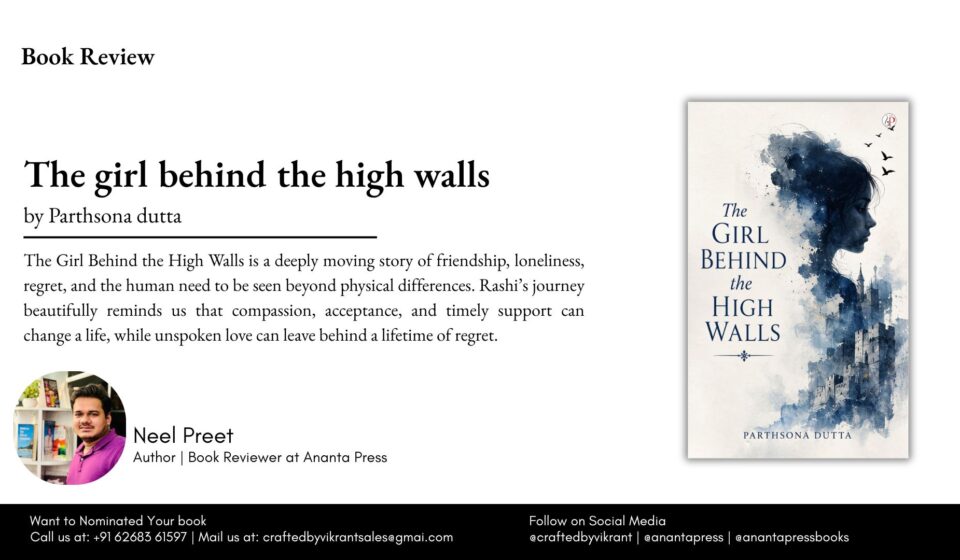

The Girl Behind the High Walls by Parthsona Dutta is a deeply moving and emotionally resonant story about friendship, loneliness, disability, love, regret, and the importance of human dignity. At its heart, the book is not merely the story of a girl named Rashi; it is a reflection on how society often sees a person’s physical limitations before seeing the person within. Through Rashi’s life and the narrator’s memories, the author creates a powerful narrative that quietly asks an important question: What happens when someone we love needs us the most, but we fail to be there?
The story begins with a very different situation—a successful operation that brings hope to a young girl named Saifi. Her family cannot afford the treatment she needs, and the organisation Rashi Aashray helps arrange the necessary support. This opening immediately establishes one of the book’s central concerns: the need for compassion and meaningful support for people living with disabilities. As the story progresses, however, the reader is taken deeper into the narrator’s past and into her relationship with Rashi, the girl whose presence ultimately changes the course of her life.
Rashi is one of the most memorable aspects of the novel. She is physically different, but the author never allows her disability to become the only definition of her character. Instead, Rashi is presented as a sensitive, affectionate, imaginative, and emotionally intelligent person. She loves songs, stories, gardens, birds, and simple moments of companionship. Her world may appear restricted by the walls around her, but her imagination and emotional world are much larger than those walls. This contrast gives the title The Girl Behind the High Walls its deeper meaning.
The friendship between Rashi and the narrator is particularly touching because it is built around ordinary childhood experiences. Their memories of the garden, the guava tree, pigeons, songs, and small conversations create an atmosphere of innocence and warmth. These moments are not dramatic in themselves, but they become emotionally powerful because the reader gradually understands how precious they were to Rashi. She did not demand extraordinary things from her friend. What she wanted was time, attention, and the assurance that she mattered.
This is one of the book’s strongest messages: sometimes people do not need grand gestures; they simply need someone to stay.
As the narrator grows older, life begins to change. Marriage, family responsibilities, and the expectations of adulthood gradually create distance between the two friends. The narrator continues to love Rashi, but love that remains unexpressed or postponed begins to lose its ability to comfort the person who needs it. Rashi understands that her friend is moving into a different life, but her sadness is visible beneath her words. The narrator promises that she will not forget her, yet she does not fully understand how deeply Rashi needs her presence.
The novel handles this emotional distance with considerable sensitivity. There is no simple villain in the relationship between the two friends. Instead, the author shows how neglect can sometimes happen gradually. People become busy. Responsibilities increase. Visits are postponed. Promises are made with good intentions but are not always kept. Each individual decision may seem small, but together they can create a painful distance that becomes difficult to repair.
The chapter titled “The Punishment She Never Deserved” is particularly difficult and powerful. The reader witnesses Rashi being physically abused by her family while being blamed for something she has not deserved. The scene reveals the darker side of social attitudes toward disability and difference. Rashi is not only restricted by her physical condition; she is also trapped within a family environment where her feelings and dignity are not adequately respected.
This part of the story is important because it forces the reader to think beyond the obvious challenges of disability. A physical condition may create difficulties, but society’s response to that condition can sometimes create an even greater burden. When a person is treated as incapable, useless, or dependent, their emotional and psychological suffering can become invisible. The book repeatedly reminds us that people with disabilities do not simply need sympathy. They need respect, opportunity, independence, affection, and the freedom to be heard.
Another strength of the novel is the way it presents Rashi’s emotional world through simple symbols. The garden, the pigeons, the harmonium, the songs, and the high walls all carry deeper meanings. The garden represents childhood, friendship, freedom, and shared memories. The pigeons become a symbol of growing up and leaving. The harmonium represents Rashi’s voice and the part of her personality that she wants others to hear. The walls represent both physical confinement and social isolation.
The image of the pigeon chicks is especially meaningful. Rashi understands that one day her friend will grow up and leave, just as birds eventually leave their nest. Her prediction eventually comes true. The narrator moves into a new life, but Rashi remains behind. The tragedy is not simply that the narrator leaves; it is that she does not fully understand what her departure means to the person she leaves behind.
The book becomes even more powerful after Rashi’s death. The narrator returns to the places and memories connected with her. The harmonium is covered, the garden has changed, and the once-familiar surroundings now feel empty. She remembers the promises she made and the moments she postponed. She had always believed there would be another opportunity to listen to Rashi’s song, to spend time with her, or simply to tell her what she meant. Now there are no more opportunities.
The emotional core of the book lies in this regret. The narrator realises that the greatest pain is not that she stopped loving Rashi—she never did. The pain is that her love remained hidden when Rashi needed to feel it. This is an exceptionally relatable idea. Many readers may recognise the tendency to assume that people know how much we care about them. We often think that our feelings are understood without being expressed. But affection needs presence, words, and action. A person may know that they are loved, but they also need to experience that love.
The narrator’s grief is therefore not only grief over death. It is grief over missed opportunities. She remembers Rashi everywhere—in songs, pigeons, familiar places, and ordinary memories. Her regret follows her because she understands that some things cannot be repaired after it is too late.
Yet the book does not end with regret alone. This is perhaps its most hopeful and meaningful aspect.
Instead of allowing guilt to consume her forever, the narrator eventually decides to transform her pain into responsibility. She realises that she cannot change Rashi’s life or return to the moments she missed, but she can help ensure that another person does not experience the same loneliness. This realisation becomes the foundation for Rashi Aashray.
The idea of Rashi Aashray gives the novel a strong sense of purpose. It is not presented simply as a centre for medical treatment. The narrator wants it to become a place where people with disabilities and their families can receive guidance, dignity, support, and the opportunity to be heard.
The symbolism behind the name is particularly beautiful. “Aashray” means shelter, but the narrator does not want the centre to become another set of walls that hides people from the world. Rashi had already spent her life behind high walls. The new shelter is intended to help people gain confidence and step beyond those walls.
This transformation—from grief to service—is what gives the novel its emotional maturity. The narrator understands that guilt alone cannot honour Rashi’s memory. Action can. Instead of simply mourning what she failed to do, she begins doing something meaningful for others.
The establishment of Rashi Aashray is also realistically portrayed. The narrator does not suddenly become capable of building a large institution. She begins with very little: two small rooms, basic furniture, donated equipment, and the willingness of a few people to help. Even the first practical step—a ramp at the entrance—carries symbolic importance. A centre created for people with disabilities should itself be accessible.
This detail reflects the larger philosophy of the book: inclusion should not remain an abstract idea. It must be visible in everyday decisions.
One of the most valuable qualities of The Girl Behind the High Walls is its ability to make readers reconsider the way they look at disability. The book encourages us to see individuals before conditions, emotions before limitations, and dreams before labels. Rashi’s talents, feelings, humour, imagination, and need for companionship are all reminders that a person’s identity cannot be reduced to their physical circumstances.
The story also carries an important message about family. Families may love their children deeply, yet love alone is not always enough. Understanding, patience, education, and dignity are equally important. The book shows how damaging it can be when protection becomes confinement or when a person’s disability becomes a reason to control their life rather than support their choices.
At the same time, the novel does not portray compassion as something that belongs only to institutions or charitable organisations. It begins with individuals: a friend who listens, a family member who understands, a doctor who helps, a person who provides guidance, or someone who simply chooses not to look away.
Ultimately, The Girl Behind the High Walls is a story about the consequences of silence and the power of presence. It reminds us that the people around us may be carrying pain that we cannot see. Sometimes the most meaningful thing we can give another person is not money, advice, or solutions, but our time and our willingness to listen.
Parthsona Dutta’s story leaves the reader with a lingering emotional question: How many people in our lives are quietly waiting to be heard?
The book is especially meaningful because it does not end by asking the reader only to feel sorry for Rashi. Instead, it asks the reader to learn from her life. Rashi’s story becomes a call for greater awareness, dignity, accessibility, and human connection. Her memory inspires the creation of a place where others can receive the support she herself needed.
In the end, The Girl Behind the High Walls is both heartbreaking and hopeful. It is heartbreaking because some opportunities come only once, and some words remain unspoken forever. But it is hopeful because regret can become responsibility, grief can become purpose, and one person’s story can inspire change for many others.
This is a book that stays with the reader after the final page—not because it offers easy answers, but because it encourages us to look more carefully at the people around us. It reminds us to say what we feel, to keep the promises that matter, to make time for those who need us, and most importantly, to recognise the person behind the walls society often builds around them.
The Girl Behind the High Walls is therefore more than a story of friendship. It is a quiet but powerful reminder that every individual deserves to be seen, heard, respected, and loved—not for what their body can or cannot do, but for who they truly are.