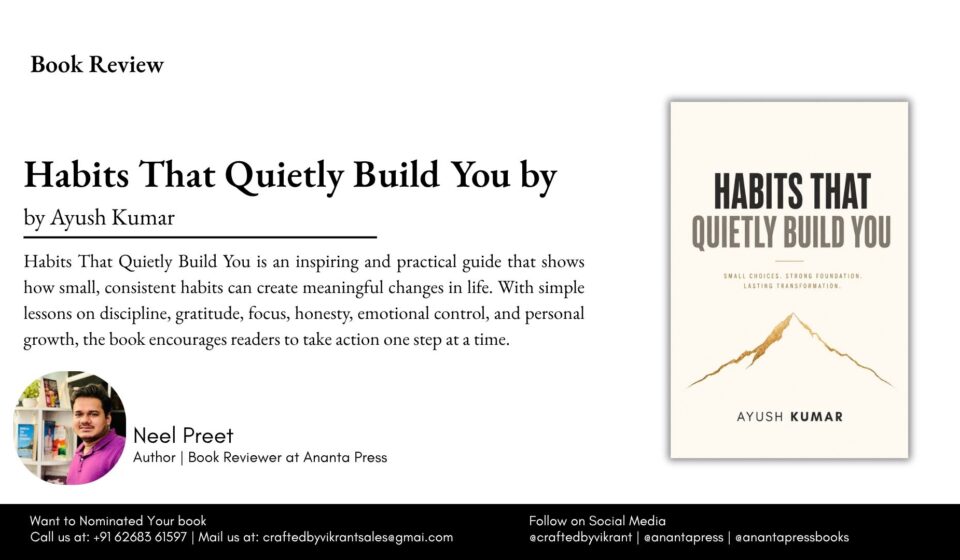

Habits That Quietly Build You by Ayush Kumar is an inspiring and practical book about personal growth, discipline, self-awareness, and the power of small daily actions. Rather than presenting success as something achieved through one extraordinary decision or a sudden transformation, the book focuses on a much simpler and more realistic idea: our everyday habits gradually shape the person we become. The author encourages readers to stop waiting for perfect circumstances and begin making small, meaningful changes with whatever they have and wherever they are.
One of the strongest aspects of this book is its simple and approachable approach to self-improvement. Many books on personal development can sometimes make change seem complicated, requiring strict routines, enormous goals, or dramatic lifestyle transformations. Habits That Quietly Build You takes a different path. It reminds readers that even small actions, when repeated consistently, can eventually produce significant results. The author’s central philosophy is that ordinary actions repeated with consistency can create extraordinary differences over time.
The book begins by addressing a problem that affects many people—procrastination. Waiting for the right time, perfect conditions, or complete motivation can easily become an excuse for doing nothing. The author encourages readers to begin instead of endlessly preparing to begin. This is a valuable message because progress rarely comes from waiting. It comes from taking the first step and continuing to move forward. The emphasis on starting small makes the advice practical and easier to apply in everyday life.
Another important habit discussed in the book is waking up early while also maintaining proper sleep. What makes this section particularly sensible is that the author does not glorify waking up extremely early at the expense of health. Instead, the book explains that an early morning becomes meaningful only when it is supported by adequate rest. A peaceful and well-planned morning can provide time for thinking, reading, exercising, planning, or simply preparing mentally for the day.
The author also makes an important distinction between discipline and unnecessary pressure. Waking up at an extremely early hour is not presented as a competition. The real objective is to wake up refreshed and create a routine that can be maintained for a long period. The book recommends making gradual changes rather than attempting a dramatic overnight transformation. This emphasis on consistency over unrealistic perfection is one of the most practical lessons in the book.
A particularly relevant chapter focuses on replacing excessive scrolling with reading, even if the reader starts with only five pages a day. In an age when social media can consume large amounts of attention, this is a highly relatable message. The author points out that endless scrolling may consume valuable time without necessarily providing lasting value, whereas reading can strengthen concentration, expand knowledge, introduce new perspectives, and encourage deeper thinking.
What makes this advice effective is that the author does not suggest that readers must immediately become voracious readers. Instead, the recommendation is to begin with something manageable—just five pages. This small target removes much of the pressure associated with starting a new habit. Ten or fifteen minutes a day may appear insignificant, but repeated over months and years, those small reading sessions can become a meaningful source of knowledge and personal development.
Another powerful theme running throughout the book is emotional control. Life inevitably brings criticism, disappointment, misunderstanding, frustration, and situations beyond our control. The author reminds readers that although we cannot always control what happens around us, we can make an effort to control how we respond. This is an important distinction because our reactions can often influence the outcome of a difficult situation.
The discussion of emotional control is especially thoughtful because the author does not suggest suppressing emotions. Instead, emotional maturity is presented as the ability to understand feelings without allowing temporary emotions to dictate permanent decisions. Taking a pause before responding, asking ourselves what we are feeling, and considering whether our reaction will improve or worsen a situation are presented as simple ways to develop greater self-awareness.
The book also presents calmness as a form of strength rather than weakness. In moments of anger or frustration, a few seconds of silence can prevent words or actions that may later be regretted. With practice, these small pauses can become natural. This idea is particularly valuable because emotional control is not portrayed as something that develops instantly; it is itself a habit that improves through repeated practice.
Honesty is another important value explored by the author. The book recognizes that being truthful is not always easy, particularly when telling the truth may lead to embarrassment, criticism, or uncomfortable consequences. However, it argues that honesty is not merely about telling the truth to other people—it also involves being honest with ourselves.
This message adds an important moral dimension to the book. Personal development is not presented only in terms of productivity, success, or achievement. It is also connected with character. Habits such as honesty, kindness, discipline, patience, and self-awareness contribute to the kind of person we become. In this way, the book goes beyond the common idea that self-improvement simply means becoming more productive.
One of the most appealing qualities of Habits That Quietly Build You is its emphasis on quiet progress. Not every improvement needs to be visible to other people. Some of the most important changes happen privately—reading instead of scrolling, controlling a reaction instead of responding impulsively, going to sleep on time, being honest when it is difficult, or simply choosing to begin rather than procrastinate. These actions may not immediately attract attention, but they gradually shape character and lifestyle.
The book’s message is therefore especially relevant to readers who feel overwhelmed by the idea of changing their entire lives at once. Instead of demanding perfection, it encourages manageable steps. Instead of promising instant results, it emphasizes consistency. Instead of focusing entirely on external success, it gives importance to internal development.
Another strength of the book is its motivational tone. The author writes directly to readers who want to become better—not necessarily to impress the world, but to improve themselves. The opening message establishes this perspective by describing the reader as someone who believes that small steps can lead to quiet victories. This makes the book feel personal and encouraging rather than overly instructional.
The author also connects personal growth with confidence, purpose, kindness, and success. The goal of developing good habits is not simply to become more efficient. It is to create a life that feels healthier, more balanced, meaningful, and purposeful. This broader understanding of success gives the book an encouraging quality.
The book can be particularly useful for young readers, students, professionals, or anyone who feels that they need to improve their daily routine. Its lessons are straightforward enough to understand and practical enough to apply. Readers do not need to adopt every habit at once. In fact, the philosophy of the book suggests the opposite: choose small changes, practice them consistently, and allow them to become part of everyday life.
Another noteworthy feature is that the book encourages reflection and application rather than passive reading. The author explicitly emphasizes that the book is not merely about reading; its real purpose lies in applying its lessons. Even if one habit from the book helps a reader become a better person, the author considers that meaningful. This is perhaps the most important message of the entire work.
Overall, Habits That Quietly Build You is a thoughtful and motivational guide to personal development. Its greatest strength lies in making self-improvement feel achievable. It does not suggest that readers must transform themselves overnight. Instead, it encourages them to begin with small choices and repeat them until those choices become habits.
The book reminds us that the future is not built only through major achievements. It is also built through the seemingly insignificant decisions we make every day. The choice to read a few pages, sleep on time, wake up with purpose, stop procrastinating, manage emotions, speak honestly, and remain consistent may appear small individually. Yet together, these choices can influence our mindset, character, relationships, and direction in life.
For readers searching for a simple, accessible, and encouraging book on personal growth, Habits That Quietly Build You offers valuable lessons. It is not a book that promises instant transformation; instead, it invites readers to embrace gradual improvement. Its core message is both simple and powerful: small habits, practiced consistently, can quietly build a better version of you.
In the end, this book succeeds because it turns personal development from an overwhelming challenge into a collection of manageable daily choices. Ayush Kumar’s message is clear—growth does not always arrive with a dramatic moment. Sometimes, it happens quietly, one decision, one habit, and one day at a time. And those quiet changes may eventually become the foundation of a life that is healthier, more disciplined, more confident, and more purposeful.