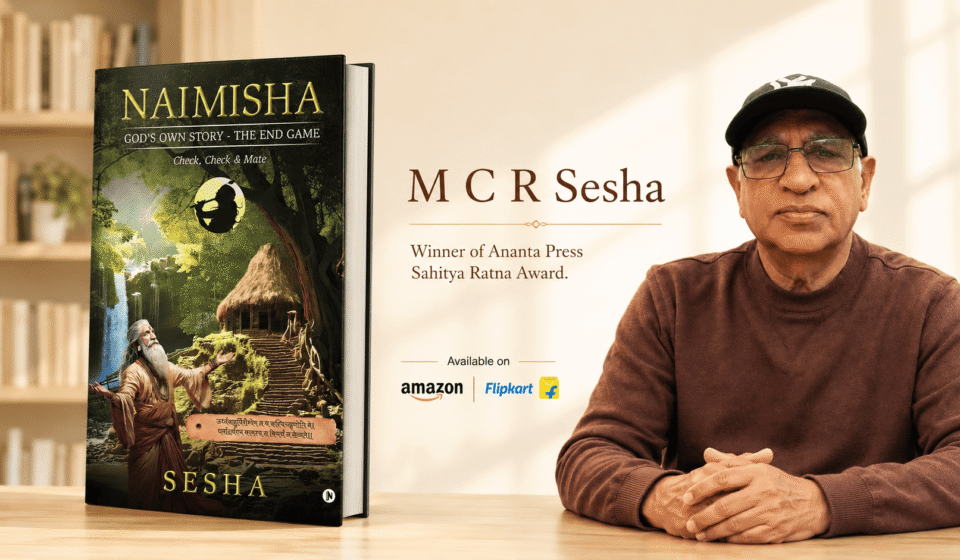

A trilogy earns its true reputation through its ending. The first volume may establish the world and the second may deepen its conflicts, but the final book has the harder task of bringing accumulated questions, relationships, moral tensions, and emotional journeys to a meaningful close. Naimisha – God’s Own Story – The End Game – Check, Check & Mate, the third volume of M C R Sesha’s Naimisha Trilogy, is presented as precisely that kind of concluding work. It returns to the vast imaginative and ethical universe of the Mahabharata, carries the reader through the Kurukshetra War and the later Ashwamedha campaigns, and aims to offer closure not only to familiar epic figures, including Krishna, but also to the trilogy’s important fictional characters, Animish and Asareer. The result, at least in conception and thematic ambition, is not simply another retelling of a celebrated Indian epic. It is an attempt to complete a long conversation about destiny, duty, conflict, mortality, and the different ways in which a life can reach its own end game.
The title is one of the book’s strongest signals. “The End Game” and “Check, Check & Mate” immediately introduce the language of strategy. That metaphor suits the Mahabharata particularly well, because its conflicts are rarely straightforward contests between obvious good and obvious evil. Choices have consequences several moves later. Alliances, vows, loyalties, family ties, personal pride, political necessity, and spiritual responsibility continually intersect. A chessboard therefore becomes a useful way to think about the epic world: every move alters the possibilities available to everyone else, and even a move that appears victorious may contain the seed of loss. By carrying this strategic idea into the title, Sesha frames the final volume as a book concerned not only with who wins a war but also with what victory finally means.
That distinction matters because the Kurukshetra War is more than a spectacular historical-mythic battle. In the cultural memory of the Mahabharata, it is the point at which generations of decisions become irreversible. A novel that chooses to revisit this conflict has to balance action with meaning. The description of this book promises detailed treatment of the war, but the larger attraction lies in the fact that those events are placed inside a concluding narrative with philosophical undertones. Battles may provide movement, yet reflection provides weight. The reader is therefore invited to look beyond armies and weapons toward the moral residue of war: the lives changed by it, the identities transformed by it, the duties fulfilled or violated through it, and the difficult question of whether any side can emerge spiritually untouched from destruction on such a scale.
The inclusion of the Ashwamedha wars broadens that perspective. Many popular retellings concentrate overwhelmingly on Kurukshetra and treat what follows as an epilogue. By extending attention to the period after the central war, Naimisha – The End Game appears interested in consequences as much as climax. This is a valuable narrative choice. Great conflicts do not end when the battlefield falls silent. Political order has to be rebuilt, authority reasserted, grief carried forward, and surviving characters must continue to live with what they have done and what they have lost. The Ashwamedha sequence naturally creates opportunities to examine the afterlife of victory. It asks what happens when the celebrated end of one struggle becomes the beginning of another set of responsibilities.
A further strength of the trilogy’s design is the coexistence of canonical epic characters with fictional figures such as Animish and Asareer. That approach gives an author room to respect the recognisable framework of the Mahabharata while creating additional emotional and interpretive pathways for the reader. Fictional characters can move through spaces that inherited tradition may leave open. They can observe, question, suffer, doubt, or represent perspectives that do not belong entirely to any famous hero or royal house. In a concluding volume, their endings are especially important because they show whether the original narrative thread has truly become integral to the larger epic fabric. The book’s description suggests that Animish and Asareer complete their journeys in different ways, leaving readers with provocative thoughts. That difference is significant. A satisfying conclusion does not require every character to arrive at the same moral destination. In fact, a work with philosophical ambitions is often richer when different lives produce different forms of meaning.
Krishna’s presence also gives the book a natural philosophical centre. Any imaginative engagement with the later phases of the Mahabharata must eventually confront Krishna not merely as a strategist or divine figure, but as a character around whom questions of dharma, action, detachment, compassion, necessity, and cosmic purpose gather. To promise closure for Krishna as part of the trilogy’s ending raises the emotional and intellectual stakes. The conclusion of his arc is not only the end of an individual’s story; within the epic imagination, it is connected to the passing of an age. That gives the final volume a potentially elegiac quality. The “mate” of the title can therefore be read on several levels: the end of military contests, the completion of personal destinies, the closing of a historical-spiritual cycle, and the completion of the novelist’s own long engagement with the story.
What makes the book particularly distinctive is its position between historical fiction, mythic retelling, and philosophical narrative. Readers who approach it only for battlefield drama may find that its deeper interest lies elsewhere. The wars matter because they reveal character. The famous figures matter because their decisions continue to provoke debate centuries after the epic was first told. The fictional figures matter because they create new points of entry into an old story. And the philosophical layer matters because it asks the reader to interpret rather than simply witness. This combination can appeal to those who enjoy epics not as fixed monuments but as living narratives capable of being revisited from new angles.
The author’s own background adds another interesting dimension. M C R Sesha came to sustained reading and writing after a long career in banking, eventually completing the three-volume Naimisha Trilogy after retirement. There is something fitting about a writer beginning a major literary project at a stage of life often associated with reflection. A long professional career, followed by travel, family life, reading, and writing, can produce a perspective less interested in youthful certainty and more alert to consequence, patience, ambiguity, and the long arc of decisions. Those qualities suit the Mahabharata exceptionally well. It is an epic in which almost nothing important can be judged only in the moment.
As the concluding book of a trilogy, Naimisha – God’s Own Story – The End Game – Check, Check & Mate appears designed for readers who want completion rather than mere continuation. Its promise is not simply to add another episode to a familiar legend but to gather the trilogy’s accumulated threads and ask what remains after ambition, war, friendship, duty, and destiny have played themselves out. The strategic title, the attention to Kurukshetra and Ashwamedha, the closure of Krishna and other epic figures, and the separate fates of Animish and Asareer all point toward a finale that values reflection as much as resolution.
For readers interested in Indian historical fiction, Mahabharata-inspired storytelling, philosophical fiction, or long-form trilogies that reinterpret inherited narratives, this final volume has a clear attraction. Its uniqueness lies in treating the epic not as a single famous war but as a continuum of choices and consequences, then placing original characters alongside legendary ones to widen the moral field. A fitting finale should make readers feel that the journey has ended while the questions continue. Naimisha – The End Game is built around exactly that possibility: the story reaches checkmate, but the mind is still invited to make its next move.Amazon Purchase Link: https://amzn.in/d/0giaBcBM