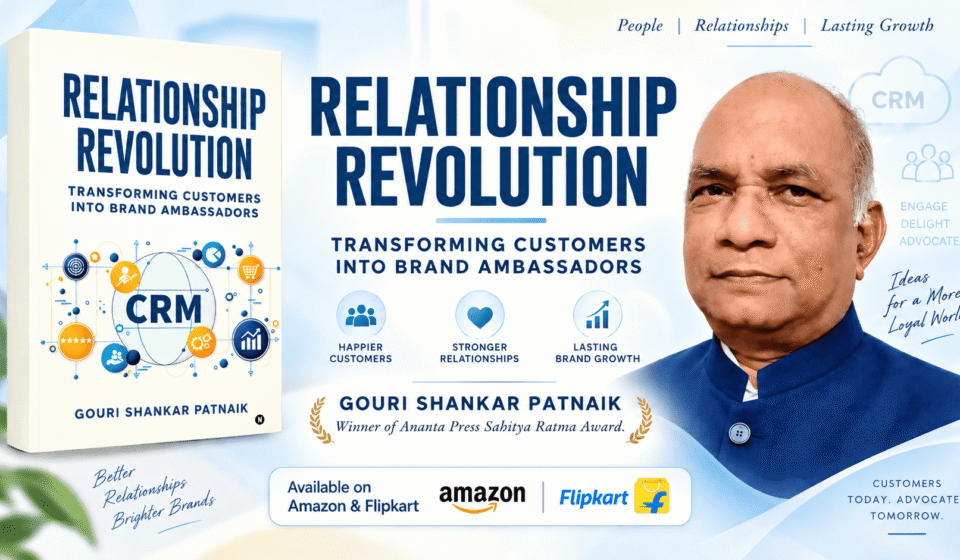

In an age when products can be copied quickly, prices can be matched instantly, and customers can compare alternatives with a few taps, the most durable competitive advantage often lies in the quality of a company’s relationships. Relationship Revolution: Transforming Customers into Brand Ambassadors by Gouri Shankar Patnaik examines this idea through the lens of Customer Relationship Management, or CRM, and presents it not merely as a software category but as a strategic discipline. The book’s central proposition is both timely and important: businesses grow more sustainably when customers are understood, served, retained, and ultimately inspired strongly enough to advocate for the brand themselves.
One of the book’s strongest qualities is the way it broadens the meaning of CRM. In many organizations, CRM is still treated as a database, a sales tracking system, or a piece of technology used mainly by marketing teams. Patnaik shifts the emphasis toward managerial purpose. Technology is discussed, but the larger concern is how information, processes, organizational goals, and customer understanding can work together across the full customer lifecycle. This makes the book especially useful for readers who want to understand why CRM matters before becoming absorbed in the technical details of how a particular platform works.
The concept of transforming customers into brand ambassadors gives the book a clear strategic direction. Customer advocacy does not happen because a company asks for a review or runs a referral campaign; it emerges when repeated interactions create trust, satisfaction, relevance, and a sense of value. By linking CRM to brand building, the book encourages readers to see each touchpoint as part of a wider relationship. Marketing brings customers into the conversation, sales converts interest into commitment, service shapes the post-purchase experience, and ongoing engagement determines whether the relationship deepens or weakens. This integrated view helps readers understand why customer experience cannot be delegated to a single department.
Another strength is the balance between academic usefulness and practical relevance. The book is suitable for students because it offers a structured foundation in CRM concepts, benefits, technologies, and implementation strategies. At the same time, professionals and senior leaders can read it as a managerial reference. The ability to begin with any chapter, rather than being forced through a strictly linear argument, increases its usefulness for readers with different needs. A student may begin with definitions and core principles, a sales professional may focus on relationship development, and a business leader may go directly to implementation, organizational alignment, or strategic outcomes.
Patnaik’s professional background adds weight to this managerial orientation. With more than four decades of experience in the pulp and paper and manufacturing sectors, including senior leadership roles at JK Paper Ltd. and ITC Limited, he brings the perspective of someone accustomed to systems, governance, quality, risk, compliance, and long-term institutional thinking. His work in quality governance, ESG and sustainability oversight, enterprise risk management, regulatory compliance, and quality systems is relevant because successful CRM also depends on disciplined processes, reliable data, accountability, and consistent execution. A customer-centric vision is meaningful only when an organization can translate it into repeatable practices.
This systems mindset is particularly valuable in a field where enthusiasm can easily outrun structure. Many organizations speak about customer centricity, but the actual customer experience may remain fragmented because different departments maintain separate goals, data, and processes. The book’s emphasis on aligning CRM with marketing, sales, and service objectives addresses this challenge. Rather than presenting CRM as an isolated initiative, it is positioned as an enterprise capability. That distinction matters because the customer experiences the organization as one brand, not as a collection of departments.
The book also stands out for emphasizing understanding over automation. Modern CRM tools can collect enormous quantities of data, but data by itself does not create relationships. The managerial challenge is to identify what information is useful, interpret behavior in context, and respond in ways that make the customer’s experience better. Patnaik’s approach reminds readers that technology should support judgment rather than replace it. This is especially relevant at a time when businesses are increasingly investing in automation, analytics, personalization, and AI-assisted customer engagement. The value of these tools depends on whether they help the organization become more attentive, relevant, responsive, and trustworthy.
For students, the book can serve as a bridge between classroom concepts and organizational reality. CRM is often taught through models, definitions, and frameworks, while the lived business problem is more complex: customers move across channels, expectations change rapidly, and different departments may define success differently. By connecting CRM to brand advocacy and business growth, the book gives learners a reason to care about the subject beyond examinations. It encourages them to ask how customer information becomes action, how loyalty is earned, and how a relationship can create value for both customer and company.
For working professionals, the book’s value lies in its ability to create a common language. Sales teams often think in terms of pipelines and conversion, marketers in terms of acquisition and engagement, service teams in terms of resolution and satisfaction, and senior management in terms of growth and profitability. CRM connects these priorities by focusing on the customer journey across time. A book that explains the subject comprehensively can therefore become useful not only for individual learning but also for cross-functional discussion.
The brand ambassador idea is another reason the book feels relevant to contemporary business. Traditional advertising remains important, but customers increasingly influence one another through reviews, recommendations, professional networks, social media, communities, and direct conversations. An enthusiastic customer can become a credible source of trust precisely because that advocacy is rooted in experience. Patnaik’s framing encourages organizations to view advocacy as an outcome of relationship quality rather than as a promotional tactic. That is a more demanding approach, but also a more durable one.
The book’s impartial tone is also a strength. It does not appear to treat CRM as a magic solution or reduce business success to the purchase of technology. Instead, it presents concepts, benefits, technologies, and implementation considerations in a broad framework. This is useful because CRM initiatives can fail when organizations expect software to correct deeper problems in process, culture, data quality, or accountability. A balanced discussion helps readers approach implementation with greater maturity.
There is also a broader leadership lesson running through the subject. Relationship management requires consistency between what a brand promises and what an organization actually delivers. Patnaik’s experience in quality, governance, sustainability, risk, and standards gives the book an underlying respect for disciplined management. Customer advocacy is difficult to sustain if product quality is unreliable, service is inconsistent, complaints are ignored, or internal systems are weak. In this sense, CRM is not a separate layer placed over a business; it is a way of organizing the business around a clearer understanding of stakeholder value.
Relationship Revolution is therefore more than an introduction to CRM. It is a practical argument for moving from transactional thinking toward relationship-based growth. Its strongest contribution is the connection it creates between customer management, organizational alignment, technology, and brand advocacy. Readers who are new to CRM will find a structured foundation, while experienced professionals can use the book to reconsider whether their own systems are truly customer centered or merely customer facing.
Gouri Shankar Patnaik brings to the subject the perspective of a senior business leader, quality professional, governance practitioner, author, and speaker. His recognition as a Most Influential Quality Leader in 2025 and 2026 and as a Topmost Quality Leader by the International Quality Congress 2025 reflects a career concerned with standards, improvement, and organizational effectiveness. Those themes fit naturally with the book’s central message: strong relationships are not created by slogans; they are built through intentional systems, informed decisions, and consistent value delivery.
For students of management, marketing, sales, service, and business strategy, the book offers an accessible route into a subject that has become essential to modern organizations. For professionals, it offers a reminder that every CRM initiative should ultimately answer a human question: does this help us understand and serve customers better? And for leaders, it makes a compelling case that the highest form of customer relationship is not merely retention, but advocacy. When customers willingly speak for a brand, the relationship has moved beyond transaction into trust. That is the revolution the book invites its readers to understand.
Amazon Purchase Link: https://amzn.in/d/04pCNjFr