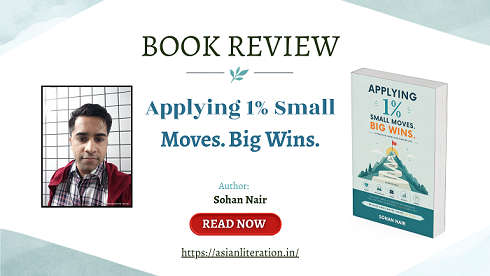

Book: Applying 1%: Small Moves. Big Wins.
Author: Sohan Nair
Applying 1%: Small Moves. Big Wins. by Sohan Nair is a practical book about personal growth and positive change. The main idea of the book is simple: we do not always need to make huge changes in our lives to become better. Instead, small improvements made regularly can create big results over time.
Many people make New Year resolutions or decide to completely change their lives. They may promise to exercise every day, eat healthy food, save a lot of money, read many books, or become more productive. However, these big promises are often difficult to maintain. After a few days or weeks, people may lose motivation and return to their old habits.
This book presents a different approach. It encourages readers to focus on becoming just 1% better each day. A small step may look unimportant today, but when repeated consistently, it can make a meaningful difference in the future.
The central message of Applying 1% is that small actions can lead to big changes. Instead of trying to transform everything at once, we can improve one small thing at a time.
For example, someone who wants to become healthier does not necessarily need to start with a difficult workout for two hours every day. They can begin with a ten-minute walk. Once that becomes a habit, they can slowly increase their activity.
Similarly, a person who wants to save money does not have to suddenly save a huge amount. They can start by saving a small amount every day or every week. Over time, this habit can become stronger.
The book teaches that consistency is often more important than making a big effort for a short period. Small actions become habits, and habits can influence the direction of our lives.
One important area discussed in the book is health. Our health is affected by the small decisions we make every day.
The book’s 1% approach can be applied to simple things such as drinking more water, walking a little more, sleeping on time, reducing unhealthy food, or spending a few minutes exercising.
These actions may seem very small. However, when we repeat them regularly, they can become part of our lifestyle.
I like this approach because it does not make improvement feel impossible. Sometimes people avoid healthy habits because they think they need to do everything perfectly. The idea of making small improvements removes some of this pressure.
The book also connects small improvements with relationships. Good relationships are usually not created by one big action. They grow through small acts of care and respect.
For example, calling a family member, listening carefully to a friend, saying thank you, helping someone, or spending a few minutes talking without using a phone can strengthen relationships.
These actions require very little time, but they can have emotional value. The book reminds us that relationships need regular attention.
This is an important lesson because people sometimes take their close relationships for granted. We may think that our family and friends already know that we care about them. But small actions can show that care in a clear way.
Another useful area is career growth. Many people want immediate success in their professional lives. However, professional development usually takes time.
The 1% method encourages us to learn something new, improve a skill, become more organized, communicate better, or complete our work with a little more care.
For example, reading a few pages of a useful book every day may slowly increase our knowledge. Spending fifteen minutes learning a new skill can also become valuable after several months.
The important point is that progress does not have to be dramatic. Regular learning and improvement can slowly build confidence and ability.
The same principle can be used for personal finances. Financial improvement often begins with small habits.
A person can start by tracking expenses, avoiding unnecessary purchases, saving a small amount, or learning more about money management.
The book’s message is useful here because financial discipline is not always about making more money. It is also about developing better habits with the money we already have.
Small financial decisions made regularly can influence our future. The book encourages readers to think about their daily choices instead of only thinking about large financial goals
Perhaps the most important part of the book is its focus on mindset. Change begins with the way we think about ourselves and our actions.
People often become discouraged when they do not see quick results. The 1% approach teaches patience. We may not notice a big difference after one day, but progress can become visible after weeks, months, or years.
The book also encourages readers not to wait for the perfect time to begin. We can start with whatever small action is possible today.
This is a practical message because many people spend too much time planning and waiting. Taking one small step can be more useful than simply thinking about change.
What I Liked About the Book
The biggest strength of Applying 1% is its simple and practical message. The idea is easy to understand and can be used in many areas of life.
I also liked that the approach does not demand perfection. Life can be busy, and people sometimes fail to follow their plans. A small-step approach can make it easier to start again instead of giving up completely.
Another positive point is that the book can be useful for different kinds of readers. A student can use the idea for studies. A working person can use it for career development. Someone interested in fitness can apply it to health. A person trying to improve relationships or finances can also use the same principle.
The concept is flexible and can be adjusted according to a person’s situation. One possible limitation is that the idea of small improvement is not completely new. Similar ideas about habits, consistency, and gradual improvement have been discussed in many personal-development books.
However, the value of this book is in bringing the idea together in a practical way and applying it to different parts of life.
Also, readers should understand that not every problem can be solved by making a 1% improvement. Some situations require major decisions or immediate action. The small-step method is best understood as a useful approach for everyday personal development, rather than a solution to every problem. Overall, Applying 1%: Small Moves. Big Wins. by Sohan Nair is an easy-to-read and practical book about improving life through small, consistent actions.
Its main lesson is simple: we do not have to change our entire life in one day. We can start with one small action and continue improving step by step.
The book covers important areas such as health, relationships, career, finances, and mindset. This makes its message relevant to everyday life.
What makes the 1% idea powerful is its simplicity. A small action may not seem important at first, but repeated actions can become habits, and habits can shape our future.
For readers who feel overwhelmed by big goals or find it difficult to maintain major changes, this book offers a practical way to begin. It encourages patience, consistency, and realistic progress.
The most important lesson I take from the book is that progress does not need to be perfect or dramatic. Even a small positive step is still progress. If we continue taking those small steps, they can eventually lead to meaningful changes in our lives.
Applying 1%: Small Moves. Big Wins. is therefore a useful reminder that a better life can begin with something very small—sometimes just one better choice today.
Amamzon link – https://www.amazon.in/Applying-1-Moves-Practical-Better/dp/937900057X/