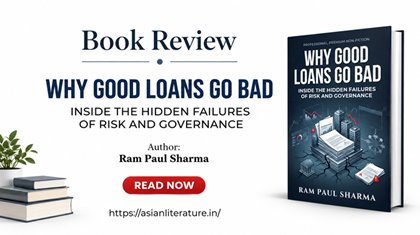
Book Review: Why Good Loans Go Bad – Inside the Hidden Failures of Risk and Governance by Ram Paul Sharma

Why Good Loans Go Bad – Inside the Hidden Failures of Risk and Governance by Ram Paul Sharma is a thoughtful and relevant book that looks at one of the most important questions in the financial world: why do loans that appear safe and properly assessed sometimes turn into serious problems?
At first glance, a bad loan may seem like the result of a borrower failing to repay. However, this book encourages readers to look deeper. Its central idea is simple but powerful—financial failures usually do not happen overnight. They develop slowly and silently. Long before a loan becomes a visible problem, there are often warning signs. The real issue is whether these warning signs are noticed, understood, and acted upon at the right time.
This is what makes the book interesting. Instead of treating bad loans only as financial numbers, Ram Paul Sharma focuses on the human and institutional side of lending. He draws attention to the role of risk management, governance, organizational culture, internal decision-making, and accountability.
The book’s main message is clear: a loan may look good on paper, but that does not always mean it will remain good in reality.
One of the strongest ideas presented in Why Good Loans Go Bad is that problems often begin much earlier than people realize.
When a loan finally becomes difficult to recover, the visible failure may appear sudden. But behind that moment, there may have been several smaller signals. Changes in financial performance, unusual behavior, delayed responses, weak monitoring, internal concerns, or other warning signs may already have been present.
The challenge is that institutions do not always respond to these signals properly.
Sometimes the warning signs may be ignored because the loan has performed well in the past. At other times, people may hesitate to raise concerns because of organizational pressure or because they do not want to question earlier decisions. In some situations, everyone may assume that someone else is responsible for taking action.
This is where the book goes beyond ordinary discussions about lending. It asks readers to think not only about what went wrong, but also about why people failed to react before the situation became serious. An important theme in the book is the “illusion of safety.”
When everything appears normal, it is easy to believe that the risk is under control. Payments may still be arriving, reports may look acceptable, and internal systems may not yet show a serious problem.
But risk can continue developing beneath the surface.
This idea is especially important because many financial failures become obvious only after the damage has already grown. By that point, corrective action becomes much more difficult.
The book reminds readers that good risk management is not simply about reacting after a problem appears. It is also about identifying changes early, asking difficult questions, and understanding whether the information being presented truly reflects reality.
That makes the book useful not only for banking professionals but also for anyone involved in financial decision-making. Another valuable aspect of the book is its broader understanding of risk. In financial institutions, risk is often measured through numbers, reports, ratings, ratios, and models. These tools are necessary, but they cannot tell the whole story. People make the decisions. A risk model may identify a concern, but someone must decide whether that concern deserves attention. A report may contain a warning, but someone must be willing to question it. A monitoring system may show unusual activity, but an institution still needs the right culture to respond. The book therefore brings together technical risk management and human behavior. This makes the subject more relatable. Readers begin to see that many financial problems are not caused by one major mistake. Instead, they may be the result of several small decisions, ignored warnings, weak communication, or delayed action.
Governance is another major area explored through the book’s central theme.
Strong governance means having clear responsibilities, proper oversight, accountability, independent thinking, and a willingness to challenge decisions when necessary.
When governance becomes weak, problems can remain hidden for longer.
A lending decision may pass through several departments and levels of approval. But simply having multiple layers does not automatically make the system safe. If everyone depends on the same assumptions, avoids questioning senior decisions, or believes that somebody else has already checked the risk, then the process may create confidence without actually reducing danger.
This is one of the most meaningful lessons of the book.
Processes and policies are important, but they are only effective when people use them seriously.
The book also encourages readers to think about workplace culture.
An institution may have excellent rules on paper, but what happens when an employee raises a concern? Is that concern welcomed and investigated? Or is the employee encouraged to remain silent?
These questions are important because a healthy risk culture depends on communication.
Employees at different levels may notice different signs. Someone working closely with a borrower may see changes before senior management does. A risk professional may identify weaknesses that are not obvious from headline numbers. An internal reviewer may question assumptions that others have accepted.
If these voices are ignored, an institution can lose valuable opportunities to prevent a larger problem.
In this way, the book reminds us that risk management is not the responsibility of only one department. It is part of the entire organization’s behavior.
Why Good Loans Go Bad can be especially useful for bankers, lenders, credit professionals, risk managers, auditors, finance students, business leaders, and people interested in corporate governance.
The subject may sound highly technical, but the core idea is easy to understand. That is one of the book’s strengths.
Readers do not need to look at financial failure only through complicated formulas. The book invites them to think about something much more basic: what information was available, who saw it, how it was interpreted, and why action was or was not taken.
The financial world is becoming more complex. Lending decisions involve large amounts of data, automated systems, financial models, internal controls, and multiple levels of approval.
Yet even with better technology, human judgment remains important.
A system can generate an alert, but it cannot guarantee that the organization will respond correctly. A report can show a concern, but it cannot force people to ask the right questions.
That is why the subject of this book feels relevant.
It reminds readers that financial safety cannot depend only on policies, systems, or historical performance. Institutions also need awareness, accountability, transparency, and the courage to respond when something does not look right.
Why Good Loans Go Bad – Inside the Hidden Failures of Risk and Governance by Ram Paul Sharma offers readers a thoughtful way to understand financial failure.
Its central lesson is valuable: major losses often begin as small signals.
The real challenge is recognizing those signals before they become serious problems.
By focusing on risk, governance, organizational behavior, and institutional decision-making, the book moves beyond the simple question of whether a borrower repaid a loan. Instead, it asks readers to examine the complete environment in which lending decisions are made.
The book ultimately leaves readers with an important thought—good lending is not only about making the right decision at the beginning. It is also about remaining alert throughout the life of the loan.
For professionals working in banking, credit, risk management, auditing, governance, or finance, this book can offer useful points for reflection. For general readers, it provides an accessible look at why financial problems are often far more complex than they first appear. Why Good Loans Go Bad is ultimately a book about seeing problems before they become crises, questioning the appearance of safety, and understanding that responsible financial decision-making requires both strong systems and people who are willing to act on what those systems reveal.
Amazon link – https://www.amazon.in/Why-Good-Loans-Bad-Governance/dp/9379000154/