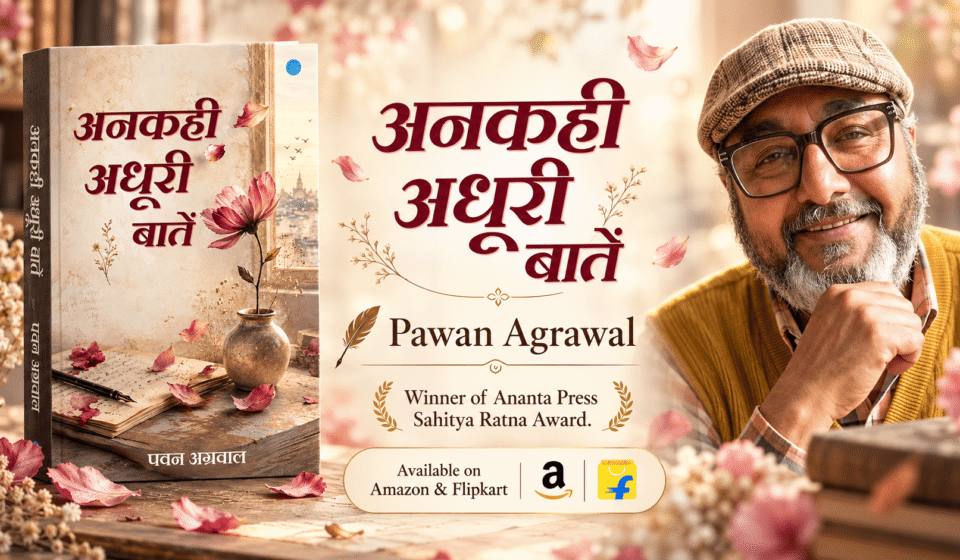

There is a particular kind of poetry that does not arrive with the ambition to sound monumental. It does not try to explain the universe, pronounce a philosophy, or decorate ordinary experience until it becomes unrecognisable. Instead, it takes the familiar material of life—relationships, disappointments, affection, disagreement, longing, frustration, memory, and moral unease—and gives it a language. Pawan Agrawal’s Hindi poetry collection “अनकही अधूरी बातें” belongs to this intimate tradition. As the title itself suggests, the book is concerned with things left unsaid, feelings that remain unfinished, and thoughts that often stay inside because speaking them aloud is difficult. Its appeal lies precisely in this closeness to lived experience.
The collection has been shaped over years rather than around a single moment or subject. That gives it the character of an emotional archive. The poems arise from personal experience and from the kinds of situations most readers recognise: tensions within marriage, the complicated tenderness of sibling relationships, the pressures created by money-centred thinking, and the many adverse circumstances that are woven into ordinary life. This thematic variety is important because it prevents the book from becoming a one-note expression of sadness or nostalgia. Instead, it presents emotion as life actually presents it—mixed, contradictory, sometimes tender, sometimes critical, sometimes wounded, and sometimes quietly observant.
One of the strongest qualities of “अनकही अधूरी बातें” is its honesty. Agrawal does not present himself as a sage delivering profound wisdom from a distance. His stated intention is much simpler and, in many ways, more engaging: to give shape to what he felt. That distinction matters. Readers often approach poetry expecting grand metaphors or difficult ideas, but personal poetry can be most effective when it remains faithful to the scale of real feeling. A misunderstanding between people, a family bond under strain, a sense of discomfort with excessive materialism, or an emotion that cannot be expressed directly may appear small compared with epic subjects, yet these are the experiences that occupy much of human life. The book understands that everyday emotions deserve artistic attention.
The idea of poetry as a form of “venting out” is also central to the collection’s identity. There are things people think but do not say, either because the moment is wrong, the relationship is delicate, or the words would be too difficult to deliver directly. Poetry creates another space. It allows an individual to transform an unspoken response into rhythm, image, tone, and reflection. In this sense, the book’s title is not merely attractive; it is conceptually accurate. These are “unspoken, incomplete things” that find a second life on the page. The unfinished nature of feeling becomes the very reason for writing.
The focus on marital issues is especially relevant because poetry about domestic life is often either romanticised or reduced to conflict. A personal collection can make room for a more complicated emotional reality. Marriage includes companionship, expectation, hurt, adjustment, silence, memory, and the friction between individual needs and shared life. By placing such experiences within poetry, Agrawal invites readers to see domestic tensions not simply as private disputes but as emotionally meaningful events. The poetic form slows down what might otherwise be dismissed as an argument or passing irritation. It asks: what did this moment feel like, what remained unsaid, and what does it reveal about the people involved?
Sibling relationships offer another rich emotional field. Few relationships carry such an unusual mix of familiarity, history, affection, rivalry, obligation, and shared memory. Writing about them can immediately connect with readers because sibling bonds are rarely simple. The emotional truth of such relationships often lies not in dramatic declarations but in small recollections, old grievances, gestures of care, comparisons, separations, and the knowledge of having grown from a common past. A poetry collection rooted in personal observation is well suited to capture these nuances because poetry can hold affection and irritation in the same space without forcing a neat conclusion.
The collection’s resistance to a money-driven mindset adds a social and ethical dimension to the personal material. This does not make the book a manifesto. Rather, it suggests that the author is attentive to the way financial priorities influence relationships, self-worth, decisions, and social behaviour. In contemporary life, money is necessary, but the conversion of every value into a financial value can produce emotional emptiness. A poetic critique of this tendency can be powerful precisely because it approaches the issue through feeling rather than statistics or argument. It can show what excessive materialism does to a person’s interior life and to the quality of human connection.
Agrawal’s professional identity as an advocate makes this literary project particularly interesting. The worlds of law and poetry may appear very different: one is associated with evidence, argument, procedure, and precision; the other with emotion, ambiguity, imagination, and suggestion. Yet both depend deeply on language. An advocate must notice details, understand competing perspectives, choose words carefully, and recognise how phrasing can alter meaning. A poet does many of the same things, though toward a different end. In “अनकही अधूरी बातें,” this dual identity gives the collection an appealing background. It is the work of someone whose professional life is built around spoken and written argument, yet who turns to poetry for the feelings that cannot be resolved through argument alone.
Another notable quality of the collection is its accessibility. The author does not claim to be offering abstract or philosophical revelations. This self-awareness can make the poetry more approachable for readers who sometimes feel excluded by highly symbolic or overly academic verse. Poetry need not be obscure to be meaningful. A simple observation, if expressed sincerely and memorably, can remain with a reader because it mirrors an experience they have had but never articulated. The book’s strength therefore lies not in presenting itself as difficult literature but in opening a conversation with the reader’s own emotional memory.
The Hindi language is particularly effective for this kind of intimate poetry. Hindi carries a wide emotional register, from direct conversational expression to lyrical tenderness and cultural resonance. In a collection based on personal life, the use of Hindi can preserve the natural rhythm of how emotions are actually thought and remembered. Feelings connected to family, marriage, social expectations, or moral values often have a different texture when expressed in the language closest to the author’s lived environment. This gives the work a sense of cultural and emotional immediacy.
What ultimately makes “अनकही अधूरी बातें” distinctive is not that it promises an extraordinary life, but that it finds poetry within an ordinary one. The collection treats personal experiences as worthy of reflection without exaggerating them. It acknowledges that much of life remains incomplete: conversations end before everything is said, relationships carry unresolved memories, and people often understand their own feelings only after time has passed. By turning those fragments into poems, Pawan Agrawal creates a space where readers may recognise fragments of themselves.
For readers who enjoy Hindi poetry grounded in everyday life, relationships, personal reflection, and emotional candour, this collection offers an inviting experience. It can be read slowly, with attention to the feelings behind the words, rather than as a book that demands a single interpretation. Its value lies in recognition—the moment when a reader encounters a thought and feels, “I have felt something like this too.” In that quiet recognition, private experience becomes shared literature. “अनकही अधूरी बातें” is therefore less a declaration than a conversation: intimate, unfinished, humane, and open enough for readers to bring their own memories into it.
Amazon Purchase Link: https://www.amazon.in/dp/8169956668