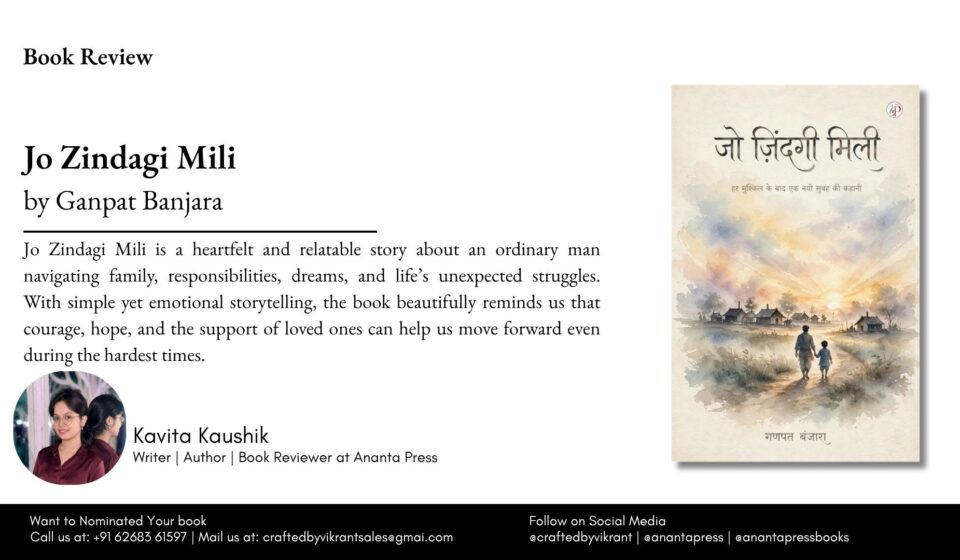

Some books impress readers with extraordinary characters, dramatic events, or larger-than-life achievements. Jo Zindagi Mili by Ganpat Banjara chooses a completely different path. It finds meaning in an ordinary life. It tells the story of a man who is neither born into privilege nor destined for instant greatness. Instead, he grows up in a modest household, learns the meaning of responsibility gradually, faces financial limitations, builds relationships, experiences setbacks, and keeps moving forward.
That simplicity becomes one of the strongest qualities of the book.
At the heart of Jo Zindagi Mili is Raghav, a character who represents countless ordinary people whose lives may never become newspaper headlines but are nevertheless filled with courage, sacrifice, love, anxiety, hope, and determination. His journey begins in a simple family where his parents, Mohanlal and Saroj, shape his earliest understanding of life. His father works hard to meet the family’s needs, while his mother surrounds the home with affection, patience, and emotional strength. From these early chapters, the author establishes that family is not simply part of Raghav’s story; it is the emotional foundation upon which his entire personality is built.
One of the most touching aspects of the novel is its portrayal of parenthood. Mohanlal is not presented as a heroic father through dramatic speeches or grand sacrifices. His love is expressed in small, believable moments. Money is often limited, yet the needs and happiness of his child come first. Raghav initially sees his father’s pocket as a place where he may find a sweet, a coin, or some little surprise. Only later does the larger truth become apparent: the same pocket also carries household calculations, bills, expenses, and the weight of responsibility.
This is where Ganpat Banjara’s writing becomes particularly relatable. The book repeatedly finds emotional significance in things that appear ordinary. A bicycle, a first salary, household expenses, a parent’s concern, a small gift, or a family conversation may seem insignificant when considered individually, but together they create a realistic portrait of Indian middle-class life. The reader is invited to recognise experiences rather than merely observe events.
Raghav’s childhood gradually gives way to education, ambition, employment, marriage, and increasing responsibility. The transformation is not sudden. In fact, one of the novel’s central observations is that life rarely changes with a single announcement. People change little by little, often without noticing it themselves. Dreams may seem large before a person starts earning, but once income begins, responsibilities become visible. Raghav experiences exactly this transition. He slowly moves from being the child whose needs are fulfilled by his parents to becoming someone who must think about the needs of others.
His first job is another important stage in the story. The salary is modest, but the emotional value of earning independently is far greater than the amount itself. His father wisely tells him that a first salary should not be judged as large or small; what matters is that it marks a beginning. His mother similarly reminds him that learning from the first job is more important than focusing entirely on money. These conversations give the novel a quiet wisdom without making it sound like a motivational lecture.
This quality continues throughout the book. Rather than presenting success as a straight road, Jo Zindagi Mili shows how adulthood is built from compromises, calculations, responsibilities, mistakes, and small decisions. As Raghav’s earnings increase, his instinct is to think first about the family’s needs. His father, however, advises him not to increase expenses immediately and reminds him that a person who earns should also think about his own future. This seemingly ordinary exchange reflects an important theme: financial maturity is not only about earning more, but also about understanding what to do with what one earns.
Marriage introduces another emotional dimension to Raghav’s life. Parvati becomes much more than a conventional supporting character. She becomes his companion in daily responsibilities, uncertainty, and hope. Their relationship is portrayed through everyday conversations rather than exaggerated romance. That makes their bond more convincing. She notices his habits, worries when he pushes himself too hard, supports his dreams, and also raises practical questions when needed.
A particularly warm part of the story is the way marriage changes the meaning of ordinary routines. Suddenly, Raghav has someone asking whether he has eaten properly, what time he leaves for work, and how his day went. These are small gestures, but the novel understands that companionship is often built precisely through these details.
As responsibilities continue to grow, the novel also explores parenthood from Raghav’s perspective. Earlier he was the child protected by his parents; now he begins preparing himself emotionally for a child of his own. The transition gives the narrative a satisfying sense of continuity. Raghav gradually starts understanding emotions that his parents must once have experienced for him. Before the baby is even born, he realises that someone he has never met already occupies a permanent place in his heart.
The book’s treatment of work and entrepreneurship is equally grounded. Raghav does not suddenly become successful through one brilliant decision. While continuing his job, he starts doing additional accounting work. His life becomes exhausting: job in the morning, his own work later, and calculations even on days that should have offered rest. Parvati repeatedly asks him not to push himself too hard, while Raghav keeps believing that he needs to work just “a little more.”
This section of the story is especially effective because it avoids romanticising entrepreneurship. Starting something of one’s own is shown as tiring and uncertain. There are mistakes, lost opportunities, fluctuating income, and moments in which effort appears to produce little reward. Instead of using failure simply as a dramatic obstacle before inevitable success, the novel treats it as part of everyday growth.
Raghav eventually creates an identity for his work through the simple name “Saaf Hisaab – Raghav Accounting and Services.” The choice suits his personality. He does not seem interested in creating an artificial image of success; he wants his work to remain straightforward and trustworthy.
One of the most meaningful ideas in this part of the book is that a closed door is not necessarily a defeat. Sometimes it merely tells a person to try another direction. Raghav experiences periods in which work becomes uncertain, but he chooses to search for another path instead of simply regretting his decision. The message feels earned because the reader has already witnessed his long journey and knows that persistence has always been part of his character.
Eventually, his small office begins to stabilise. Regular clients arrive, income becomes more predictable, and he reaches the point where he can seriously consider leaving his job and depending on his own work. Even then, the decision is not portrayed as blindly courageous. Raghav and Parvati discuss savings, household expenses, and financial security before taking the next step. This makes the moment much more believable than a typical motivational “follow your dream” narrative.
Another strength of Jo Zindagi Mili is its language and emotional accessibility. The storytelling is straightforward and easy to follow. It does not depend heavily on complex literary language. Instead, it uses familiar situations and conversations to establish emotional connection. This makes the book suitable for readers who prefer realistic family stories and narratives that reflect everyday life rather than highly stylised fiction.
The simplicity of the prose also complements the subject matter. A story about an ordinary man should not necessarily sound overly dramatic, and the author understands this. Emotional moments emerge naturally from domestic situations, financial anxiety, changing relationships, and personal growth. Readers may find themselves remembering their own parents, childhood experiences, first jobs, household conversations, or moments when responsibilities suddenly seemed larger than their dreams.
The relationship between parents and children remains one of the most memorable themes throughout the novel. Raghav’s childhood teaches him love before he understands sacrifice. As he grows older, he gradually begins to understand the hidden efforts behind the comfortable parts of his childhood. This reflects a universal experience: children often understand their parents’ sacrifices only when they themselves become adults.
The novel also offers a mature view of success. Success here is not defined only through wealth. For Raghav, progress means becoming capable of taking responsibility, helping his family, learning from mistakes, building something independently, and maintaining hope through difficult periods. His journey suggests that a meaningful life may be measured in stability, relationships, courage, and self-respect rather than extraordinary achievement.
Perhaps the most appealing aspect of the book is that Raghav remains recognisable even as his circumstances change. He does not transform into an unrealistic hero. He continues to worry, calculate, work, fail, recover, and think about the people around him. His evolution is internal as much as external. Gradually, the boy who depended on his father’s pocket becomes the man carrying responsibilities of his own.
The title Jo Zindagi Mili beautifully captures this philosophy. We may not receive the exact life we imagined. We cannot control every financial difficulty, personal loss, responsibility, or unexpected change. What remains within our control is the way we respond to the life we have been given.
That is ultimately the book’s strongest message.
Life does not always become easier, but people can become stronger. Dreams may change shape. Plans may fail. Responsibilities may increase. There may be days when progress feels invisible. Yet family, patience, discipline, hope, and the willingness to begin again can gradually change the direction of a person’s life.
Ganpat Banjara’s Jo Zindagi Mili is therefore much more than the story of Raghav. It is a reflection of ordinary families, hardworking parents, young people beginning their careers, couples learning to manage life together, and individuals trying to create better futures despite limited resources.
Readers looking for dramatic twists may find this book intentionally quieter than conventional commercial fiction. But readers who appreciate emotional realism, family relationships, everyday struggles, and hopeful storytelling are likely to connect deeply with it.
It reminds us that an ordinary life is not an insignificant life.
Behind every salary is effort. Behind every parent’s smile may be an unseen sacrifice. Behind every stable household are countless calculations and compromises. Behind every small success may be years of uncertainty. And behind every person who continues moving forward is a story that deserves to be recognised.
Jo Zindagi Mili celebrates exactly those stories.
It leaves the reader with a simple but meaningful thought: we may not always choose the circumstances life gives us, but we can choose to understand them, accept them, work through them, and slowly build something better from them.