
By Nitish Kumar Chandrakar
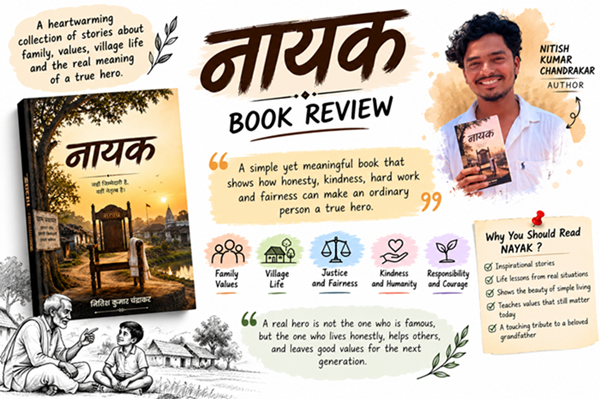
Some books entertain us, some books teach us, and some books quietly remind us of the people and values we may have left behind while moving ahead in life. Nayak by Nitish Kumar Chandrakar feels like one of those books. It is a simple, emotional, and meaningful collection of stories based on family, village life, relationships, courage, kindness, justice, and the wisdom passed from one generation to another.
The thing I liked most about the idea of Nayak is that it is not trying to create a hero with extraordinary powers. Its hero comes from ordinary life. He is remembered because of the way he lived, the way he treated people, and the values he followed.
At the heart of the book is Asaram Ji and the values he received from his father, Barat Ram. Honesty, hard work, kindness, fairness, responsibility, and respect for others become an important part of his life.
This makes the book feel personal.
Many of us have had someone in our family whose words stay with us for years. It may be a grandfather, grandmother, father, mother, or another elder. Sometimes they do not give us lessons through long speeches. We simply watch how they live.
We notice how they treat a poor person.
We see how they solve a family problem.
We remember how they stand for what is right.
We learn from how they behave when life becomes difficult.
These small memories slowly become life lessons.
Nayak seems to understand this very well.
The village setting also gives the stories a warm and familiar feeling. Rural life has its own beauty and its own struggles. People often know each other closely. Families are connected, neighbours become part of everyday life, and one person’s problem can sometimes become a concern for the whole community.
At the same time, village life can also bring disagreements, social pressures, financial struggles, questions of fairness, and difficult decisions.
Through such situations, the book explores what it means to be a good human being.
One of the strongest values in the book is justice.
Doing what is right sounds easy when we say it, but real life is rarely that simple. Sometimes doing the right thing means standing against someone close to us. Sometimes it means speaking when remaining silent would be easier. Sometimes fairness means putting aside our own personal benefit.
The stories remind us that a truly fair person should not change his values depending on who is standing in front of him.
This is a simple lesson, but an important one.
Another beautiful theme is kindness.
Today, people often measure success through money, position, property, or social status. But Nayak gives importance to another kind of success — becoming a person who is remembered with love and respect.
A person may not be famous to the whole world, but he can still be a hero to his family and community.
That thought stayed with me.
The book also talks about hard work and responsibility. These are values that older generations often tried to pass on to their children. Life was not always easy, especially in rural families where people had to work hard for even basic comforts.
Because of this, hard work was not simply about earning money. It was connected with dignity and responsibility.
The characters in Nayak seem to carry this understanding.
The book also gives importance to family relationships.
Family is often the first place where we learn about love, sharing, sacrifice, responsibility, and forgiveness. It is also where we experience disagreements and misunderstandings.
No family is perfect.
But what matters is whether people continue to care for one another even when life becomes difficult.
The emotional connection between generations is especially meaningful here. Values do not automatically move from one generation to another. Someone has to live them, someone has to observe them, and someone has to remember them.
This is why the book feels like more than a normal collection of stories.
It is also an attempt to preserve memories.
The author has created an emotional tribute to a beloved grandfather. Through these stories, a person’s memories, struggles, thoughts, habits, and values are given a life beyond his own lifetime.
I find this idea very touching.
With time, people leave us. Their voices are no longer around us. The places they lived may change. New generations may never get the chance to meet them.
But stories can keep something of them alive.
A child who never met his great-grandfather may still understand what kind of person he was through a story. He may learn about a decision he once made, a person he once helped, or a difficult situation in which he stood for what was right.
In this way, storytelling becomes a bridge between generations.
That is perhaps one of the most beautiful things about Nayak.
The book also made me think about the meaning of its title.
What exactly makes someone a “Nayak”, or a hero?
Is a hero only someone who does something huge and becomes famous?
I don’t think so.
Sometimes a hero is a father who works honestly throughout his life to support his family. Sometimes it is a grandfather who teaches is grandchildren to respect others. Sometimes it is a person who helps a neighbour without expecting anything in return. Sometimes it is someone who chooses justice when choosing the easier path would benefit him personally. These people may never appear in newspapers or history books.But they leave a deep mark on the lives around them.This is the kind of hero that Nayak celebrates. I also appreciate that the stories are connected with values without making the basic message feel complicated. The themes are things almost every reader can understand — respect your family, help people when you can, work honestly, take responsibility, be fair, and do not forget your humanity. These ideas may sound old-fashioned to some people, but I think they are needed even more today.Our lifestyles have changed greatly.Technology has changed.Villages and cities are changing.Families are becoming smaller.People are busier than before.But the basic qualities that make someone a good human being have not really changed.Honesty still matters.Kindness still matters.Respect still matters.Keeping your word still matters.Standing for what is right still matters. And caring for people still matters.This is why the lessons in Nayak can remain meaningful even outside the village setting. Another thing I liked is that the book can be read not only as a story collection but also as a family memory. This personal touch gives i t emotional value. You are not simply reading about fictional situations. You are also seeing an author’s effort to protect the memory and personalit of someone important to him.
There is love behind that effort. There is respect. And there is also a wish that the wisdom of one generation should not disappear with time. Overall, Nayak by Nitish Kumar Chandrakar feels like a warm and heartfelt book about ordinary people with extraordinary values. Readers who enjoy family stories, rural settings, emotional memories, moral values, and simple stories with meaningful lessons may connect strongly with it. For younger readers, the book can introduce values that older generations lived by. For older readers, some stories may bring back memories of their own childhood, village, parents, or grandparents.
For me, the biggest message of Nayak is very simple:
A real hero is not always the strongest, richest, or most famous person. Sometimes a real hero is simply someone who lives honestly, treats people with kindness, stands for what is right, and leaves good values behind for the next generation.
People may leave this world, but the lessons they give us can remain. Their stories can remain. Their values can remain. And as long as someone remembers them and tries to live by what they taught, a part of them continues to live too. That is what makes Nayak more than just a collection of stories. It is a book about memory, family, values, and the quiet heroes who shape our lives without ever asking to be called heroes.
Amazon Link – https://www.amazon.in/Nayak-Nitish-Kumar-Chandrakar/dp/9379000677/