
By S. Kumar
Money is an important part of our life. We need it for our daily needs, our family, our dreams, and our future. But have we ever stopped and thought about how we actually think about money?
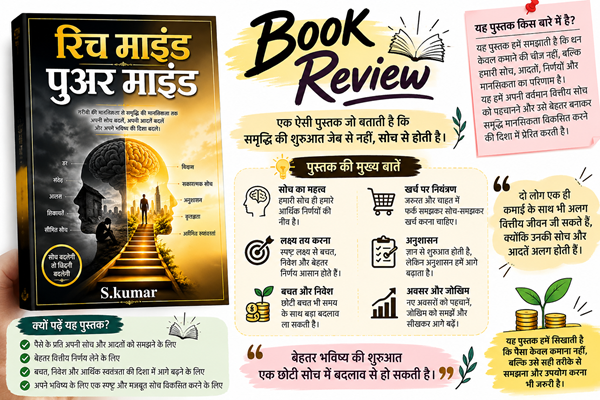
Rich Mind Poor Mind by S. Kumar is a simple and useful book that talks about this very question. The main idea of the book is easy to understand — before changing our financial condition, we often need to change our thinking.
What I liked about this book is that it does not say that becoming financially strong is only about earning a very high income. It talks about something that comes before income — our mindset.
Two people may earn the same amount of money but use it in completely different ways. One person may spend almost everything and have nothing left at the end of the month. Another person may save a small amount regularly, plan for the future, and slowly start investing.
Their income may be similar, but their habits are different.
And these habits often begin with the way they think.
This is where the idea of a “rich mind” and a “poor mind” becomes interesting. A rich mind does not necessarily mean that a person is already rich. It means developing a way of thinking that helps us make better financial decisions. It means understanding the value of money, thinking about the future, looking for opportunities, and learning before making decisions. The book encourages readers to look at their own relationship with money. For example, when we receive money, what is our first thought?
Do we immediately think about what we can buy?
Do we think about saving some of it?
Do we have any financial goals?
Do we know where our money goes every month?
These are very simple questions, but sometimes we avoid asking them. One of the useful subjects in the book is saving. Saving may look boring when compared with spending. Buying something new can give us instant happiness, while putting money aside does not always give us the same feeling. But savings can give us something more valuable — security. Even a small amount saved regularly can become useful over time. The book reminds us that good financial habits do not always have to start with a large amount of money. Sometimes they begin with one small decision repeated again and again. The book also talks about spending. Spending money is not wrong. We work hard so that we can enjoy life and take care of our needs. But there is a difference between spending consciously and spending without thinking.
Sometimes we buy things because other people have them. Sometimes we spend to look successful. Sometimes an online offer makes us buy something we never really needed. Small expenses may not look serious at first, but together they can affect our financial future. This is why awareness is important. Another important topic is financial goals.
I liked this idea because saving becomes easier when we know what we are saving for. Someone may want to build an emergency fund. Someone may want to buy a home. Someone may be planning for children’s education. Someone may want to start a business. And someone may simply want a future where money does not create constant stress. Having a clear goal gives direction to our financial decisions. The book also introduces the reader to the importance of investment and risk. Saving money is important, but understanding how money can be used wisely for long-term goals is also useful. At the same time, financial decisions should not be made blindly.
A good mindset also means learning, understanding the risks, and thinking carefully before taking action. Another thing I liked is the book’s focus on discipline. Motivation can make us start something, but discipline helps us continue. Almost everyone knows that saving money is good. Still, knowing something and actually doing it every month are two different things. This is where discipline becomes important.Financial improvement may not happen overnight. It can take months or even years. Small habits may look unimportant today, but they can create a big difference over a long period of time. The book also makes us think about opportunities. Sometimes our thinking becomes so focused on problems that we stop looking for possibilities.
A person with a healthier financial mindset may ask:
What new skill can I learn? Can I improve my income? Can I use my time better? What financial habit should I change? What can I learn about saving or investing?
These questions can slowly change the direction of a person’s life. For me, one of the strongest messages of Rich Mind Poor Mind is that financial freedom is not only about having a lot of money. It is also about having control and clarity. If we earn more but our expenses keep increasing without any plan, we may still feel financially stressed. On the other hand, understanding our income, controlling unnecessary expenses, saving regularly, and maki g thoughtful decisions can give us greater confidence about the future. Of course, mindset alone cannot solve every financial problem. People’s incomes, responsibilities, opportunities, and circumstances can be very different. But improving our understanding of money can help us make better decisions within the situation we have. That is why I think this book can be useful for beginners. It does not require the reader to be a financial expert. The ideas are connected with everyday life — earning, spending, saving, goals, discipline, opportunities, risk, investment, and financial independence. These are things that almost everyone has to think about at some point.The book also reminds us that we should not compare our financial journey too much with other people. Someone may appear rich because of an expensive car, clothes, phone, or lifestyle. But what we see from outside does not always tell us the full financial story. Real financial strength is often quieter. It can be found in good habits, thoughtful decisions, savings, planning, and peace of mind. Overall, Rich Mind Poor Mind is a simple and motivating book about building a better relationship with money. It encourages readers to first understand their present habits instead of only dreaming about becoming rich. It asks us to look at our thinking, question our old beliefs, and slowly develop habits that can support a stronger financial future. For me, the biggest lesson of the book can be explained in one simple line: Before trying to make your wallet richer, try to make your thinking wiser. Money may come and go, but the way we understand and manage it can affect our life for many years.A better financial future does not always begin with a huge salary or a lucky opportunity.
Sometimes it begins with a small change in thinking. Then comes a better habit. Then a better decision. And slowly, those decisions can create a different future. That is what makes the message of Rich Mind Poor Mind simple but meaningful: Prosperity does not begin in the pocket. It begins in the mind.