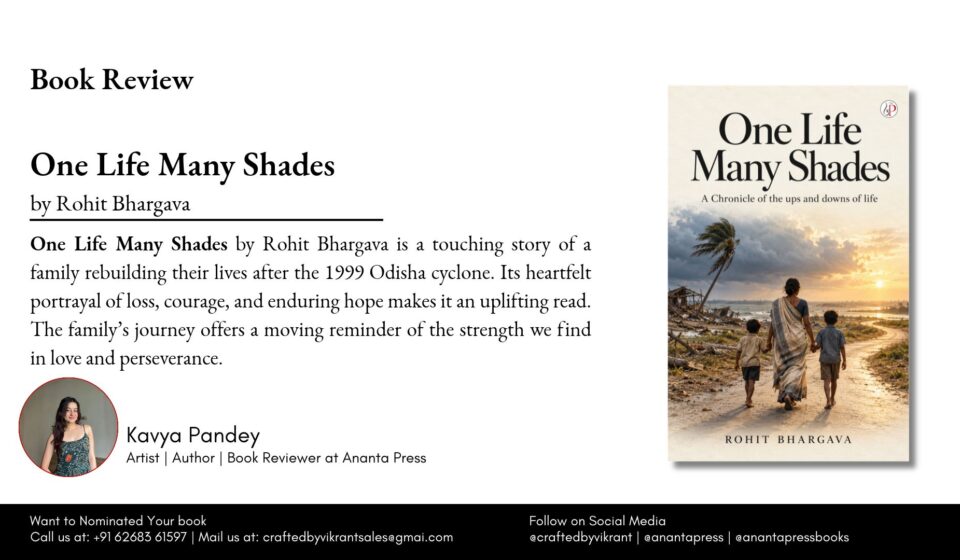

Rohit Bhargava’s One Life Many Shades explores the uncertain journey between losing the life we know and discovering the strength to begin again. Following a family whose world is shattered by the 1999 Odisha super cyclone, the book develops into a broader story of motherhood, ambition, kindness, love, and perseverance. Its emotional appeal comes from a recognisable truth: surviving one tragedy does not protect anyone from future difficulties. Life continues to bring challenges, even after moments of happiness and achievement. Through characters who repeatedly find reasons to move forward, Bhargava presents hope as something sustained through effort, relationships, and faith.
The opening establishes the family’s vulnerability with immediate urgency. Rajbir, a handicraft shop owner in Pipili, faces the terrifying responsibility of protecting his wife, Ramdei, and their two young sons, Piyush and Uday. As warnings give way to destruction, familiar surroundings become dangerous, and ordinary decisions acquire life-changing consequences. The disaster matters here primarily through its effect on a household. Readers encounter fear through parents trying to protect their children, rather than through a distant account of devastation. This personal perspective gives the opening emotional weight and establishes the family bond that remains central throughout the narrative.
Rajbir’s sacrifice becomes the defining absence around which the surviving family must rebuild. Although his physical presence is lost early, his love continues to influence the meaning of their journey. Bhargava gives his fatherhood a practical expression: he assesses danger, makes decisions, and places his family’s safety above his own. This portrayal makes the loss especially affecting because it interrupts an ordinary life of work and responsibility. The reader understands that the family has lost more than financial security. They have lost a source of reassurance, companionship, and stability whose place cannot simply be filled by later success.
Ramdei provides the story’s strongest emotional foundation. Her courage emerges through the work of continuing when grief offers every reason to stop. She must earn, raise her children, make unfamiliar decisions, and adapt to circumstances she never chose. Her strength is therefore visible in daily responsibilities rather than occasional declarations. Whether working at a dhaba, helping at the printing press, or taking up domestic work during later difficulties, she treats labour as a means of protecting her family’s future. These details give substance to the book’s message of resilience. Perseverance has a cost, and Ramdei repeatedly bears it.
Her character also brings attention to the relationship between dignity and economic hardship. The narrative respects work that people may overlook or undervalue. Ramdei’s willingness to do what circumstances require reflects determination, resourcefulness, and love. Her contribution cannot be measured only by the careers her children eventually build. She creates the conditions that allow them to imagine those careers at all. This makes her role particularly meaningful within a story that later enters the more visible worlds of journalism and entertainment. Behind public achievement stands a mother whose efforts are largely private, demanding, and continuous.
Santosh Dubey introduces another important dimension: the possibility of finding family beyond blood relationships. A journalist who runs a printing press and publishes a local newspaper, he offers Ramdei and her children shelter, employment, and guidance. His kindness changes their circumstances, but its significance extends beyond immediate assistance. He helps create a dependable environment in which the children can grow. His own bereavement gives additional depth to his affection for them. The relationship becomes mutually restorative, suggesting that helping another person can also bring purpose into a life marked by loss. Compassion becomes a lasting commitment rather than a passing gesture.
Aradhana’s presence strengthens this portrait of chosen family. Her care helps turn shelter into belonging, while her willingness to share responsibilities gives the household emotional continuity. Together, she and Santosh demonstrate that generosity involves more than making an initial decision to help. It requires patience, adjustment, and continued participation in other people’s difficulties. The book’s treatment of these relationships is among its most appealing qualities. Gratitude and affection develop through shared living and repeated acts of support. Readers who value stories about community will find particular warmth in this widening circle of family.
As Piyush and Uday grow older, their different ambitions expand the narrative. Piyush’s interest in journalism connects naturally with Santosh’s influence, while Uday’s enthusiasm for performance leads him towards acting and television. Their paths allow Bhargava to examine aspiration from two perspectives without losing the family connection. Both young men carry their difficult beginnings into professional environments where talent must encounter competition, uncertainty, and questions of trust. Their progress is meaningful because readers understand the effort behind it. Education, opportunity, guidance, and sacrifice all contribute to what might otherwise appear to be individual achievement.
Piyush’s journey gives the book an opportunity to consider integrity alongside ambition. Journalism represents a profession in which personal advancement and responsibility towards others can come into tension. His attachment to Santosh’s ideals provides a moral reference point as his circumstances change. What makes this thread relevant is the question beneath it: can a person preserve the values that shaped him while pursuing recognition? The narrative consistently places importance on loyalty and principled conduct. Piyush’s development therefore concerns identity as much as career progress, inviting readers to consider what they would want success to preserve within themselves.
Uday’s experiences bring a different pressure into focus. His attraction to the entertainment industry grows from a childhood interest in dancing and acting, giving his ambition an understandable foundation. Yet the world he enters contains jealousy, hostility, and manipulation alongside opportunity. Through his difficulties, the book explores how quickly professional success can become insecure. Recognition does not remove vulnerability, and public reputation can be threatened by forces outside an individual’s control. This thread adds tension while reinforcing the broader theme that favourable circumstances are temporary. The confidence to continue must come from something more durable than applause.
The relationships involving Sudha and Swati add tenderness and companionship to these professional struggles. Sudha’s connection with Piyush develops through shared aspirations, concern, and familiarity. Their interactions suggest that affection grows through attention: remembering preferences, making time, recognising distress, and offering support. Such moments give the characters room to exist beyond hardship. Swati similarly brings independence, professional experience, and encouragement into the narrative. These women help sustain the family through difficult periods while also possessing ambitions of their own. Their presence broadens the story’s understanding of strength to include emotional understanding and dependable partnership.
One of the book’s most effective ideas is that achievement does not end uncertainty. A simpler inspirational story might move directly from disaster to struggle and finally to permanent happiness. Bhargava allows further setbacks to disturb that progression. False accusations and damaging circumstances test the family after they have already worked towards stability. This gives the title greater relevance. The many shades of life include the fear of losing what has been rebuilt, the disappointment of misplaced trust, and the effort required to recover confidence. Hope must be renewed because life does not provide a final guarantee of safety.
Bhargava’s storytelling is direct, emotionally expressive, and openly concerned with moral reflection. Dialogue, family interactions, and explanations of the characters’ experiences make the narrative easy to follow. The book frequently states the lessons it wishes readers to consider, particularly those concerning courage, gratitude, action, and faith. Readers who enjoy inspirational fiction are likely to appreciate that clarity. Those who prefer greater ambiguity or lessons conveyed entirely through implication may find some passages more explanatory than necessary. Nevertheless, the sincerity of the approach is evident. The author wants the story to offer reassurance as well as an account of struggle.
The manuscript would benefit from further attention to grammar, phrasing, and consistency, as some sentences interrupt the flow of otherwise affecting scenes. Its explicit reflections can also repeat ideas that the characters’ experiences have already communicated. These limitations matter when assessing the reading experience, but they do not erase the emotional value of the central relationships. The strongest passages are rooted in concrete human needs: shelter after displacement, encouragement during education, companionship in loneliness, and loyalty when reputation collapses. Whenever the narrative stays close to these experiences, its message gains force through the lives unfolding on the page.
Ultimately, One Life Many Shades offers an earnest and compassionate account of people learning to live beyond circumstances that could have defeated them. Its lasting appeal lies in the connections between its characters: a father’s protection, a mother’s endurance, a mentor’s generosity, and the support of loving partners. Rohit Bhargava brings these relationships together in a story that values perseverance without forgetting the importance of help. For readers drawn to family-centred inspirational fiction, the book offers an emotionally engaging journey through grief, aspiration, injustice, and renewal, with the reassuring belief that another beginning can remain possible.