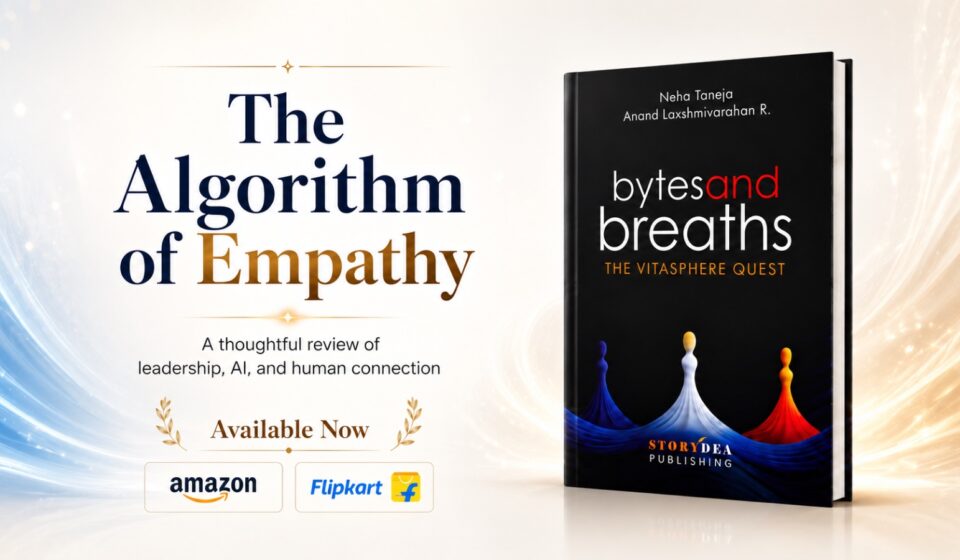

What happens when a machine learns to feel, or at least learns to understand feeling well enough to change the way we lead? That question sits at the heart of Bytes and Breaths: The Vitasphere Quest, and authors Neha Taneja and Anand Laxshmivarahan R. explore it with real nuance, warmth, and honesty.
The novel opens in the corner office of Zara, CEO of VitaSphere, a Mumbai-based nutraceutical startup riding the crest of disruption. Zara is a leader we recognise instantly: driven, visionary, emotionally intelligent by instinct, but increasingly overwhelmed by the pace of change around her. When her old friend Hana Nakamura arrives with a sleek, buttonless device called Aria, an AI-powered leadership coach, the novel finds its beating heart.
Aria is not HAL 9000. She is not threatening, omniscient, or dystopian. In the authors’ careful construction, she is a companion, one who reads voice tones, facial expressions, and behavioural patterns to help Zara understand not just her team’s emotions but her own. The parable that unfolds is less about technology replacing human wisdom and more about technology helping us see it clearly.
What the book does exceptionally well is resist the temptation to turn Aria into a deus ex machina. Zara’s growth, from a technically gifted founder to an emotionally complete leader, is earned rather than handed to her. The conversations between Zara and Aria are some of the finest passages in the book: layered, probing, and genuinely moving. When Aria asks Zara why she avoids acknowledging her team’s fatigue, the silence that follows doesn’t feel mechanical. It feels human.
Taneja and Anand have crafted a prose style that sits comfortably between business parable and literary fiction. Their sentences are clean, their metaphors apt, and the dialogue between Zara and Hana in particular feels lived-in rather than scripted. The narrative touches on imposter syndrome, the loneliness of leadership, and the quiet grief of watching a company you built begin to falter, and all of it is handled with a light touch.
Structurally, the book is tight. The alternating chapters, one authored per perspective, never lose coherence. If anything, the dual authorship adds texture. You can sense two distinct sensibilities at work, one more analytical and one more empathetic, and together they build the very synthesis the book is arguing for.
There is one place where the novel’s ambitions slightly outrun its reach: the competitive-market subplot around VitaSphere’s declining market share feels underexplored. The business crisis that pushes Zara toward new solutions works more as backdrop than plot. We’re told the stakes without always feeling them, and a few more chapters spent in that world, with sharper competitive pressure, would have made Zara’s emotional arc land even harder.
These are minor quibbles against a book that manages something genuinely rare: it makes leadership feel urgent and human at the same time. Most business books lean either too theoretical or too anecdotal. Bytes and Breaths finds a third path, the parable, and walks it with confidence.
Neha Taneja and Anand have written a book for leaders who sense that something is missing from the standard playbook of metrics and KPIs. If you’ve ever felt that the most important conversations in your organisation are the ones nobody quite gets around to having, this book is for you.
Buy the Book: Bytes and Breaths: The Vitasphere Quest on Amazon India