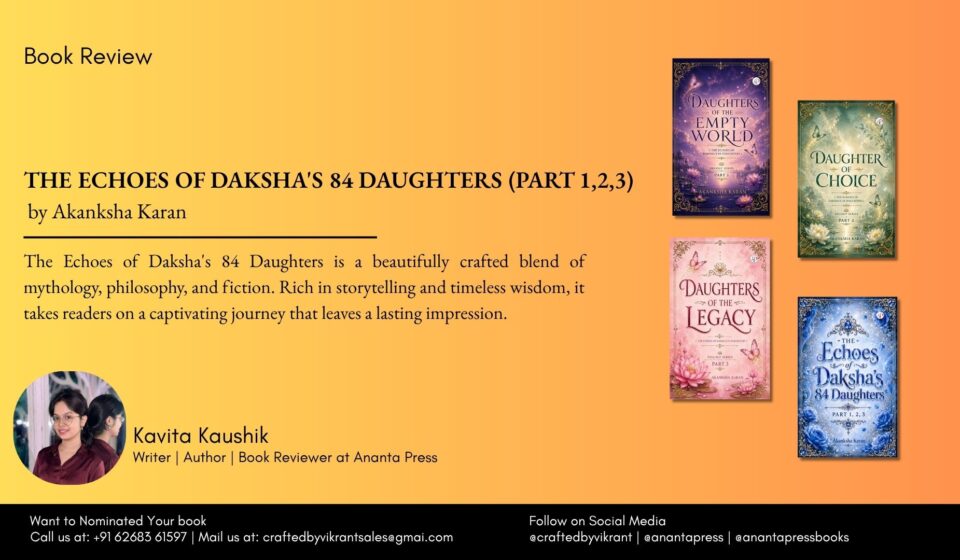
Book Review: Echoes of Daksha’s Daughters (Parts 1, 2 & 3), by Akanksha Karan

Echoes of Daksha’s Daughters is far more than a mythological novel. It is an ambitious literary work that combines Indian philosophy, Sanatan cosmology, historical imagination, coming-of-age fiction, and emotional storytelling into a single narrative. Rather than merely retelling familiar Puranic stories, the author creates a bridge between the modern world and the timeless wisdom of ancient India. The novel explores questions of identity, purpose, tradition, knowledge, and human relationships while introducing readers to the forgotten daughters of Daksha Prajapati—women whose contributions to creation and civilization have often remained in the shadows of mythology.
The story begins with Krish, a young man from Delhi, whose modern outlook and privileged upbringing sharply contrast with the traditional environment of Anantam, a cultural and spiritual institute in Deoghar. Initially unwilling to accept the disciplined lifestyle of the institute, Krish views its practices with skepticism. His discomfort with simple living, Ayurveda, storytelling sessions, yoga, and the absence of modern gadgets reflects the mindset of many contemporary readers. This makes him an ideal protagonist because his journey mirrors the transformation that the audience experiences while reading the book.
One of the novel’s greatest strengths is its setting. Anantam is not merely a backdrop but almost a living character. The descriptions of rain-soaked courtyards, herbal gardens, storytelling halls, ancient shrines, clay workshops, and traditional kitchens create an atmosphere filled with warmth and authenticity. Every page reflects the beauty of Indian heritage without romanticizing it excessively. The institute becomes a symbol of a forgotten way of life where education extends beyond classrooms and includes culture, discipline, compassion, art, and spiritual inquiry.
The supporting characters are equally memorable. Keisha emerges as one of the novel’s most touching personalities. Gentle, intelligent, disciplined, and deeply rooted in tradition, she quietly struggles with her own unfulfilled dream of learning Kathak. Her conflict between personal passion and family expectations feels emotionally genuine and universally relatable. The gradual friendship between Krish and Keisha develops naturally, avoiding unnecessary melodrama. Their conversations reveal mutual respect rather than superficial romance, making their relationship believable and emotionally engaging.
Pahi and Rishvika bring balance to the narrative with humor, warmth, and youthful energy. Their friendly teasing, everyday conversations, and support for one another create a realistic portrayal of friendship. The interactions among these four young characters prevent the novel from becoming overly philosophical. Instead, moments of laughter, curiosity, and emotional vulnerability make the story accessible even when it discusses profound spiritual concepts.
Perhaps the most remarkable aspect of the novel is its storytelling structure. The narrative moves between present-day life at Anantam and ancient cosmic history. Through Kalyani ji’s mythology sessions, readers are introduced to Hindu cosmology in an organized, engaging, and easy-to-understand manner. Rather than presenting mythology as a collection of disconnected legends, the author explains creation as a coherent philosophical system.
The discussions on Narayana, Hiranyagarbha, Brahma, the Four Kumaras, Manas Putras, the fourteen Lokas, Mahapralaya, cosmic cycles, Manus, and Manvantaras are presented with impressive clarity. Readers unfamiliar with Sanatan cosmology will find these explanations approachable, while those already interested in Indian philosophy will appreciate the careful organization of traditional concepts. The book succeeds in transforming complex scriptural knowledge into engaging narrative without making it feel like a textbook.
Another notable achievement of the author is the emphasis on inquiry rather than blind belief. Kalyani ji encourages students to ask questions, while Krish repeatedly challenges traditional ideas with modern skepticism. This creates meaningful dialogue instead of one-sided preaching. Philosophy is presented not as unquestionable doctrine but as an invitation to explore deeper truths. Such an approach makes the book intellectually satisfying while remaining respectful toward tradition.
The introduction of Prasuti marks another fascinating transition in the story. Instead of focusing on famous kings, warriors, or gods, the author chooses to narrate ancient civilization through the perspective of a curious young princess. This decision immediately gives freshness to the narrative. Prasuti’s endless questions about creation, purpose, and existence beautifully mirror the curiosity of modern readers. Her character promises to become a compelling guide through the ancient world and highlights the often-overlooked contributions of women in early Hindu traditions.
The language of the novel deserves special appreciation. The prose is elegant yet simple, poetic without becoming difficult, and descriptive without slowing the pace. Natural imagery—rain, rivers, lotuses, forests, stars, temples, and lamps—is woven throughout the narrative, creating a peaceful atmosphere that complements the philosophical themes. The dialogues feel realistic and help reveal character personalities without unnecessary exposition.
Emotionally, the novel remains restrained and mature. Instead of relying on dramatic twists or exaggerated conflict, it builds emotional depth through quiet moments—a shared notebook, silent encouragement, conversations beneath the stars, or Keisha secretly watching Kathak practice from outside a classroom. These subtle scenes often leave a stronger impact than louder emotional episodes.
The novel also deserves praise for presenting Indian knowledge systems in an integrated manner. Ayurveda, yoga, mythology, Sanskrit, storytelling, philosophy, traditional arts, environmental awareness, and community living are shown as interconnected aspects of one holistic culture rather than isolated subjects. This educational dimension significantly enriches the reading experience.
However, the book may not appeal equally to every reader. Those expecting fast-paced adventure or continuous action might find its measured pacing slower than contemporary commercial fiction. Several mythology sessions contain detailed philosophical explanations that require patience and attention. Yet these sections form the very heart of the novel and reward readers who appreciate reflective literature.
One of the most refreshing qualities of Echoes of Daksha’s Daughters is its respectful portrayal of Indian civilization without becoming dogmatic. The novel neither blindly glorifies tradition nor dismisses modernity. Instead, it encourages dialogue between both worlds. Krish represents modern skepticism, while Keisha represents inherited wisdom, and together they gradually learn from one another. This balanced perspective gives the novel both emotional depth and intellectual credibility.
As the narrative progresses, readers realize that the title itself carries profound meaning. The daughters of Daksha are not merely historical or mythological figures; they symbolize the forgotten feminine voices that silently shaped civilization through knowledge, values, relationships, and continuity. By bringing these characters to the forefront, the author offers a refreshing reinterpretation of ancient narratives while remaining rooted in traditional sources.
Overall, Echoes of Daksha’s Daughters is an original, thoughtful, and beautifully crafted work that successfully blends mythology, philosophy, education, and fiction. It encourages readers not only to learn about ancient India but also to reflect upon their own lives, values, ambitions, and understanding of existence. The novel demonstrates that mythology is not simply about gods and miracles—it is about human questions that remain timeless across generations.
This book is highly recommended for readers interested in Indian mythology, Sanatan philosophy, spiritual fiction, historical imagination, and meaningful coming-of-age stories. It is equally suitable for young adults seeking cultural roots and mature readers looking for intellectually enriching literature. Rich in wisdom, emotion, and imagination, Echoes of Daksha’s Daughters stands out as a memorable contribution to contemporary mythological fiction and promises an even more rewarding journey in the volumes that follow.