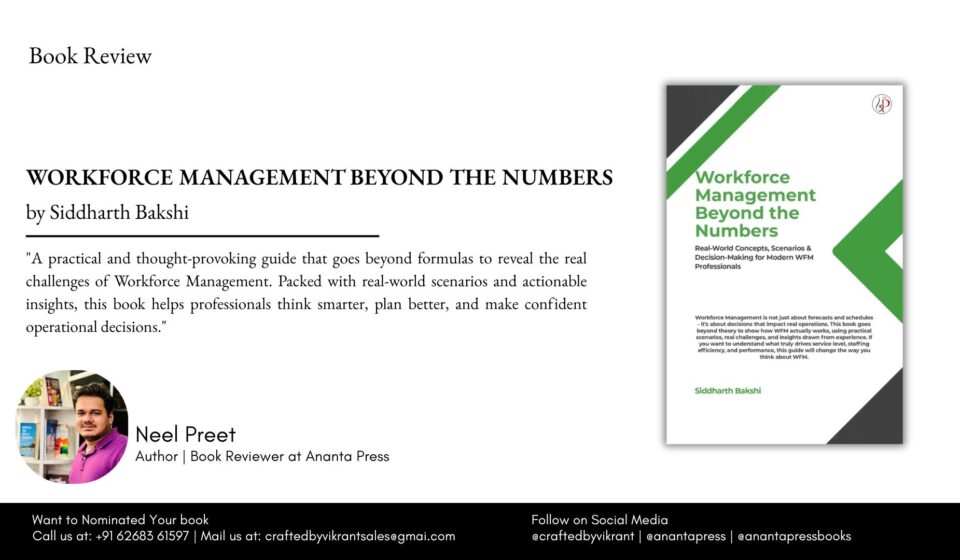

Workforce Management Beyond the Numbers: Why Plans Fail, Metrics Mislead, and Real Operations Demand More Than Calculation
Author: Siddharth Bakshi
In today’s fast-paced business environment, Workforce Management (WFM) has become one of the most critical functions in customer service, contact centers, and business operations. While countless books explain forecasting formulas, staffing calculations, scheduling techniques, and performance metrics, very few explore the deeper reality behind successful workforce management. Workforce Management Beyond the Numbers by Siddharth Bakshi fills this gap with remarkable clarity and practical insight. Rather than presenting WFM as a collection of mathematical models and technical formulas, the book emphasizes that true operational success depends on decision-making, execution, adaptability, and understanding the realities of day-to-day operations.
One of the book’s greatest strengths is its ability to challenge conventional thinking. The author repeatedly reminds readers that having perfect forecasts, accurate staffing calculations, or impressive dashboards does not automatically guarantee operational success. Through numerous real-world examples, the book explains why even well-designed plans often fail once they encounter the unpredictable nature of live operations. This perspective makes the book particularly valuable because it prepares readers for the complexities that cannot be solved by formulas alone.
Unlike traditional WFM textbooks that concentrate heavily on definitions and theoretical concepts, this book adopts a practical, scenario-based approach. Each topic is presented through thought-provoking questions that encourage readers to think critically before arriving at the solution. Instead of simply memorizing concepts, readers are guided to understand why workforce management challenges occur and how experienced professionals approach them. This learning style makes the material far more engaging and applicable to real business situations.
A particularly impressive aspect of the book is its detailed explanation of the gap between planning and execution. The author demonstrates that planning is only the beginning of the WFM journey. Forecast accuracy, staffing calculations, shrinkage assumptions, occupancy targets, and scheduling all create a foundation, but real performance depends on how effectively these plans are executed throughout the day. The book explains how unexpected call spikes, adherence issues, system failures, changes in Average Handling Time (AHT), and operational variability can quickly invalidate even the most carefully prepared plans. These insights help readers appreciate that workforce management is a continuous process of monitoring, adjusting, and making informed decisions rather than simply creating schedules.
Another remarkable contribution of this book is its discussion on metrics. Many professionals assume that green dashboards automatically indicate healthy operations. However, the author carefully explains how metrics can often be misleading when interpreted without context. Average Service Level, Occupancy, AHT, and Forecast Accuracy are important indicators, but they do not always reveal the hidden operational problems occurring behind the scenes. By encouraging readers to think beyond numbers, the book promotes a more balanced and analytical approach to performance management. This shift in mindset is one of the most valuable lessons offered throughout the text.
The writing style deserves special appreciation. Despite dealing with technical business concepts, the language remains simple, conversational, and easy to understand. Complex operational scenarios are explained in a logical manner without overwhelming readers with excessive mathematical calculations. This makes the book equally suitable for beginners entering the field as well as experienced professionals looking to strengthen their strategic thinking. The clear organization of chapters allows readers to progress naturally from foundational concepts to advanced operational challenges.
The coverage of real-time management is another highlight. The book explains that successful workforce management requires continuous observation, quick decision-making, and effective coordination between WFM teams and operations. Topics such as adherence management, interval-level staffing, occupancy balancing, shrinkage control, and demand variability are discussed with practical relevance. Readers gain an understanding that operational excellence depends not only on accurate planning but also on timely interventions when reality begins to differ from expectations.
One of the strongest features of the book is its focus on developing the mindset of a Workforce Management professional. Instead of encouraging readers to chase numerical targets alone, the author repeatedly emphasizes the importance of understanding business outcomes. Concepts such as output versus outcome, execution versus calculation, and planning versus operational reality are explained with clarity and reinforced through practical examples. These discussions help readers develop the decision-making skills required in real operational environments where conditions change constantly.
The book also succeeds in addressing the needs of a broad audience. Beginners will appreciate the straightforward explanations and structured learning path, while experienced WFM analysts, planners, team leaders, operations managers, and business professionals will benefit from the strategic insights and practical decision-making frameworks. Because the content focuses on principles rather than software-specific tools, the lessons remain relevant across different organizations and operational environments.
From an educational perspective, the question-and-answer format keeps readers actively involved throughout the book. Instead of passively reading information, readers are encouraged to pause, analyze situations, and consider how they would respond before reviewing the author’s explanation. This interactive approach significantly improves understanding and retention while making the learning experience more engaging.
The author also deserves credit for maintaining a strong balance between theory and application. While the book introduces essential Workforce Management concepts, it consistently connects them to real business situations. Every chapter reinforces the central message that successful workforce management is ultimately about delivering consistent operational performance rather than achieving perfect calculations. This practical orientation distinguishes the book from many traditional WFM resources available today.
If there is one defining message throughout the book, it is that Workforce Management is fundamentally about people, decisions, and execution—not merely spreadsheets, formulas, or performance dashboards. The author successfully demonstrates that operational excellence emerges when planning is combined with continuous observation, flexibility, collaboration, and informed decision-making. This philosophy gives the book lasting value far beyond technical instruction alone.
Overall, Workforce Management Beyond the Numbers is an outstanding resource that offers a fresh and highly practical perspective on Workforce Management. It goes beyond teaching technical concepts by helping readers develop the critical thinking, operational awareness, and decision-making abilities required to succeed in today’s dynamic business environment. Whether you are beginning your WFM journey or looking to elevate your professional expertise, this book provides valuable knowledge that can be immediately applied in real-world operations. It is an insightful, engaging, and highly recommended read for anyone seeking to understand not only how Workforce Management works, but also why successful operations require far more than numbers alone.