Book Review: Whispers from the Chinars – Noor-E-Wadi Lives On by Mohammad Muslim

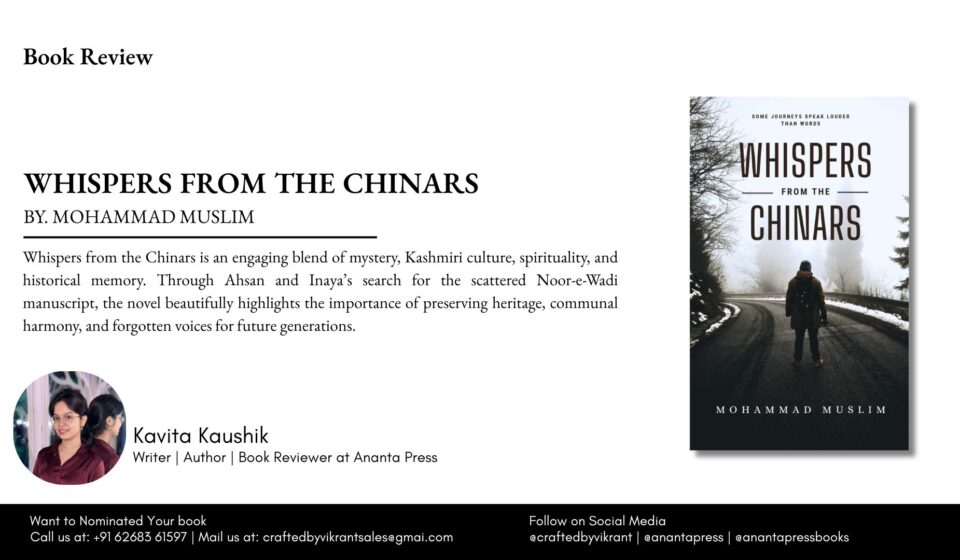
Mohammad Muslim’s Whispers from the Chinars – Noor-E-Wadi Lives On is a thoughtful combination of mystery, cultural history, spirituality, and social reflection. Set against the evocative landscape of Kashmir, the novel takes readers on a journey through ancient shrines, forgotten manuscripts, family memories, devotional poetry, and the living traditions of the valley. At its heart, the book is not merely about uncovering a hidden document; it is about recovering a shared cultural inheritance that powerful individuals have attempted to suppress, distort, or control.
The story begins with Ahsan, a young photographer who is deeply interested in capturing the everyday beauty and cultural life of Kashmir. Unlike those who focus only on the region’s conflict, Ahsan wants his photographs to preserve its dignity, spirituality, traditions, and ordinary human moments. His artistic vision immediately establishes one of the novel’s central concerns: the responsibility of younger generations to preserve what time, neglect, and division threaten to erase.
A visit to his grandmother Zareena’s old Srinagar home changes the direction of his life. There, Ahsan notices an iron key belonging to a room that has remained locked since his grandfather’s death. When the room is finally opened, he and his friend Inaya discover shelves of books, handwritten letters, maps, notebooks, an old camera, and a damaged photograph in which one man’s face has been deliberately scratched away. They also encounter references to a mysterious cultural and spiritual collection known as Noor-E-Wadi.
What initially appears to be a private family discovery gradually develops into a wider investigation. Ahsan and Inaya learn that Noor-E-Wadi is not a conventional manuscript contained within a single volume. It is a dispersed collection of poetry, songs, historical reflections, oral testimonies, and spiritual teachings preserved across different shrines and cultural centres. The collection represents Kashmir’s tradition of compassion, dialogue, communal fellowship, and shared artistic inheritance.
The mystery becomes more urgent when the disappearance of a shrine caretaker is connected to the manuscript. Ahsan and Inaya, assisted by Inspector Danish, journalist Irfan, Syed Kareem Shah, musicians, scholars, caretakers, and village elders, begin following clues scattered through photographs, calligraphic symbols, coded verses, musical compositions, maps, and concealed letters. Their journey takes them from Srinagar’s old wooden houses and the banks of the Jhelum to shrines, libraries, houseboats, orchards, mountain retreats, abandoned halls, forests, and remote settlements.
One of the strongest elements of the book is its Kashmiri setting. The author creates a vivid sense of place through descriptions of carved wooden homes, chinar trees, riverside paths, snow-covered roads, shrines, prayer halls, kehwa, traditional carpets, calligraphy, folk songs, devotional gatherings, and village hospitality. These elements are not included merely as decoration. They actively shape the narrative and give emotional meaning to the characters’ search.
The chinar tree itself becomes an important symbol throughout the novel. Its whispering leaves seem to carry the voices of earlier generations, reminding the characters that history does not disappear simply because people stop listening to it. Similarly, the Jhelum represents continuity. Like the river, cultural memory moves through time, carrying fragments of the past into the present. The title therefore beautifully reflects the book’s larger purpose: allowing forgotten voices to speak again.
Ahsan is a compelling protagonist because his transformation develops naturally. At the beginning, he is an observant photographer searching for meaningful subjects. By the end, he becomes a responsible custodian of cultural memory. His camera also evolves in significance. It begins as an artistic instrument but gradually becomes a tool of evidence, documentation, preservation, and public communication. Through Ahsan, the novel suggests that art must sometimes move beyond observation and accept moral responsibility.
Inaya is equally important to the story. Her knowledge of calligraphy, Kashmiri and Persian scripts, Sufi poetry, and symbolic language makes her essential to the investigation. She is intelligent, disciplined, courageous, and methodical. Rather than functioning only as Ahsan’s companion, she has her own intellectual role. Her ability to decode symbols and interpret manuscripts demonstrates how scholarship and artistic sensitivity can work together. Her later desire to prepare accessible interpretations for younger readers strengthens the novel’s message that preservation must include meaningful transmission.
Inspector Danish brings caution and practical awareness to the group. He understands that the manuscript has attracted people who want to manipulate cultural history for personal or ideological advantage. His presence helps balance the idealism of Ahsan and Inaya. Irfan, meanwhile, represents ethical journalism. He recognizes the value of public awareness but also understands the danger of sensationalism and premature disclosure. Syed Kareem Shah provides spiritual and historical guidance, repeatedly reminding the group that discovering the manuscript is less important than protecting and sharing it responsibly.
Zareena is one of the novel’s most emotionally resonant characters. Through her memories of Ahsan’s grandfather, the reader understands that the younger generation’s journey continues work begun many years earlier. Her locked room contains grief, love, responsibility, and unfinished history. By finally giving Ahsan the key, she does more than open a physical space; she entrusts him with a legacy.
The novel’s central theme is the preservation of cultural memory. It repeatedly asks what happens when stories, songs, records, and shared traditions are deliberately erased or allowed to disappear. The answer offered by the book is hopeful but demanding: memory survives only when people actively protect, interpret, teach, perform, and share it. An archive alone is not enough. Heritage must remain connected to living communities.
Another major theme is unity. Noor-E-Wadi contains voices belonging to different spiritual, artistic, and community traditions. Its teachings emphasize compassion, mutual inheritance, civil dialogue, and collective belonging. This makes the manuscript threatening to those who gain influence by encouraging division. The conflict is therefore not simply between heroes and criminals; it is between two approaches to history. One seeks ownership, distortion, and control, while the other seeks understanding, participation, and responsible access.
The mystery structure keeps the story moving. Scratched photographs, hidden compartments, coded poetry, secret symbols, missing caretakers, concealed recordings, and rival searchers create continuous suspense. At the same time, the novel avoids turning the recovery of the manuscript into a simple treasure hunt. Every recovered fragment carries ethical and cultural significance. The real treasure is not wealth but knowledge capable of restoring dialogue between people.
Mohammad Muslim’s writing is generally clear, serious, and descriptive. The language often adopts a formal, reflective tone that suits the spiritual and historical subject. The author pays close attention to physical surroundings, documents, architecture, weather, and cultural practices. At certain points, the pace becomes deliberately measured because the narrative spends substantial time documenting each discovery. Readers seeking a fast action thriller may find some sections slow. However, those interested in heritage, atmosphere, moral inquiry, and cultural mystery are likely to appreciate this patient approach.
The book is especially effective when it connects personal memory with collective history. Ahsan’s relationship with his grandfather’s work gives emotional depth to the wider investigation. The search matters because it is simultaneously personal, cultural, and social. As the story progresses, each character changes from a seeker into a custodian. They understand that recovering Noor-E-Wadi is only the beginning; the more difficult task is ensuring that it cannot again be hidden, monopolized, or misrepresented.
The public presentation of the recovered songs, photographs, calligraphy, and manuscript passages provides a satisfying development. Concealment is ultimately replaced by careful visibility. The manuscript returns not as an object of private possession but as a living source of education, performance, and dialogue. The novel’s conclusion reinforces the idea that cultural inheritance belongs not to a single individual or institution but to everyone willing to approach it with respect.
Overall, Whispers from the Chinars is an ambitious and meaningful novel that celebrates Kashmir’s spiritual richness and cultural resilience. It combines an engaging mystery with an important reflection on history, identity, unity, and generational responsibility. Through Ahsan and Inaya’s journey, Mohammad Muslim reminds readers that forgotten voices can be recovered, but only when courage is joined with patience, scholarship, humility, and compassion.
This is a rewarding book for readers who enjoy culturally rooted fiction, historical mysteries, spiritual themes, and stories about the preservation of endangered traditions. More than a search for a lost manuscript, Whispers from the Chinars is a tribute to the people who protect memory and ensure that its wisdom continues to speak to the future.