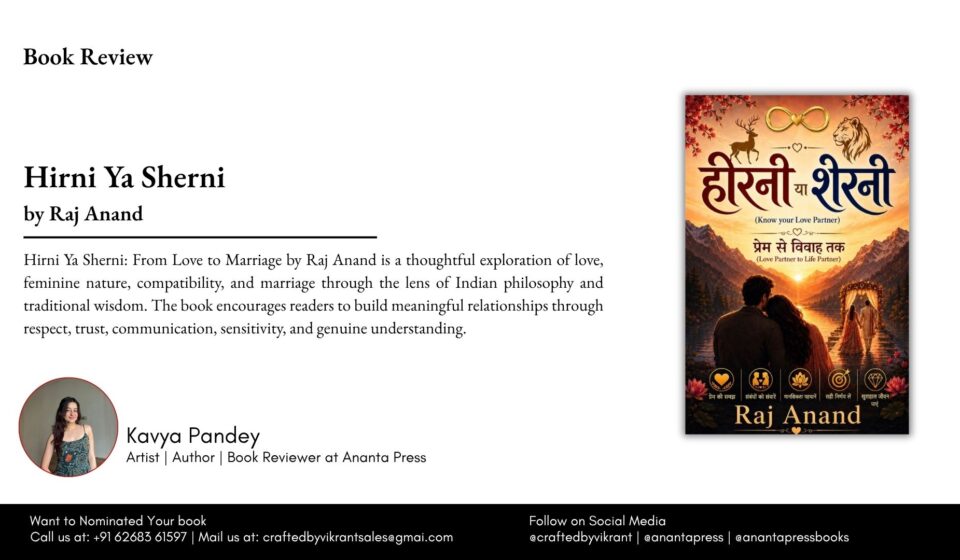

Hirni Ya Sherni: From Love to Marriage
By Raj Anand
Raj Anand’s Hirni Ya Sherni: From Love to Marriage is not merely a book about romantic relationships. It is an extensive exploration of feminine nature, love, compatibility, marriage, Indian philosophical traditions, and the emotional foundations of a successful partnership. Drawing upon traditional Indian texts, cultural ideas, and personal reflection, the author examines how attraction develops into love and how love can mature into a stable and respectful married life.
The book opens with a clear message to readers. The author explains that the classifications and ideas discussed in the book are inspired by traditional Indian sources such as Ratirahasya, Ananga Ranga, Rati Manjari, and other classical works. He also clarifies that these concepts should not be treated as modern scientific conclusions. Rather, they are traditional frameworks intended to encourage self-reflection, mutual understanding, respect, and harmony in relationships. This clarification gives readers a useful perspective from which to approach the book.
One of the book’s greatest strengths is its distinction between attraction and love. Attraction, according to the author, may begin with appearance, personality, speech, confidence, intelligence, or emotional warmth. It may be immediate and temporary. Love, however, develops slowly and rests upon deeper qualities such as trust, patience, communication, respect, loyalty, and emotional commitment.
The book presents love as a gradual journey that moves through several stages: attraction, affection, trust, surrender, emotional unity, separation, and mature love. This progression helps readers understand that long-lasting relationships cannot be built upon physical attraction alone. They require time, emotional honesty, and a willingness to accept the other person fully.
Another important part of the book focuses on the philosophical nature of women. The author describes a woman not only as an individual but also as a symbol of creativity, sensitivity, compassion, strength, memory, and emotional depth. He discusses the physical, emotional, and spiritual dimensions of feminine nature and repeatedly emphasizes that a woman should not be judged only by her appearance or social role.
According to the book, understanding a woman requires patience and emotional awareness. Her silence, memories, fears, expectations, and expressions of affection may communicate much more than spoken words. The author argues that successful relationships begin when a partner stops trying to change the other person and instead makes a genuine effort to understand them.
The title, Hirni Ya Sherni, is symbolic. A woman may possess the gentleness, grace, and sensitivity associated with a deer, while also carrying the courage, resilience, and fierce protective strength of a lioness. These qualities are not presented as contradictions. Rather, they reveal the many dimensions that can exist within one personality.
The book also discusses the traditional Indian classification of women into four broad types: Padmini, Chitrini, Shankhini, and Hastini. These categories are used to explain differences in temperament, emotional expression, energy, behaviour, and relationship needs. The author clearly states that the purpose of such classifications is not to declare one woman superior or inferior to another. Their purpose is to help readers understand that every person has a distinct nature and that compatibility depends upon recognizing and respecting those differences.
A particularly engaging section compares feminine temperaments with the four seasons. The spring-like nature is associated with affection, enthusiasm, creativity, and beauty. The summer-like nature reflects intensity, passion, strength, and resistance to injustice. The autumn-like nature represents balance, maturity, wisdom, and stability. The winter-like nature suggests patience, depth, loyalty, and a strong attachment to family.
The author rightly observes that no woman belongs entirely to a single category. Human beings are complex, and one person may display different qualities at different moments. This idea adds flexibility to the traditional classifications and prevents them from becoming overly rigid.
The book places great emphasis on the importance of respect, trust, communication, patience, and understanding. These are described as the five essential pillars of a lasting relationship. The author argues that love cannot survive for long where respect is absent. Trust gives emotional security, communication prevents misunderstandings, patience allows both individuals to grow, and understanding helps partners accept each other without unnecessary judgment.
The discussion of communication is especially relevant to modern relationships. The author notes that many emotional conflicts arise not from major betrayals but from small acts of neglect, poor listening, unspoken expectations, and a lack of emotional presence. He explains that when a woman expresses pain, she may not always be asking for an immediate solution. Sometimes she simply wants to be heard, understood, and emotionally supported.
The book also points out several common mistakes made by men in relationships. These include misunderstanding silence, dismissing small emotional gestures, focusing only on physical appearance, attempting to solve every problem without listening, and assuming that they already understand their partner completely. The author reminds readers that every person continues to change over time. Therefore, understanding one’s partner is not a one-time achievement but an ongoing process.
Another major theme is the strength of women. The book describes feminine strength as something that often exists quietly within. It may appear through endurance, emotional resilience, patience, intuition, forgiveness, creativity, motherhood, and the ability to manage several responsibilities at once.
The author presents love as one of a woman’s greatest powers. Through care, support, and emotional commitment, she can bring stability and transformation to the lives of those around her. At the same time, the book warns that this emotional generosity should never be exploited or mistaken for weakness.
Motherhood is discussed as one of the deepest expressions of feminine love and sacrifice. The author portrays a mother as someone who not only gives birth but also protects, nurtures, teaches, forgives, and often places the needs of her children before her own. The emotional bond between mother and child is described as one of the purest examples of unconditional love.
The book also examines women’s pain and the ways in which emotional suffering can shape personality. It discusses the pain of one-sided love, neglect, betrayal, separation, loss, and self-erasure. One of the most meaningful ideas in this section is that a woman may continue giving so much to others that she gradually loses her own identity. This observation encourages readers to recognize the importance of emotional balance and self-respect within relationships.
Beyond love and marriage, the book enters a wider social and historical discussion about the treatment of women in Indian society. It refers to practices such as sati, purdah, jauhar, female slavery, and other forms of oppression. Through these examples, the author highlights the painful contradiction between worshipping feminine power symbolically and mistreating women socially.
This historical section expands the scope of the book. It reminds readers that the subject of women’s dignity cannot be limited to private relationships alone. It is also connected with education, freedom, equality, social participation, and the basic right to live with respect. However, because many historical subjects involve different scholarly interpretations, these sections are best read as the author’s perspective and as an invitation for further study.
The spiritual dimension of the book is another distinctive feature. The author frequently uses Sanskrit verses, philosophical reflections, and references to Shakti, Shiva, devotion, sacrifice, and the divine feminine. Womanhood is presented as an expression of creative energy and spiritual power. The book suggests that respecting women is not merely a social duty but also a moral and spiritual responsibility.
The language is emotional, direct, and reflective. Many passages read like personal guidance rather than academic analysis. This makes the book accessible to general readers, especially those interested in Indian philosophy, relationships, spirituality, and traditional wisdom. At the same time, some sections are highly idealistic and may not represent the experiences of every woman or every relationship. Readers will benefit most when they approach these ideas as reflective frameworks rather than fixed rules.
One of the most positive messages of the book is that love should never be based on control or ownership. True love requires trust, dignity, emotional sensitivity, loyalty, and freedom. A partner should not be treated as someone to dominate or reshape. The aim should be to create a relationship in which both people feel safe, heard, valued, and respected.
The book also reminds readers that compatibility does not mean complete similarity. Two individuals may have different temperaments, expectations, habits, and ways of expressing love. A successful marriage depends not upon eliminating these differences but upon understanding how to live with them constructively.
Overall, Hirni Ya Sherni: From Love to Marriage is a thoughtful and wide-ranging book that brings together love, marriage, feminine psychology, Indian tradition, spirituality, social history, and relationship guidance. It encourages readers to look beyond physical attraction and examine the deeper foundations of companionship.
The book is especially suitable for readers who wish to explore relationships through an Indian cultural and philosophical lens. It may also appeal to couples, young adults, and readers interested in emotional compatibility and marital understanding.
Raj Anand’s central message is simple yet meaningful: love becomes successful only when it is supported by respect, trust, communication, patience, and genuine understanding. A woman may be gentle like a deer and courageous like a lioness, but in every form she deserves dignity, empathy, and equal regard.
Rather than offering a final or universal definition of women, love, or marriage, the book invites readers to reflect upon their own attitudes and relationships. Its true value lies in this invitation—to listen more carefully, judge less quickly, communicate more honestly, and build relationships based upon respect rather than possession.