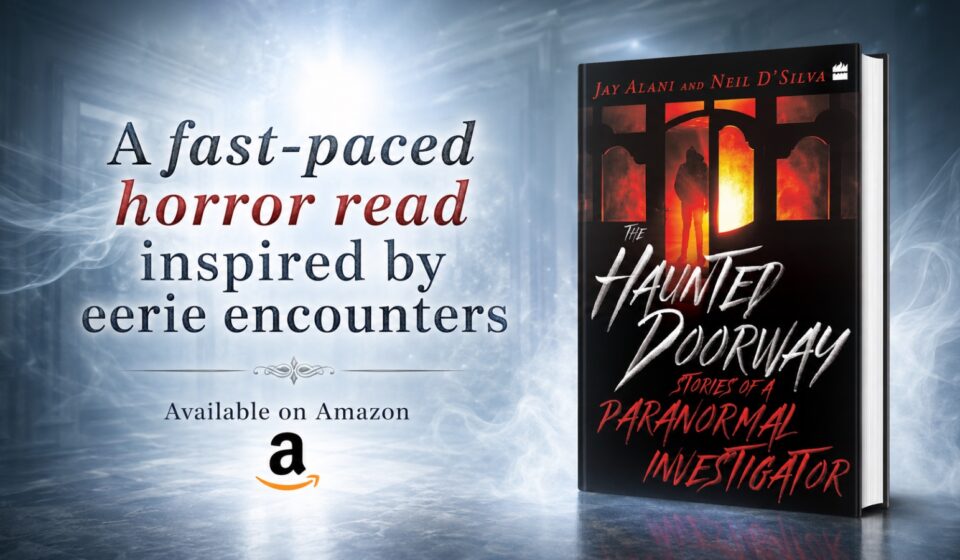

Jay Alani and Neil D’Silva build a fast-moving collection that treats fear as a mystery to investigate rather than a noise to amplify.
The fear that begins after the explanation
The most effective horror does not always arrive with a scream. Sometimes it enters through a reasonable explanation,waits until the reader feels safe, and then quietly leaves one detail unresolved. That is the unsettling territory explored by JayAlani and Neil D’Silva in The Haunted Doorway: Stories of a Paranormal Investigator. The book is presented as a collection often paranormal tales inspired by the work and experiences of a professional investigator. Yet its deepest strength is not simplythat it offers ghosts, entities, dangerous objects, and inexplicable encounters. Its strength lies in the way it repeatedly asks thereader to examine what fear is made of. Is a person being pursued by something outside the self, or is grief, trauma, stress,suggestion, or isolation changing the way reality is experienced? Can a case be explained and still remain frightening? Andwhen every obvious explanation has been tested, what should an honest investigator do with the residue that remains?
A collection shaped by investigation rather than superstition
Many books of supernatural fiction begin by assuming that the ghost is real and then build a plot around that fact. TheHaunted Doorway takes a more interesting route. Its stories move through uncertainty. A strange occurrence becomes a case;a case demands questions; and the answers may lead toward psychology, folklore, deception, environmental causes, orsomething that still resists classification. This investigative structure gives the collection a distinctive rhythm. The reader isnot merely waiting for an apparition to appear. The reader is gathering clues, observing behaviour, considering competingexplanations, and wondering which details matter. That approach reflects the professional identity Jay Alani has built overmore than fifteen years and more than 1,500 investigations. His experience gives the fictional situations a proceduralseriousness, while Neil D’Silva’s storytelling turns that material into accessible, dramatic narratives.
Atmosphere before spectacle
The stories are fast-paced, but the collection does not depend only on sudden shocks. It works through atmosphere: aroom that feels wrong, a presence that may be imagined, an object that becomes the centre of obsession, a recurring image,a sound that has no clear source, or a person whose fear begins to reshape everyone around them. This is why even readerswho do not normally choose horror may find the book approachable. The prose keeps moving, the situations are clearlyestablished, and each story presents a fresh kind of threat. The collection understands that dread is created throughanticipation. The reader is allowed to notice the doorway before being asked what may be standing on the other side.
Ten stories, ten different forms of unease
A short-story collection needs variety, and The Haunted Doorway appears designed around different emotional and culturaltextures of fear. Reader responses have highlighted stories such as The Demonic
Doll, Dead Man’s Fingers, The Woman Who Was Molested by a Demon, The Red Lady’s Ghost, Qarinah, The Wonder Witch ofDreams, The Woman with the Stone Eyes, and the title story itself. Even the names suggest the collection’s range: cursed orthreatening objects, bodily horror, folklore, dream states, spiritual belief, stalking, possession, and encounters that blur theline between a haunted environment and a haunted mind. The stories do not all aim for the same emotional result. Somedisturb, some provoke curiosity, some encourage research beyond the page, and some leave enough ambiguity to keep the reader thinking after the immediate tension has passed.
The mind is not treated as a convenient twist
One of the collection’s most valuable qualities is its refusal to use mental health merely as a last-minute explanationthat dismisses everything a character has experienced. Psychological possibilities are treated as part of the investigation fromthe beginning. Trauma, grief, sleep disturbance, stress, fear conditioning, social influence, and vulnerability can all alterperception without making a person foolish or dishonest. This matters because paranormal narratives often create a falsechoice: either a ghost is real or the witness is unreliable. The Haunted Doorway suggests a more responsible spectrum. Awitness can be sincere and still be mistaken. A psychological explanation can be serious rather than trivial. A case can involve manipulation or medical distress. And, occasionally, a disciplined inquiry may still reach the edge of what can becomfortably explained.
Folklore gives the horror cultural depth
The book’s engagement with Indian, Arabian, European, and Western beliefs expands its imaginative world. Folklore is notused only as decoration. It shapes what characters fear, how communities interpret an event, and which explanations feelpossible to them. A paranormal investigator does not enter a culturally empty room. Every family and neighbourhood carriesinherited stories, religious frameworks, superstitions, local warnings, and memories of earlier incidents. Those beliefs canintensify fear, but they can also contain symbolic knowledge about grief, danger, transgression, and community boundaries.By allowing multiple traditions to enter the collection, the authors create a horror landscape that feels broader than ageneric haunted-house template.
Research makes the strange more convincing
Several readers have described pausing to search for terms, locations, theories, and natural phenomena mentioned inthe stories. That response is significant. Curiosity is one of the book’s major pleasures. A detail such as the fungus associatedwith Dead Man’s Fingers can begin as an eerie image and then become a doorway into botany, decomposition, folklore, orlocal history. Research does not weaken horror; it can sharpen it. The more specific the world becomes, the harder it is todismiss as a vague fantasy. The collection benefits from details that feel observed rather than randomly invented, and thistexture gives the supernatural possibilities greater weight.
The ethics of looking for ghosts
The book also carries an implicit warning about paranormal entertainment. Curiosity can be healthy, but recklessprovocation, trespassing, imitation rituals, and the pursuit of online attention can expose people to very real dangers. Thosedangers may be structural, criminal, medical, psychological, or environmental even when nothing supernatural occurs. JayAlani’s public work, including a paranormal awareness helpline, suggests an approach based on responsibility rather thansensationalism. The stories echo that position: investigation requires patience, consent, observation, and a willingness torecommend practical help. Fear should not be monetised at the expense of vulnerable people.
A strong entry point into Indian horror fiction
For experienced horror readers, The Haunted Doorway offers the pleasure of recognising familiar traditions while seeingthem filtered through Indian settings, field experience, and contemporary psychological awareness. For first-time horrorreaders, its short-story format makes the genre less intimidating. Each narrative offers a complete experience, and themovement from one case to another prevents any single premise from becoming exhausting. The simple, engaging style keepsthe focus on the event, the witness, and the investigation. The result is a book that can be read quickly but invites slower reflection.
A visual and cinematic reading experience
The collection also has a strongly visual quality. Doors, dim rooms, silhouettes, dolls, unfamiliar organic forms, andcharged domestic spaces are easy to imagine, which makes the stories feel suited to adaptation. That visual clarity mayreflect Jay Alani’s work as a filmmaker and Neil D’Silva’s instinct for scene construction. Yet the images do not exist only forspectacle. A doorway becomes a boundary between safety and exposure. A face becomes frightening because it cannot beread. A familiar room becomes unstable when one detail changes. The book understands that horror is often created byaltering an ordinary image rather than inventing an entirely new world. This cinematic quality makes the collection easy topicture, but reading retains an advantage over film: the reader supplies the darkness, the sound, and the exact shape of whatmay be present. The unseen becomes personal, and therefore more difficult to escape.
Final verdict
The Haunted Doorway succeeds because it understands that the unknown is most powerful when the known has beentaken seriously. Jay Alani and Neil D’Silva do not ask readers to abandon reason in order to feel fear. Instead, they use reasonas part of the suspense. Every explanation closes one door and may reveal another. The collection is atmospheric, accessible,research-informed, and varied enough to hold attention across ten cases. It is particularly well suited to readers who enjoyparanormal podcasts, psychological mysteries, folklore, investigative horror, and stories that resist a simple division between belief and disbelief. Read it for the entities and eerie encounters, but remember it for the questions it leaves behind.
https://www.amazon.in/Haunted-Doorway-Stories-Paranormal-Investigator/dp/936989652X