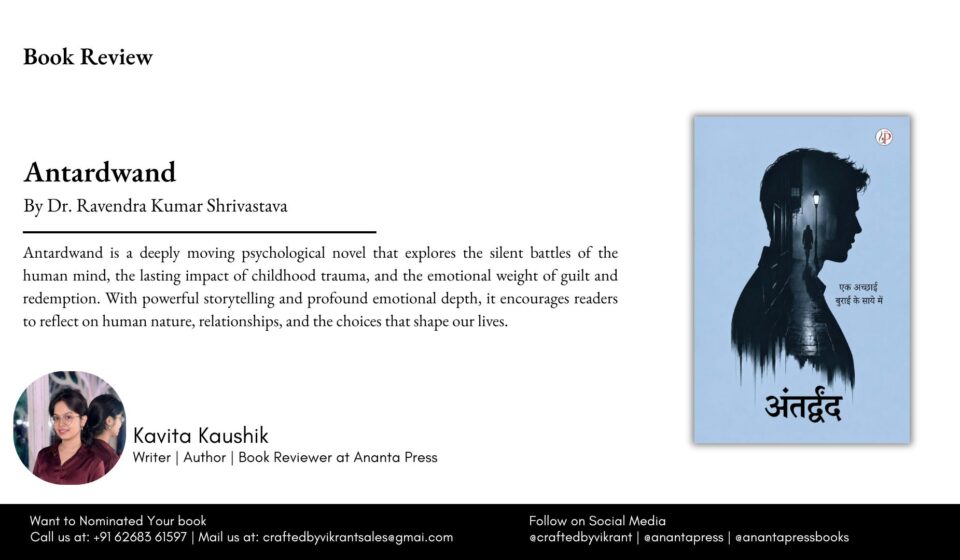

By Dr. Ravendra Kumar Shrivastava
There are novels that entertain, and there are novels that leave a lasting impression on the reader’s mind. Antardwand (Inner Conflict) belongs to the latter category. Written by Dr. Ravendra Kumar Shrivastava, this deeply psychological and emotionally compelling novel explores the hidden struggles of the human soul. It is not merely the story of a man sentenced to death; it is a profound exploration of memory, childhood trauma, loneliness, guilt, love, regret, and the silent battles that shape a person’s destiny.
The novel opens inside a prison cell, where the protagonist awaits his execution. Rather than focusing on the crime alone, the author invites readers into the character’s mind, where memories begin to unfold one by one. As the protagonist reflects upon his past, readers witness how a single painful childhood experience gradually transforms his personality, relationships, beliefs, and eventually his life. This narrative approach immediately distinguishes Antardwand from conventional crime fiction. Instead of asking “What happened?”, the novel asks the much more meaningful question: “Why did it happen?”
One of the book’s greatest strengths is its remarkable psychological depth. Dr. Shrivastava demonstrates an exceptional understanding of human emotions and behavior. The protagonist is neither portrayed as a perfect hero nor as a simple villain. Instead, he is presented as a deeply flawed yet profoundly human individual whose actions emerge from years of emotional neglect, silent suffering, broken trust, and unresolved pain. This complexity makes the character realistic and emotionally relatable. Readers may not justify his actions, but they certainly understand the emotional journey that led him there.
The novel also presents a powerful commentary on childhood experiences and their lifelong consequences. A seemingly small incident during the protagonist’s childhood becomes the emotional foundation upon which his entire personality develops. Through this narrative, the author reminds us that emotional wounds often remain invisible but can influence decisions, relationships, and identities for decades. The story emphasizes that silence, neglect, and emotional abandonment can sometimes leave deeper scars than physical violence.
Another remarkable aspect of Antardwand is its exploration of morality. The novel refuses to divide humanity into simple categories of good and evil. Instead, it suggests that every individual carries conflicting emotions, contradictory desires, and hidden vulnerabilities. The title itself—Antardwand (Inner Conflict)—perfectly captures this central theme. Every chapter reveals another layer of the protagonist’s conscience, allowing readers to witness the continuous struggle between compassion and anger, hope and despair, forgiveness and revenge.
The author’s writing style deserves special appreciation. The language is elegant, reflective, and emotionally rich without becoming unnecessarily complicated. Descriptions are vivid, allowing readers to visualize both the external settings and the internal emotional landscape of the characters. The prison cell, childhood memories, family relationships, and moments of emotional isolation are all depicted with remarkable sensitivity. The pacing is calm and deliberate, encouraging readers to absorb every emotional detail rather than rushing through the plot.
Beyond its psychological dimension, the novel also examines broader social issues. It raises important questions about parenting, emotional communication, loneliness, justice, and society’s tendency to judge individuals only by their final actions instead of understanding the experiences that shaped them. Rather than defending crime, the book encourages empathy by exploring the circumstances that often precede destructive choices. It reminds readers that understanding human behavior requires looking beyond surface-level judgments.
One of the most emotionally powerful aspects of the novel is the relationship between the protagonist and his mother. Their bond is filled with love, disappointment, silence, longing, and emotional distance. This relationship becomes the emotional core of the narrative and symbolizes the lasting influence that family relationships have on personal identity. The author handles these emotional conflicts with maturity and realism, making the story deeply moving.
The philosophical reflections scattered throughout the novel add another layer of richness. As the protagonist confronts death, he also confronts himself. Questions about guilt, forgiveness, identity, destiny, and personal responsibility emerge naturally through his memories rather than through forced philosophical discussions. This subtle integration of introspection makes the novel intellectually engaging as well as emotionally satisfying.
Readers who appreciate psychological fiction, literary novels, character-driven narratives, and emotionally layered storytelling will find Antardwand especially rewarding. It is not a fast-paced thriller designed merely to create suspense. Instead, it is a thoughtful literary work that encourages contemplation long after the final page has been turned. Every chapter gradually deepens the reader’s understanding of the protagonist while simultaneously inviting reflection on one’s own emotions, relationships, and moral choices.
Dr. Ravendra Kumar Shrivastava deserves recognition for creating a novel that successfully combines psychological realism, emotional authenticity, and philosophical depth. His ability to portray the complexities of the human mind demonstrates both literary skill and profound insight into human nature. The narrative never attempts to sensationalize suffering; instead, it presents pain with honesty, dignity, and compassion.
In conclusion, Antardwand is an exceptional psychological novel that explores the fragile balance between goodness and darkness within every human being. It reminds us that behind every action lies a story, behind every silence lies an emotion, and behind every judgment lies a life filled with unseen struggles. Thought-provoking, emotionally powerful, and beautifully written, this novel stands as an important contribution to contemporary Hindi literature. It is a book that deserves to be read slowly, reflected upon deeply, and remembered long after its final chapter. Highly recommended for readers who value meaningful literature that touches both the heart and the mind.