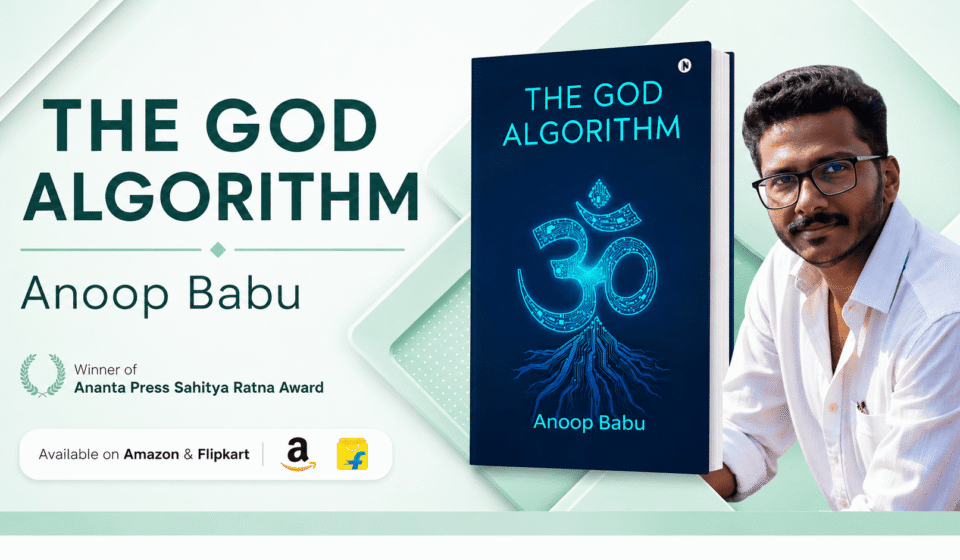

THE GOD ALGORITHM | Anoop Babu | Fiction (General)
There are novels that entertain, novels that provoke, and a smaller group of novels that attempt to function as intellectual meeting places. The God Algorithm by Anoop Babu belongs most naturally to the third category. It is presented as a work of general fiction, but its ambitions reach well beyond the boundaries usually associated with that label. At its centre lies a techno-thriller framework: a group of students, a modern college campus, escalating social and political tensions, and the emergence of artificial intelligence as a force powerful enough to appear almost divine. Yet the machinery of suspense is not the book’s ultimate destination. The thriller is the vessel; the philosophical inquiry is the cargo.
The novel’s most striking premise is also its most imaginative strength. It asks readers to picture the great temperaments of human history—the saint, the scientist, the poet, the warrior, the rebel, the ascetic, and the practitioner of non-violence—not as distant icons protected by the glass of history, but as young people sharing classrooms, arguments, friendships, anxieties, and responsibilities on a contemporary campus. This move gives the book a rare dramatic possibility. Philosophies that are usually encountered in quotations, textbooks, scriptures, biographies, or commemorative speeches are placed under pressure. They are not merely explained; they are challenged by the immediate problems of the present.
That present is recognizable. The world of The God Algorithm is shaped by speed, noise, division, moral exhaustion, and technological acceleration. Its questions are familiar to anyone who has wondered whether human judgment is keeping pace with human invention. Artificial intelligence can process information, recognize patterns, generate language, and influence decisions at a scale that may exceed the understanding of ordinary citizens. But can it tell us what deserves to be protected? Can it distinguish efficiency from justice? Can it understand sacrifice, compassion, conscience, or spiritual responsibility? The book’s title compresses these anxieties into two words. “God” suggests ultimate authority, creation, omniscience, and moral judgment. “Algorithm” suggests procedure, calculation, data, and repeatable logic. Placing them together creates a productive tension that powers the entire concept.
What makes the novel especially relevant is that it refuses the simplest response to technology. It does not appear interested in declaring artificial intelligence either a miraculous saviour or an uncomplicated villain. Instead, it places AI inside a larger crisis of direction. The danger is not merely that machines may become powerful. The deeper danger is that human beings may hand over power after losing confidence in their own moral maps. Science can describe what is possible. Politics can organize competing interests. Spiritual traditions can preserve wisdom. Yet each of these systems can also become rigid, fragmented, or misused. The novel therefore asks a harder question: when every available map seems incomplete, how should humanity choose a direction?
The campus setting is a wise choice for such an inquiry. A college is a place where ideas are still alive enough to be argued about and identities are still fluid enough to change. Students stand between inheritance and possibility. They carry the beliefs of families, communities, and histories, but they are also exposed to new information, new friendships, and new contradictions. Mar Athanasius College of Arts thus becomes more than a backdrop. It is a miniature republic of competing visions. Within its boundaries, the personal can become political, the philosophical can become urgent, and an abstract debate about AI can become a decision with consequences for humanity.
Anoop Babu’s professional and literary background adds another layer of interest to this project. The author’s life combines the analytical discipline of auditing with a sustained engagement in poetry, philosophy, and speculative fiction. That combination is well suited to a novel built around the meeting of calculation and imagination. An auditor looks for structures, inconsistencies, risks, and accountability; a poet looks for resonance, ambiguity, human feeling, and the truth that cannot be reduced to a balance sheet. The God Algorithm appears to draw energy from both habits of mind. It wants to examine systems, but it also wants to ask what systems cannot measure.
The philosophical heart of the book is likely to appeal especially to readers who enjoy fiction that continues working after the plot has moved forward. The archetypal figures suggested by the premise encourage comparison rather than passive admiration. The saint and the rebel may agree about injustice but differ on method. The scientist and the ascetic may both seek truth while disagreeing about evidence. The warrior and the advocate of non-violence may share courage but define action differently. The poet may recognize emotional realities that the algorithm overlooks. These tensions give the novel the potential to turn debate into drama. Instead of presenting one voice as automatically correct, the story can show how wisdom emerges through encounter, friction, and self-correction.
The book is also distinctive because its method of creation reflects its subject. The God Algorithm is described as a conversation born from collaboration between a human author and an AI co-author. That fact is not a decorative marketing detail; it is formally connected to the novel’s central concern. A book about the relationship between ancient human wisdom and new machine intelligence has itself been shaped through a human-machine exchange. The reader is therefore invited to evaluate AI collaboration not only as a theme inside the story but as a creative process embodied by the story. This gives the novel a self-reflective quality uncommon in conventional techno-thrillers.
Such ambition brings challenges, and they are worth acknowledging because they reveal the seriousness of the undertaking. A novel containing multiple philosophical positions, contemporary political anxieties, social injustice, spirituality, theoretical questions, and technological danger risks becoming overly crowded. The success of this kind of work depends on maintaining a balance between ideas and characters. Readers need enough conceptual depth to feel that the questions matter, but they also need emotional stakes, human vulnerability, and narrative momentum. The strongest feature of the premise is that it recognizes this need by wrapping a philosophical core in thriller form. Suspense can prevent reflection from becoming static, while philosophy can prevent suspense from becoming disposable.
For general readers, the book offers several possible entry points. Those drawn to artificial intelligence will find a narrative concerned with power, ethics, and the future. Those interested in Indian philosophical thought will recognize a search for moral orientation grounded in traditions that have long examined duty, action, selfhood, and the consequences of desire. Readers of campus fiction can engage with the energy of young minds confronting institutional and social pressures. Admirers of speculative fiction can appreciate the movement from a local setting to a choice that may determine the fate of humanity. This multiplicity is one reason the novel stands out: it is not dependent on a single genre promise.
The title also deserves praise for its memorability. The God Algorithm immediately creates curiosity because it sounds both spiritual and technological, ancient and futuristic, reverent and unsettling. It raises questions before the first page is opened. Is the algorithm treated as a god by those who trust it? Is it an attempt to encode ultimate truth? Is it a warning about the human tendency to worship systems? Or does it suggest that reality itself contains an intelligible pattern linking consciousness, morality, and creation? A strong title does not merely identify a book; it opens a field of expectation. This one does exactly that.
Ultimately, The God Algorithm is valuable because it treats the crisis of artificial intelligence as a humanistic crisis. It understands that the future will not be decided by technical capacity alone. The decisive questions will concern purpose, restraint, justice, courage, compassion, and responsibility. By bringing symbolic heirs of great historical philosophies into a contemporary campus and forcing them to confront a seemingly god-like technology, Anoop Babu creates a framework in which old wisdom is neither worshipped blindly nor discarded casually. It is tested.
The novel’s uniqueness lies in this fusion: a philosophical conclave, a youthful campus narrative, a techno-thriller escalation, an Indian intellectual foundation, and a human-AI collaborative origin. Few books attempt to make all these elements speak to one another. Whether readers approach it for suspense, ideas, spirituality, or curiosity about AI-authored literature, they are likely to leave with the book’s central question still alive in them: when knowledge expands faster than wisdom, who—or what—should choose the direction?
Purchase on Amazon: https://amzn.in/d/0h5eoaSK