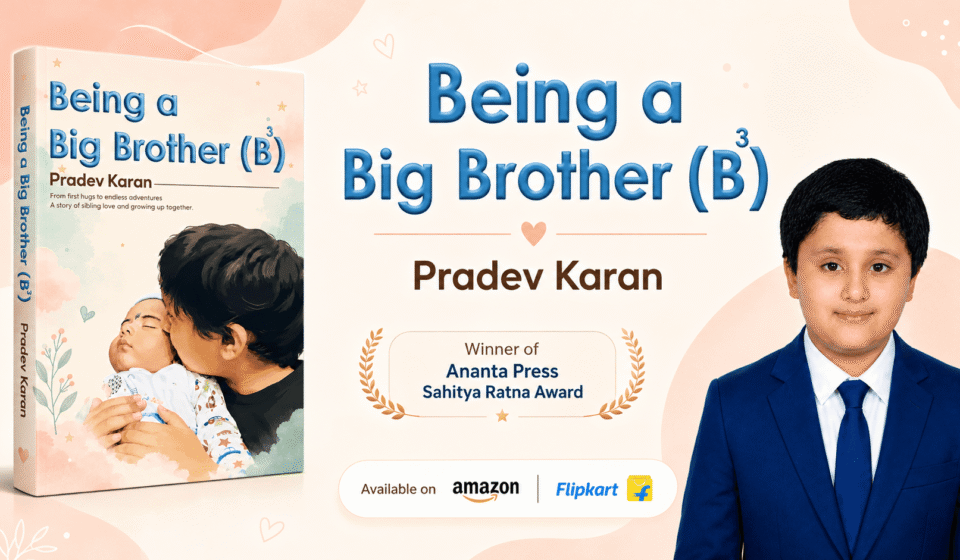

There is something unusually moving about a child choosing to record family life not as a fantasy, a moral fable, or an assignment, but as lived experience. Being a Big Brother by Pradev Karan is remarkable first because of its subject and then because of the perspective through which that subject is presented. The arrival of a younger sibling is one of the earliest major changes a child can experience. It alters routines, attention, responsibility, identity, and even the meaning of home. Adults often describe this transition from the outside, explaining what an elder child ought to feel or how a family should help that child adjust. Pradev approaches it from within. He writes as the elder brother himself, allowing readers to encounter affection, confusion, pride, disagreement, humour, jealousy, learning, and emotional growth as parts of one continuing relationship.
That directness gives the book its greatest strength: authenticity. The stories are rooted in ordinary family moments, yet the emotions beneath them are universal. A playful memory can carry a lesson about patience. A disagreement can reveal how difficult it is to share attention or space. A family outing can become a lesson in cooperation. A small act of care can show how responsibility develops long before a child has the vocabulary to define it. Because the material comes from a young author’s own life, the book does not need to manufacture dramatic events in order to hold meaning. Its world is the world children actually inhabit: conversations, misunderstandings, laughter, travel, daily routines, family decisions, and the gradual discovery that love is not merely a feeling but also a practice.
The title itself is especially effective. Being a Big Brother does not present brotherhood as a completed achievement or a fixed role. The word “being” suggests an ongoing process. An elder sibling is not born with perfect patience, wisdom, or selflessness. He learns through experience. He makes mistakes, reacts emotionally, notices the consequences of his behaviour, and slowly grows into a deeper understanding of another person. This makes the book reassuring for young readers. It does not ask them to be ideal siblings from the beginning. Instead, it shows that family relationships are built through repeated efforts to listen, forgive, include, protect, and begin again.
Pradev’s age makes this perspective even more valuable. At eleven, he is close enough to the experiences he describes to preserve their emotional texture. His memories have not been softened into adult nostalgia or reshaped into lessons that sound too polished. The appeal lies in the feeling that a child is speaking honestly to other children and, at the same time, opening a window for adults. Young readers can recognise themselves in the mixture of affection and frustration that often defines sibling life. Parents can see how family changes may be interpreted by a child, even when that child does not immediately express every feeling aloud. In that sense, the book becomes a bridge between generations.
The tone suggested by the book’s premise is another of its notable qualities. It is warm without becoming sentimental, instructive without sounding like a lecture, and emotional without losing playfulness. Children respond best to stories that respect their intelligence and emotional complexity. Being a Big Brother appears to do precisely that. It acknowledges that joy and difficulty can exist together. A child may love a younger sibling deeply and still feel irritated. He may be proud to help and still wish for freedom. He may understand a family rule one day and resist it the next. Rather than treating these contradictions as failures, the book presents them as part of growing up.
This emotional honesty also supports the book’s themes of empathy and resilience. Empathy is often taught as a simple instruction: be kind, share, think of others. Pradev’s approach makes it more concrete. Empathy develops when a child begins to imagine what a sibling needs, notices the effect of words and actions, and learns that another person’s feelings matter even when they differ from his own. Resilience, likewise, is not presented only through extraordinary hardship. It can be seen in the willingness to recover from a quarrel, adjust to changed circumstances, or keep participating in family life after disappointment. These are small acts, but they form the foundation of emotional maturity.
The book’s value extends beyond homes with two children. Only children may gain insight into sibling relationships. Teachers and school counsellors may find it useful as a conversation starter about family roles, feelings, and responsibility. Parents expecting another child may use it to introduce the idea of becoming an elder sibling without presenting the change as either entirely easy or entirely frightening. Families can read sections together and discuss their own memories, disagreements, and moments of care. Because the narrator is a child, such discussions may feel less formal and more inviting.
Another quality that makes the book distinctive is its celebration of ordinary memory. Modern childhood is often documented through photographs and videos, yet the emotional meaning of events can still disappear quickly. By turning everyday experiences into written stories, Pradev demonstrates that a family’s history is not made only of birthdays, awards, and major milestones. It is also made of jokes repeated at the dinner table, minor arguments, travel mishaps, shared discoveries, and gestures of affection that may seem small at the time. The act of writing preserves these moments and helps readers recognise the richness of their own lives.
The author’s personal journey strengthens the book’s message. Completing a nonfiction work at eleven while balancing school, activities, and community involvement reflects discipline as well as creativity. Yet the achievement does not feel separate from the book’s subject. His involvement in service and awareness initiatives, together with the values of compassion and responsibility described in his family environment, naturally supports the sensitivity visible in his chosen themes. He is not simply presenting himself as a young achiever; he is using his voice to honour relationships and encourage other children to trust their observations.
Perhaps the most important contribution of Being a Big Brother is that it treats a child’s inner world as worthy of literature. Children are often spoken about, guided, assessed, and represented by adults. Pradev instead speaks for himself. His book quietly argues that young people do not need to wait until adulthood before their experiences become meaningful. Their stories already contain insight, humour, tenderness, and truth. By sharing his bond with his younger sister, Preetha, he gives readers a personal account of brotherhood while also making a larger statement about the value of children’s voices.
Being a Big Brother stands out as a sincere, accessible, and emotionally intelligent work of general nonfiction. Its uniqueness does not come from complexity of plot or elaborate language, but from the clarity of its purpose and the honesty of its narrator. It invites children to reflect on how they love, how they grow, and how they contribute to family life. It invites parents to listen more carefully. Most of all, it reminds every reader that the smallest family moments can carry the deepest lessons. Pradev Karan’s debut is therefore not only a record of becoming an elder brother; it is a celebration of childhood as a time of genuine thought, feeling, responsibility, and creative possibility.
Purchase the book on Amazon: https://amzn.in/d/0bT3hytF