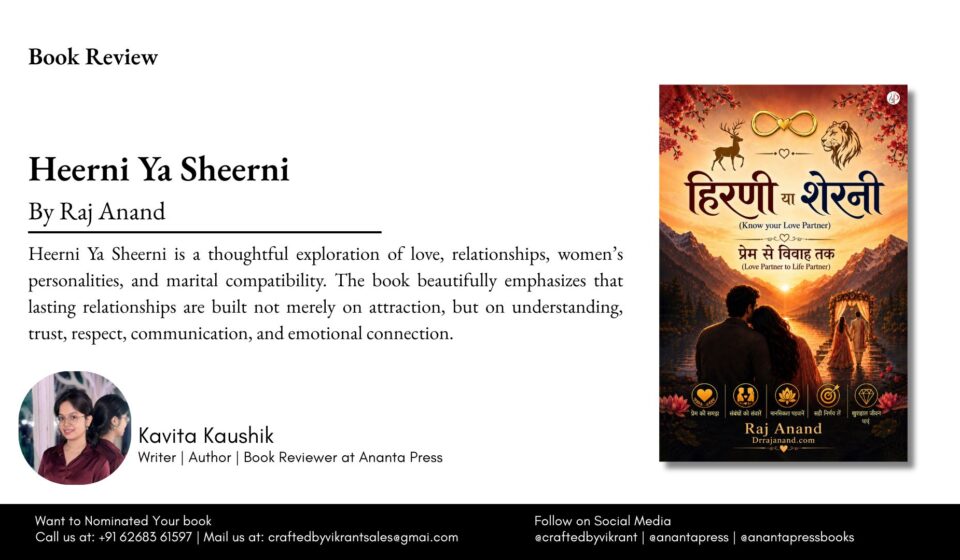

Heerni Ya Sheerni is a thoughtful and distinctive exploration of women, relationships, love, personality, emotional compatibility, and self-understanding. Rather than presenting relationships as something based only on attraction or external qualities, the book encourages readers to look deeper into personality, emotional needs, communication, mutual understanding, and the different ways people experience love and companionship.
One of the most interesting aspects of the book is its attempt to understand human personality through different personality types and their characteristics. The book presents various feminine and masculine personality patterns and explores how these characteristics can influence relationships. Through these descriptions, readers are encouraged to understand that every individual has a different emotional nature, way of thinking, strengths, weaknesses, expectations, and approach toward relationships. This makes the book particularly interesting for readers who want to understand not only others but also themselves.
At its heart, Heerni Ya Sheerni is a book about understanding. It asks readers to move beyond superficial judgments and recognize that a person’s personality is made up of many different layers. Some people may be gentle, emotional, artistic, and affectionate, while others may be strong, practical, responsible, independent, or leadership-oriented. The book shows that none of these qualities is necessarily better than another. What matters is how these qualities are expressed and how they interact with the personality of another person.
The discussion of different feminine personality types is especially noteworthy. The book presents women as individuals with diverse emotional and psychological characteristics rather than placing them into a single definition. Some personalities are portrayed as graceful and affectionate, others as creative and intellectually curious, while others are shown as strong, protective, determined, and powerful. This variety gives the reader an opportunity to think about the complexity of personality and the many forms that strength and femininity can take.
For example, the description of the Chitrini personality highlights creativity, intelligence, communication, curiosity, imagination, and an appreciation for literature, music, and art. Such a personality may seek not only romantic affection but also meaningful intellectual and emotional connection. At the same time, the book also recognizes possible challenges such as restlessness, idealism, or difficulty maintaining stability. This balanced approach—presenting both strengths and weaknesses—makes the personality discussion more relatable.
Similarly, the portrayal of the Hastini personality emphasizes stability, motherhood, protection, responsibility, and loyalty. However, the book does not suggest that strength should mean endless sacrifice. One of its meaningful ideas is that strength also includes knowing when to respect oneself. This is an important message because relationships should not require a person to lose their identity or continuously tolerate situations that diminish their self-worth. The book suggests that responsibility and protection become healthier when they are accompanied by self-care and emotional balance.
The portrayal of the Shankhini personality offers another important perspective. This personality is associated with courage, leadership, confidence, strength, and a powerful presence. Yet the book makes an insightful distinction between strength and control. True strength, according to the book’s underlying message, is not about dominating others but about achieving balance. When confidence is combined with compassion, leadership with humility, and strength with sensitivity, a powerful personality can become an inspiring one.
These observations make Heerni Ya Sheerni more than a simple discussion of personality categories. The book repeatedly returns to the importance of balance. Strength needs sensitivity. Love needs understanding. Responsibility needs self-respect. Confidence needs humility. Emotional connection needs communication. In this sense, the book’s central message can be applied far beyond romantic relationships.
Another major strength of the book is its focus on compatibility. The chapters dedicated to marital compatibility attempt to give readers a structured way of thinking about how different personalities may interact. The book introduces compatibility ratings and matching systems, ranging from highly compatible relationships to relationships requiring greater understanding and mutual development. It even presents examples of different male-female personality combinations and assigns compatibility scores to them.
While readers may approach such classifications differently, the broader idea behind the compatibility discussion is valuable: successful relationships require more than simply liking another person. Two people may be attracted to each other and still struggle if their expectations, emotional styles, communication patterns, or values are very different. Conversely, people with different personalities can sometimes build strong relationships when they understand and respect those differences.
The book’s compatibility framework is therefore most interesting when viewed as a tool for reflection rather than as an absolute formula. The ratings and matching examples provide a structured language for discussing compatibility, while the deeper message encourages mutual understanding and development. The book recognizes that some relationships may naturally feel harmonious, while others may require greater patience, communication, and effort. Its compatibility system categorizes relationships from exceptional compatibility to combinations where significant understanding may be needed.
This emphasis on mutual development is particularly relevant. No relationship is completely effortless, and even highly compatible couples can face disagreements, misunderstandings, changing circumstances, and emotional challenges. A healthy relationship is not necessarily one without differences; it is one in which both individuals learn how to deal with those differences constructively.
Another appealing quality of Heerni Ya Sheerni is that it does not limit its discussion to romantic attraction. It connects relationships with identity, self-respect, emotional security, and personal growth. The book suggests that understanding oneself is an important step toward understanding another person. This idea becomes especially significant in the later discussion of self-awareness or aatmabodh. The book describes self-awareness as knowing oneself and connects it with inner peace, self-respect, acceptance, reduced fear, and compassion.
This movement from understanding others to understanding oneself gives the book a broader philosophical dimension. Love and self-knowledge are not presented as completely separate paths. Instead, the book suggests that meaningful love can coexist with personal awareness and that genuine understanding of oneself can contribute to healthier relationships.
The connection between love and knowledge is another thoughtful element. The book considers whether the paths of knowledge and love are truly different and ultimately suggests that they can lead toward a similar form of understanding. This idea adds depth to a book that otherwise focuses heavily on personality and compatibility. It reminds readers that relationships are not merely about finding the “right” person; they are also about becoming more aware of one’s own emotional world.
One of the strongest messages that emerges from the book is the importance of self-respect. In many relationships, people can become so focused on fulfilling responsibilities or keeping others happy that they forget their own needs. Heerni Ya Sheerni encourages a healthier perspective in which caring for others does not require abandoning oneself. This is particularly evident in its discussion of the Hastini personality, where responsibility is balanced with self-care and protection is distinguished from excessive sacrifice.
The book can therefore appeal to a wide range of readers. Young adults may find it useful while thinking about love and marriage. Married couples may discover ideas that encourage them to understand each other’s personalities more carefully. Readers interested in psychology, relationships, Indian traditions, personality analysis, or self-development may also find several points of reflection.
What makes the book particularly engaging is the way it combines traditional personality concepts with a modern discussion of relationships. It attempts to connect ideas about personality and compatibility with contemporary concerns such as emotional security, communication, self-respect, personal identity, and mutual growth. This combination gives the book a distinctive character.
At the same time, readers should approach the personality classifications thoughtfully. Human beings are complex, and no individual can always be completely represented by a single category. People change with age, experience, relationships, environment, and circumstances. Personality frameworks can be useful for reflection, but real relationships remain more complicated than any chart or compatibility score. In this respect, the book works best when its classifications are used as prompts for understanding rather than rigid labels.
The compatibility examples are one of the book’s most visually and conceptually structured features. For instance, the book presents combinations such as Shashaka-Padmini, Ashwa-Chitrini, and Vrishabha-Hastini with high compatibility scores, while other combinations are described as more challenging. These examples give readers a simple way to engage with the concept of compatibility and may encourage couples to think about their own strengths and differences.
Ultimately, Heerni Ya Sheerni is not simply a book about identifying the “perfect” partner. Its deeper value lies in encouraging readers to ask better questions: What kind of person am I? What do I need emotionally? What qualities do I value in another person? How do I communicate? How do I respond to differences? Can I maintain my self-respect while caring for someone else? And what does a truly balanced relationship look like?
The book’s message is particularly relevant in a time when relationships are often judged quickly on the basis of attraction, appearance, social expectations, or compatibility on the surface. Heerni Ya Sheerni encourages a slower and more thoughtful approach. It reminds readers that lasting companionship requires emotional understanding, respect, patience, communication, and willingness to grow together.
In conclusion, Heerni Ya Sheerni is an interesting and reflective book that brings together personality, relationships, compatibility, love, and self-awareness. Its discussions of different personality types offer readers a framework for thinking about individual differences, while its compatibility analysis encourages deeper reflection on marriage and companionship. Most importantly, the book emphasizes balance—between strength and compassion, responsibility and self-care, love and individuality, and connection and self-respect.
For readers interested in relationships and human personality, this book offers plenty of ideas to think about and discuss. Its greatest takeaway is perhaps that a successful relationship is not created simply by finding someone who appears perfect, but by developing the understanding, respect, emotional maturity, and self-awareness necessary to build a meaningful partnership. Heerni Ya Sheerni ultimately invites its readers to look beyond appearances and discover the deeper qualities that make relationships truly fulfilling.