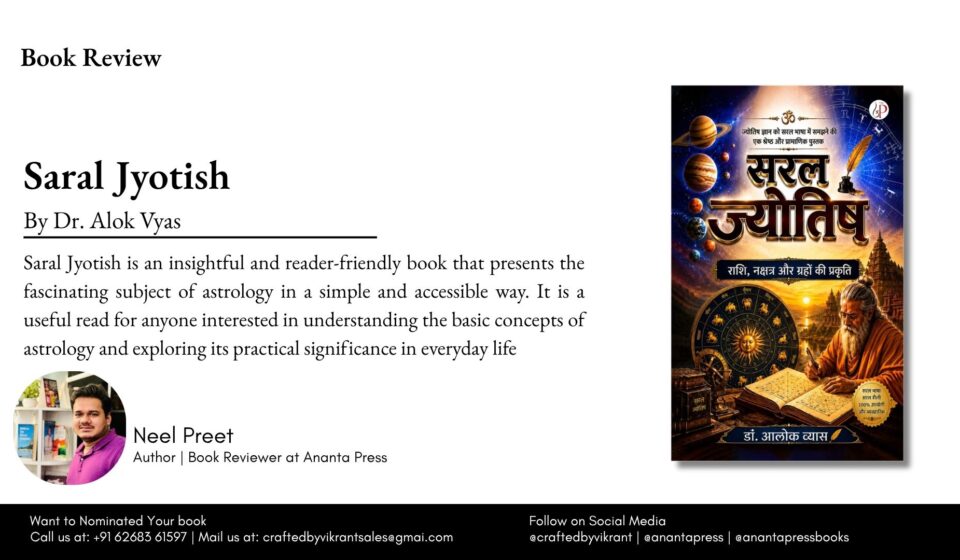

Saral Jyotish by Dr. Alok Vyas is an ambitious and thoughtfully structured book that attempts to present the vast and traditional subject of Vedic astrology in a simple, accessible, and practical manner. Rather than treating astrology merely as a system of predictions, the book approaches it as a framework through which readers can explore personality, tendencies, strengths, challenges, career possibilities, spiritual inclinations, and the influence of celestial bodies on human life. The author’s intention, as expressed in the preface, is to make the deeper principles of astrology understandable to young readers, students, researchers, and anyone curious about this ancient discipline.
One of the most appealing aspects of Saral Jyotish is its organization. The book is divided into three major conceptual sections: the twelve zodiac signs or Rashis, the twenty-seven Nakshatras, and the nine Navagrahas. This three-part structure gives the book a clear progression, beginning with broader personality patterns and gradually moving toward more detailed astrological concepts. The contents section shows that each Rashi receives its own dedicated treatment, followed by an extensive exploration of all twenty-seven Nakshatras and then individual chapters on the nine planets.
The first section, devoted to the twelve Rashis, is particularly reader-friendly. Each sign is introduced through its symbolic identity, ruling planet, element, nature, associated Nakshatras, personality characteristics, strengths, weaknesses, professional possibilities, health-related associations, important astrological features, and suggested traditional remedies. For example, Aries is presented as an energetic beginning, associated with courage, initiative, leadership, and action, while Taurus is discussed through themes of stability, creativity, patience, material comfort, and persistence. Gemini is connected with communication, curiosity, adaptability, and intellectual activity, while Cancer emphasizes sensitivity, emotional depth, nurturing, and intuition.
A notable strength is that the author does not present any sign as being entirely positive or negative. Every Rashi is discussed through both its strengths and its limitations. This makes the descriptions more balanced and gives readers an opportunity for self-reflection. Aries, for instance, is associated with courage and leadership but is also cautioned against anger, impatience, and impulsiveness. Taurus is described as patient and dependable but potentially stubborn or resistant to change. Gemini’s intelligence and communication skills are balanced by warnings about indecision, lack of concentration, and overthinking. This approach makes astrology feel less like a fixed label and more like a way of examining different aspects of personality.
Another useful feature is the book’s attention to professional life. Instead of limiting astrological descriptions to personality traits, the author connects different signs with possible areas of work. Aries, for example, is associated with fields such as defence, engineering, medicine, sports, and entrepreneurship. Taurus is connected with education, administration, agriculture, finance, music, and design. Gemini is linked with writing, journalism, technology, programming, marketing, public relations, and astrology. Such examples make the discussion more practical and may be particularly interesting to younger readers who are exploring their interests and career possibilities.
The second major section, dealing with the twenty-seven Nakshatras, adds considerably more depth to the book. Here the discussion moves beyond the twelve broad zodiac signs into a more detailed system of astrological interpretation. Each Nakshatra is given a distinctive theme and symbolic identity. Ashwini, for example, represents movement, healing, and new beginnings; Bharani emphasizes transformation, discipline, and creative energy; Krittika is associated with purification, strength, and sharp intellect; Rohini represents creativity, beauty, and stability; and Mrigashira is connected with curiosity, exploration, and the search for knowledge.
The Nakshatra section is perhaps where the book becomes most interesting for readers who already have some familiarity with astrology. The author explores not only the symbolic meanings of the Nakshatras but also their associated Rashis, planetary rulers, deities, symbols, personality strengths, weaknesses, career possibilities, and traditional remedies. For example, Ashwini is described as possessing speed, healing ability, courage, and an inclination toward modern ideas, while its challenges include impatience and a tendency to move too quickly from one task to another. Mrigashira is similarly portrayed as intellectually curious and versatile, but potentially restless and indecisive.
The symbolism used throughout the Nakshatra section is another interesting element. The author frequently uses traditional symbols to make abstract astrological ideas easier to visualize. Ardra, represented by a tear drop or diamond, is connected with transformation and purification. Punarvasu symbolizes the return of light and hope. Anuradha uses the lotus as an image of growth through difficult circumstances, while Mula uses roots as a metaphor for searching beneath the surface and discovering fundamental truths. These symbolic associations give the book a philosophical dimension beyond simple horoscope descriptions.
The final major section focuses on the nine Navagrahas: Sun, Moon, Mars, Mercury, Venus, Jupiter, Saturn, Rahu, and Ketu. This section provides an overview of what each planetary force traditionally represents and how its influence is interpreted in Vedic astrology. The Sun is associated with the soul, authority, confidence, and vitality; the Moon with the mind, emotions, and nurturing qualities; Mars with courage and action; Mercury with intellect and communication; Venus with beauty, love, relationships, and artistic expression; Jupiter with wisdom, dharma, learning, and expansion; Saturn with time, discipline, karma, and justice; Rahu with ambition, unconventional thinking, technology, and illusion; and Ketu with detachment, intuition, spirituality, and liberation.
The planetary chapters are especially valuable because they continue the book’s pattern of presenting both positive and challenging dimensions. Jupiter, for example, is described as the planet of wisdom, ethics, higher learning, prosperity, and guidance, but the book also notes that excessive optimism, rigidity, or intellectual ego can become problematic. Saturn is presented not simply as a difficult planet but as a teacher of patience, discipline, responsibility, and maturity. Rahu represents ambition, technological ability, unconventional thinking, and transformation, while its negative side can involve confusion, shortcuts, excessive desire, or instability. Ketu, meanwhile, is presented as a symbol of intuition, research, detachment, and spiritual development, while its challenging side can manifest as isolation or excessive withdrawal.
One of the book’s strongest qualities is its emphasis on remedies and constructive action. Almost every Rashi, Nakshatra, and planet is accompanied by traditional suggestions involving prayer, mantra, charity, service, meditation, respect for elders, environmental care, or other forms of positive conduct. Importantly, many of these suggestions go beyond ritual and encourage ethical or compassionate behavior. For example, the discussion of Saturn emphasizes respect for workers and helping people who perform difficult manual work, while several Nakshatra remedies encourage environmental service, assistance to others, or respect for teachers and elders. This gives the book a moral and reflective dimension.
The writing also repeatedly encourages readers to understand their qualities rather than simply blame destiny. The author’s message in the preface is particularly significant: astrology is presented as a means of understanding one’s foundation and directing hidden abilities toward the right path. The book therefore attempts to connect astrological interpretation with self-awareness and personal development. Its underlying message is that knowledge of one’s tendencies should ideally lead to better decisions and more conscious action.
From a reader’s perspective, the greatest strength of Saral Jyotish is accessibility. Astrology can often appear intimidating because of its specialized terminology, numerous planetary relationships, technical calculations, and traditional concepts. Dr. Alok Vyas attempts to reduce that barrier by dividing the subject into clearly defined sections and explaining each concept through recognizable themes such as personality, career, strengths, weaknesses, lifestyle, and remedies. The recurring format also makes it easier for readers to compare different Rashis or Nakshatras.
The book is also likely to appeal to different categories of readers. A beginner can use it as an introductory guide to the basic vocabulary of Vedic astrology, while a more experienced reader may appreciate the detailed treatment of Nakshatras and planetary influences. Students and researchers can also find value in its systematic organization, while general readers may simply enjoy reading about the symbolic and psychological characteristics associated with different signs and Nakshatras.
At the same time, readers should approach the book within the framework of astrology as a traditional belief and interpretive system rather than treating its astrological or health-related statements as scientific or medical diagnoses. The book itself presents astrology as systematic and structured, but individual readers may interpret its claims differently depending on their own beliefs and perspectives. This is particularly important when the text discusses health associations or traditional remedies.
Overall, Saral Jyotish is a comprehensive and accessible introduction to the world of Vedic astrology. Its greatest achievement lies in bringing together the twelve Rashis, twenty-seven Nakshatras, and nine Navagrahas in one organized volume while maintaining a practical focus on personality, career, challenges, strengths, and traditional remedies. The book does more than list astrological characteristics; it repeatedly invites readers to reflect on their own behavior, abilities, responsibilities, and spiritual direction.
Dr. Alok Vyas has created a book that can serve as a useful starting point for readers who want to explore astrology without immediately becoming overwhelmed by its complexity. The systematic structure, symbolic explanations, practical examples, and reflective messages make the book approachable and engaging. For readers interested in Vedic astrology, self-exploration, traditional wisdom, and the relationship between cosmic symbolism and human nature, Saral Jyotish offers a substantial and thought-provoking reading experience.
In conclusion, Saral Jyotish succeeds in making a traditionally complex subject considerably more approachable. It combines astrological concepts with discussions of personality, profession, strengths, weaknesses, spirituality, and traditional practices, creating a broad introduction to the subject. Whether read for curiosity, cultural interest, personal reflection, or an initial study of Vedic astrology, the book provides plenty of material to explore. Its central message is perhaps its most meaningful one: understanding one’s tendencies is valuable, but the real purpose of knowledge is to use that understanding wisely and consciously in life.