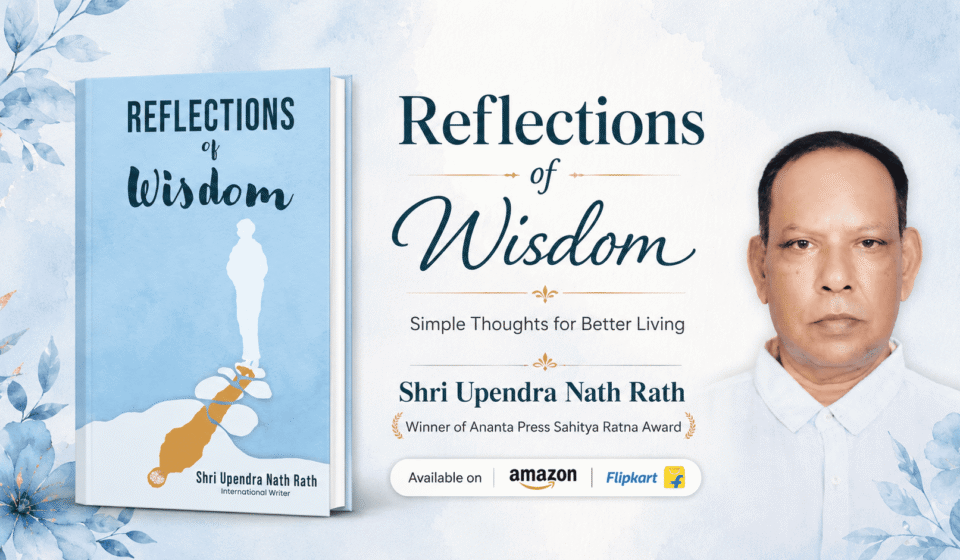

There are books that try to impress readers with complexity, and there are books that try to improve the way readers live. Reflections of Wisdom, by Shri Upendra Nath Rath, belongs to the second tradition. Its stated focus is simple yet unusually important: healthy living, manners, ways of living, and social behavior. These themes may sound familiar, but that familiarity is precisely why they deserve renewed attention. The most essential principles of a good life are often not hidden in difficult theories; they are found in ordinary habits, choices, attitudes, and relationships. Reflections of Wisdom invites readers to look at those ordinary areas with greater awareness.
The title itself is well chosen. “Reflections” suggests that the book is not merely interested in giving commands. It encourages readers to think, observe, and examine themselves. “Wisdom” suggests knowledge that has been tested by experience rather than knowledge that exists only in theory. Taken together, the title prepares the reader for a work concerned with practical understanding. The book’s subject matter reinforces that impression. Healthy lifestyle, manners, personal conduct, and social behavior are all subjects that become meaningful only when ideas are translated into action.
One of the strongest qualities of the book is the breadth of its practical concerns. A healthy lifestyle cannot be reduced to physical fitness alone. A person may be physically disciplined and still suffer from poor relationships, careless habits, impatience, social isolation, or a lack of purpose. In the same way, manners are not merely about formal etiquette. At their best, manners are visible expressions of respect: how we speak, how we listen, how we disagree, how we treat people who cannot benefit us, and how we behave in shared spaces. By placing lifestyle, manners, living practices, and social behavior within one field of reflection, the book points toward a more holistic idea of well-being.
This holistic quality makes Reflections of Wisdom particularly relevant in contemporary life. People today have access to an enormous amount of information, but information does not automatically create judgment. We can know what is healthy and still fail to practice it. We can understand the importance of kindness and still speak harshly. We can admire discipline and still live without routine. We can speak about community while becoming increasingly disconnected from neighbors, elders, children, nature, or public responsibility. A book centered on everyday wisdom becomes useful because it asks readers to return from abstract awareness to lived behavior.
The author’s background gives this project an additional dimension. Shri Upendra Nath Rath spent decades as an English teacher in Kendriya Vidyalaya and has long been associated with Scouts and Guides, training programs, education, social service, plantation drives, cleanliness initiatives, and support for disadvantaged people. That life of teaching and civic involvement helps explain why a book about conduct and healthy living feels like a natural extension of his experience. He is not approaching the subject only as an observer. His biography reflects a sustained engagement with students, institutions, communities, and service. For a work concerned with manners and social behavior, such experience matters because these values are learned not only from books but also from repeated participation in real communities.
His academic background is equally notable. He has pursued postgraduate studies in English, History, Political Science, Human Resource Development, and Education. These areas collectively expose a person to language, culture, institutions, human motivation, social systems, and teaching. That combination is especially suitable for reflective nonfiction. A reader does not need an academic treatise on each of these disciplines, but the author’s wide educational journey likely contributes to the broad human perspective behind the book’s central concerns.
What makes Reflections of Wisdom distinctive is that it deals with values that cross age groups. A book about social behavior may be useful to young readers developing their identity, but it is equally relevant to adults who have become too busy to examine their habits. A book about manners may help students and professionals, parents and teachers, community leaders and retirees. A book about healthy living can speak to anyone who wants to create balance rather than simply chase achievement. This wide applicability is important because many self-improvement books are designed for a narrow audience. Reflections of Wisdom, by contrast, is grounded in universal areas of daily life.
Another quality worth appreciating is the moral seriousness of the project. “Moral” here does not need to mean moralizing. There is a difference between preaching at a reader and asking a reader to think about the consequences of personal behavior. The themes of the book naturally raise questions: What kind of habits strengthen a person? What kind of conduct creates trust? What does respectful behavior look like in families, schools, workplaces, and communities? How should personal health relate to social responsibility? What kind of life leaves others better rather than merely more impressed? These are not outdated questions. They are permanent questions that become even more urgent in periods of rapid social change.
The book also gains meaning from the author’s connection with nature. His biography emphasizes a love for flora, fauna, birds, animals, and the village atmosphere, while his public activities include large plantation drives. This connection suggests a vision of healthy living that is larger than individual comfort. A healthy way of life includes the environment in which we live. Clean surroundings, care for nature, reduced waste, respect for shared resources, and awareness of the living world are forms of both personal discipline and social behavior. When lifestyle is understood in this broader way, it becomes part of citizenship.
This is where Reflections of Wisdom can be especially valuable for educational settings. Teachers and parents often want young people to develop discipline, empathy, responsibility, and good habits, but these values are difficult to teach through rules alone. Reflection gives values a personal foundation. When readers understand why a habit matters, they are more likely to adopt it sincerely. The author’s long career in education makes the book’s subject particularly fitting for students, teachers, and families who want to discuss character beyond examination scores.
At the same time, the book should not be seen only as a school-oriented work. Adults may find its themes even more challenging because adulthood often normalizes unhealthy patterns. Busyness becomes an excuse for poor routine. Stress becomes an excuse for harsh communication. Professional status becomes an excuse for arrogance. Digital connection replaces real attention. Social media rewards display more than depth. Under such conditions, a work that returns to manners, balance, respect, and thoughtful conduct can function as a mirror. Its value lies in reminding readers that success without self-discipline and social sensitivity can be incomplete.
The author’s record of service strengthens this message. His involvement in helping fire victims, supporting free teaching for economically disadvantaged students, conducting awareness activities, and working in community welfare shows that social behavior is not only about politeness. It is also about responsibility. Good manners without compassion can become superficial. Healthy living without concern for others can become self-absorption. Wisdom, in a fuller sense, requires the ability to connect personal well-being with collective well-being.
For readers, one of the best ways to approach Reflections of Wisdom is slowly. A reflective book does not always need to be consumed in one sitting. Its ideas can be read, considered, discussed, and revisited. A reader may find one observation especially relevant to family life, another to workplace communication, another to health, and another to community participation. This kind of reading turns a book into a companion rather than a one-time experience.
The book’s uniqueness therefore lies less in promising a dramatic formula and more in returning attention to foundational values. In a publishing environment filled with quick-fix solutions, there is something refreshing about a work that treats everyday conduct as worthy of serious thought. The habits that shape a life are often small: how one begins the day, speaks to another person, treats public spaces, responds to difficulty, cares for the body, manages anger, honors commitments, or contributes to society. A book that helps readers examine those details may have a quieter but more lasting influence than one built around fashionable slogans.
Reflections of Wisdom is best understood as a work of practical, values-oriented nonfiction. It is suitable for readers interested in self-improvement, personal discipline, character, education, social responsibility, and meaningful living. Its core message appears to be that wisdom must be visible in behavior. Thought becomes valuable when it improves life; education becomes valuable when it refines character; and personal growth becomes meaningful when it strengthens one’s relationship with others and with the world.
Shri Upendra Nath Rath’s long experience as a teacher, Scout leader, social contributor, and advocate of peace and community welfare gives the book a credible human foundation. His reflections emerge from a life in which education and service have repeatedly intersected. For that reason, Reflections of Wisdom has the potential to appeal not only to readers looking for advice but also to those looking for perspective. It reminds us that a good life is not built in a single heroic moment. It is built through repeated choices—healthy, respectful, responsible, and humane.
For readers who believe that wisdom should be practical, that manners still matter, that health includes social and emotional balance, and that individual conduct influences the wider community, Reflections of Wisdom offers a timely and meaningful reading experience.
Amazon / Purchase Link: https://share.google/vXOiJuSkHlGvVx2ny