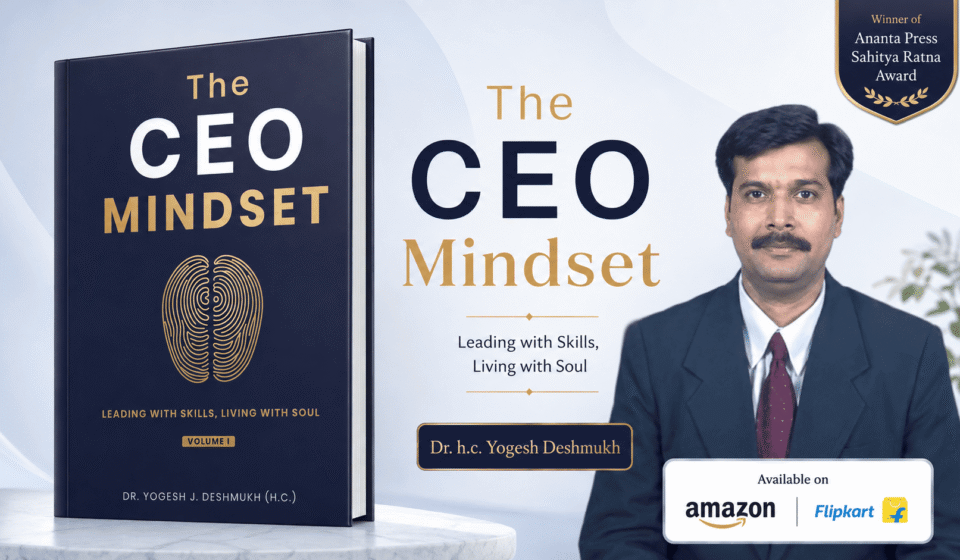

Leadership books often begin with a promise of acceleration: become more decisive, build a sharper strategy, increase performance, dominate the market, or learn the habits of high achievers. The CEO Mindset: Leading with Skills, Living with Soul, Volume I takes a notably different route. Dr. h.c. Yogesh Deshmukh does not reject competence, ambition, discipline, or business performance; instead, he argues that these qualities become incomplete when they are separated from the human being who must carry them. The result is a management book that asks readers to examine leadership not merely as a professional role but as a personal practice shaped by values, emotional awareness, integrity, humility, and presence.
The central strength of the book is its refusal to accept the old myth of the invulnerable executive. Corporate culture has often celebrated the leader who always appears certain, energetic, composed, and in control. Yet the more complex an organisation becomes, the less realistic that image is. Leaders work with incomplete information, conflicting priorities, exhausted teams, demanding stakeholders, technical constraints, ethical dilemmas, and consequences that cannot always be predicted. Deshmukh’s premise is that a leader remains a human being in the middle of all this complexity. That observation may sound simple, but it has profound implications. If leaders are human, then empathy, self-awareness, listening, emotional resilience, and moral courage are not decorative qualities. They are part of the architecture of effective leadership.
This is where the book’s subtitle becomes especially meaningful. “Leading with Skills, Living with Soul” is not a slogan placed beside conventional management advice; it expresses the book’s governing tension. Skills matter because organisations need clarity, execution, systems, accountability, and expertise. Soul matters because people do not experience leadership as a spreadsheet. They experience it through conversations, decisions, conflicts, encouragement, fairness, trust, and the atmosphere created by those in authority. By bringing these dimensions together, the book offers a more complete picture of executive effectiveness.
Deshmukh’s professional background gives this argument unusual credibility. With more than three decades of experience across railway signalling, high-speed rail, metro systems, software engineering, renewable energy, and large infrastructure programmes, he writes from environments where leadership cannot remain abstract. In safety-critical and multidisciplinary projects, a small communication failure or unresolved interface can create consequences far beyond a single department. Such work requires technical intelligence, but it also requires people to cooperate across specialisations, organisations, responsibilities, and cultures. The author’s exposure to companies such as Siemens Mobility, Hitachi Rail, Bombardier, and GE’s John F. Welch Technology Center reinforces the sense that his ideas emerge from lived complexity rather than from motivational theory alone.
One of the book’s most compelling ideas is that leadership becomes visible in ordinary pressure points. A leader is revealed not only in a boardroom presentation or a celebrated strategic announcement, but in the late-night meeting when patience is thin, in the response to a serious error, in the way a fatigued team is treated, and in whether uncomfortable information is welcomed or punished. This shift in emphasis is valuable because it moves leadership from image to behaviour. Titles can be granted; presence must be practiced. Authority may produce compliance; trust has to be earned. A strategic plan may be technically correct; its execution still depends on people feeling secure enough to communicate risk, challenge assumptions, and take responsibility.
The discussion of truth to power is particularly relevant. Many organisational failures are not caused by a complete absence of expertise. They happen because information does not travel honestly. Employees may notice a problem but hesitate to raise it. Middle managers may soften bad news. Senior leaders may unintentionally create a culture in which optimism is rewarded more than accuracy. By stressing listening, transparency, and humility, The CEO Mindset points toward a healthier model of authority: one in which a leader’s strength is demonstrated by the ability to receive reality, not merely to project certainty.
Another quality that distinguishes the book is its understanding of success as “sustainable significance” rather than a short-term victory. The phrase captures an important difference. Success can be measured in targets, revenues, deadlines, promotions, or market share. Significance asks what remains after the numbers are reported. Did the organisation become more trustworthy? Did people grow? Were decisions ethically defensible? Was capability built for the future? Did the leader leave behind stronger systems and stronger human relationships? This broader frame prevents the book from becoming a collection of executive tactics. It encourages readers to ask what kind of institution their leadership is creating and what kind of person they are becoming while creating it.
The book is also timely because contemporary leaders operate in conditions where authority alone is increasingly insufficient. Technology evolves rapidly, employees expect greater transparency, multidisciplinary collaboration is normal, public accountability is immediate, and disruption can come from unexpected directions. In such an environment, a rigid command-and-control style may produce speed in the short term but can weaken adaptability. Teams need psychological room to share expertise, question assumptions, and learn. The CEO Mindset therefore treats empathy and emotional intelligence not as softness but as capabilities that improve organisational awareness and resilience.
Readers from management backgrounds will appreciate the book’s practical orientation, while readers from technical professions may find its synthesis especially useful. Engineers, project managers, programme leaders, entrepreneurs, functional heads, and senior executives frequently reach a stage where technical excellence alone no longer determines effectiveness. The higher the responsibility, the more leadership depends on integrating disciplines, negotiating differences, communicating purpose, and creating trust among people who may not report directly to one another. Deshmukh understands this transition intimately. His career across complex infrastructure and technology gives the book a natural bridge between the language of systems and the language of human behaviour.
The book’s uniqueness lies in that bridge. There is no shortage of writing about emotional intelligence, nor is there a shortage of books on business strategy. What is less common is an account that treats the analytical and emotional dimensions as mutually necessary rather than competing approaches. The engineer and the empath can occupy the same mind. A leader can insist on standards while remaining compassionate. A CEO can be commercially ambitious while also being a custodian of culture. Precision and humanity do not cancel each other; at their best, they strengthen one another.
The CEO Mindset also avoids presenting leadership as a final destination. Its emphasis on continuous learning is important because executive responsibility can create the illusion that seniority equals completion. In reality, increasing authority often increases the need for reflection. The leader’s assumptions affect more people, and personal blind spots can become organisational blind spots. A mindset of learning therefore becomes a governance advantage. Leaders who remain curious are more capable of revising outdated beliefs, integrating new knowledge, and noticing changes before they become crises.
For readers seeking a step-by-step manual promising instant transformation, this book may feel more reflective than formulaic. That is precisely part of its value. Leadership cannot be reduced to a checklist because context matters and human beings are not predictable components. The book invites readers to think, examine, and align rather than merely imitate. It asks them to consider whether their outer authority is supported by inner clarity.
Ultimately, The CEO Mindset is a thoughtful contribution to contemporary management literature because it expands the definition of leadership without weakening its demands. It still respects strategy, competence, execution, and accountability. But it insists that these qualities become more durable when grounded in character. Dr. h.c. Yogesh Deshmukh presents the CEO not as an untouchable figure at the top of a hierarchy, but as a person whose decisions shape both systems and lives. The strongest leaders, in this view, do more than build organisations. They create conditions in which people, purpose, and performance can grow together.
That is what makes the book relevant beyond the C-suite. Anyone responsible for people, projects, decisions, or institutional outcomes can recognise the challenge at its heart: how to remain effective without becoming mechanical, ambitious without becoming disconnected, and authoritative without losing the capacity to listen. By holding skills and soul in the same frame, The CEO Mindset offers a leadership philosophy that feels both demanding and deeply humane.
Purchase on Amazon: https://www.amazon.in/dp/9371399201