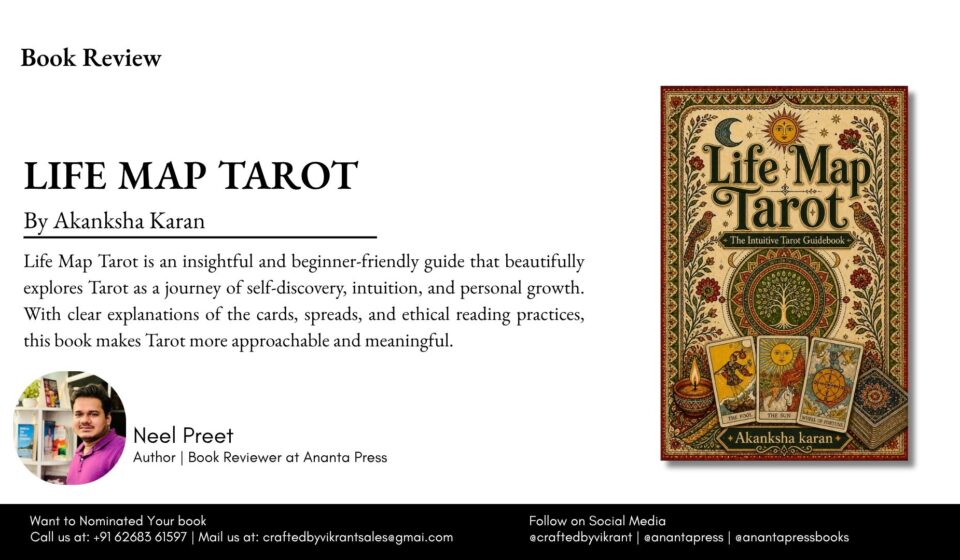

Life Map Tarot: The Intuitive Tarot Guidebook by Akanksha Karan is much more than a conventional handbook explaining the meanings of Tarot cards. It is a carefully structured introduction to Tarot as a language of symbols, intuition, reflection, and personal awareness. Rather than presenting Tarot as a mysterious method of predicting an unavoidable future, the book consistently encourages readers to see the cards as a means of observing their present circumstances, emotional patterns, choices, and inner responses. This central philosophy gives the book both its accessibility and its distinctive character. The title and authorship identify it clearly as an intuitive guidebook, and that description accurately reflects the experience it offers.
One of the strongest aspects of Life Map Tarot is the way it welcomes the reader into a subject that can initially appear complicated or intimidating. The opening chapters avoid overwhelming beginners with dozens of definitions. Instead, the author first establishes what Tarot represents. Tarot is described not merely as fortune-telling but as a symbolic language, an inner mirror, and a bridge between intuition and understanding. The book also makes an important distinction between exploring possibilities and assuming that the future is permanently fixed. This idea becomes a foundation for everything that follows.
That perspective is further strengthened when the book addresses some of the misconceptions surrounding Tarot. Akanksha Karan acknowledges its historical association with mystery and prophecy but takes the reader beyond those stereotypes. The discussion of Tarot’s development—from early European playing cards to its later association with esoteric traditions and the influential Rider-Waite imagery—provides useful context without allowing history to overshadow the book’s practical purpose. Particularly refreshing is its insistence that Tarot should be thought of less as a fixed script for the future and more as a mirror reflecting possibilities, patterns, and influences in the present.
The organization of the book is another major strength. The manuscript moves progressively from introductory ideas to the structure of the deck, the Major and Minor Arcana, connecting with a deck, reading techniques, spreads, intuition, ethics, personal growth, detailed individual card interpretations, and finally practical tips for readers. Its sixteen-chapter structure gives beginners a logical path through a large amount of material without forcing them to absorb everything at once.
The explanation of the Tarot deck itself is especially clear. Readers learn that a traditional deck contains seventy-eight cards, divided into twenty-two Major Arcana cards and fifty-six Minor Arcana cards. The Major Arcana are introduced through the symbolic journey beginning with The Fool and concluding with The World, representing significant themes, turning points, and stages of development. This makes the cards easier to understand as part of a larger narrative rather than as seventy-eight isolated definitions.
The Minor Arcana receives similarly thoughtful treatment. Cups, Swords, Wands, and Pentacles are connected with different dimensions of everyday experience. Cups relate to emotion and connection; Swords to thought and truth; Wands to action and creative energy; and Pentacles to practical and material concerns. The book’s explanation that the Major Arcana represents the larger journey while the Minor Arcana reflects the lived details of that journey is particularly effective. It helps readers understand why seemingly ordinary cards can be as meaningful as dramatic Major Arcana cards.
What makes Life Map Tarot genuinely useful for beginners, however, is its refusal to reduce Tarot reading to memorization. Many introductory guides unintentionally create anxiety by presenting long lists of keywords that readers feel they must remember before attempting a reading. Karan takes the opposite approach. She explains that knowledge provides vocabulary, but a meaningful reading depends on interpretation, connection, and awareness. Readers are encouraged to look at the imagery, notice what attracts their attention, observe their emotional response, and connect what they see with the question being asked.
This approach creates a healthier relationship between traditional meanings and personal intuition. The book does not tell readers to ignore established Tarot symbolism. Instead, it encourages them to use traditional knowledge as a foundation from which intuitive interpretation can develop. That balance is one of the guidebook’s most valuable qualities.
The chapter on connecting with a Tarot deck continues this philosophy. Rather than making the relationship with the cards seem inaccessible or dependent on elaborate rituals, the author describes connection as something created through familiarity, attention, repetition, and trust. She also recognizes that different decks appeal to different readers and advises beginners to choose imagery that feels visually and intuitively understandable to them. This is practical advice because Tarot is fundamentally visual; a reader is naturally more likely to develop intuitive associations with imagery that genuinely speaks to them.
Another excellent section concerns the formulation of questions. Karan makes the important observation that a reading begins before the cards are actually drawn. The quality of the question influences the depth of the reflection that follows. Instead of vague questions seeking certainty, the book recommends open-ended questions that explore what a person needs to understand, what energy surrounds a decision, or what can be learned from an experience. This subtly shifts Tarot away from passive prediction and toward active self-examination.
The chapter on Tarot spreads is equally practical. Spreads are presented not merely as arrangements of cards but as frameworks for organizing thought, emotion, and intuition. Readers are given simple practices such as a one-card daily insight as well as structured multi-card layouts, and they are reminded that spreads can be adapted rather than followed rigidly. This flexibility is important because it prevents the reader from becoming dependent on formulas and instead encourages a more natural development of reading style.
Perhaps the most mature aspect of Life Map Tarot is its attention to ethics. Many introductory Tarot books devote enormous space to card meanings while giving comparatively little attention to the responsibility involved in interpreting cards for another person. Karan takes that responsibility seriously. She notes that words used during a reading can influence how someone views their circumstances and themselves. Readers are therefore advised to avoid absolute predictions, fear-based statements, unnecessary dependency, and interpretations that remove another person’s sense of choice.
The discussion of privacy and boundaries adds further credibility. The guidebook encourages readers to recognize when a question is outside their ability to interpret responsibly, to respect the privacy of people receiving readings, and to approach sensitive issues without judgment. This is not simply good Tarot practice; it is good interpersonal practice. It reinforces the book’s larger message that Tarot should increase awareness and empowerment rather than fear or helplessness.
The personal-growth dimension of the book becomes especially clear in the later conceptual chapters. Tarot is repeatedly described as a mirror capable of revealing patterns, emotions, avoidance, imbalance, and perspectives that might otherwise remain unnoticed. The section on Tarot journaling is particularly useful because it transforms individual readings into a longer process of reflection. Readers are encouraged to record their questions, cards, interpretations, and connections to current circumstances and then revisit those entries later to observe how their understanding has changed. This turns Tarot into an ongoing reflective practice rather than a collection of isolated readings.
The detailed interpretation chapters also make the volume valuable as a reference book. After building conceptual foundations, Karan spends substantial space on the Major Arcana and then on Wands, Swords, Cups, and Pentacles. This structure means that the reader can initially move through the book as a course and later return to it as a guide during actual readings. That dual function—learning resource and practical reference—significantly increases its usefulness.
Stylistically, the book is direct and approachable. Complex spiritual or symbolic concepts are usually translated into understandable language rather than surrounded by unnecessary mysticism. Short reflective questions, practical examples, keywords, and structured explanations break the material into manageable sections. Readers completely unfamiliar with Tarot are therefore given a relatively gentle entry point, while readers with some previous experience may find the intuitive and ethical sections useful for refining how they approach readings.
If there is one challenge inherent in a guide this comprehensive, it is the sheer amount of material contained in the later card-by-card sections. A new reader may be tempted to consume all the meanings quickly. Yet the book’s own philosophy offers the solution: it repeatedly encourages practice rather than mechanical memorization. Life Map Tarot works best when read slowly, with a deck nearby, allowing knowledge and experience to develop together.
The conclusion beautifully returns to the central idea with which the journey began. By the end, Tarot is presented not as something that controls a person’s path but as a practice that can help them observe themselves more clearly. The closing pages emphasize that the cards do not possess the reader’s future; instead, they offer perspective, reflection, and a language through which thoughts, feelings, choices, and patterns can be examined. The book ultimately suggests that while the cards themselves remain unchanged, the person learning to look at them—and through them, at life—may change considerably.
Overall, Akanksha Karan’s Life Map Tarot is an accessible, thoughtful, and impressively comprehensive guide for anyone wishing to understand Tarot without becoming trapped either in rigid memorization or sensational ideas about fortune-telling. Its greatest strength is its balance: history and practice, structure and intuition, symbolism and self-reflection, spiritual openness and personal responsibility all coexist within the same framework.
For beginners, it offers a clear pathway into the seventy-eight-card system. For developing readers, it provides spreads, interpretive methods, ethical guidance, and detailed meanings to return to repeatedly. And for readers interested primarily in self-awareness rather than prediction, it offers perhaps its most valuable lesson: the purpose of Tarot is not necessarily to tell us exactly what will happen next, but to help us see more clearly what is happening within us now.