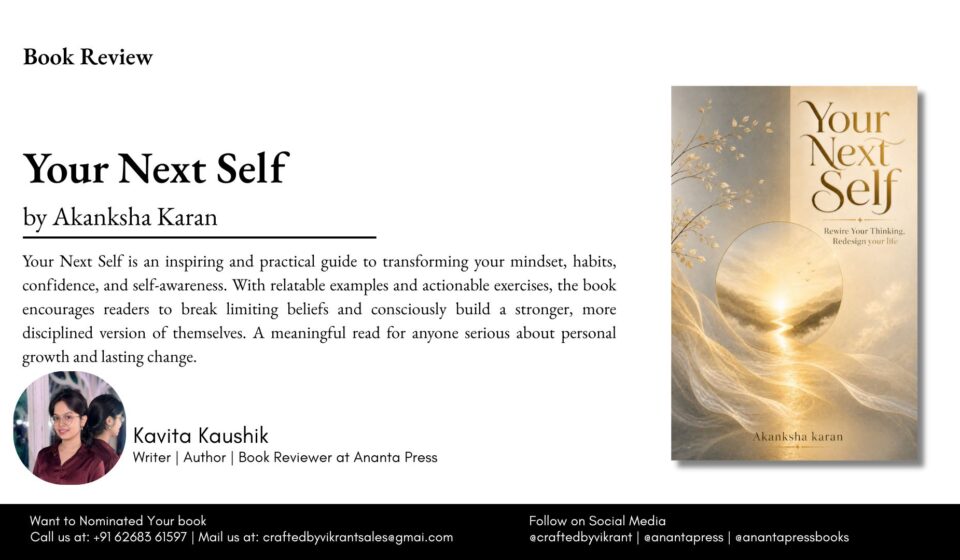

Your Next Self: Rewire Your Thinking, Redesign Your Life by Akanksha Karan is a practical and thoughtfully structured self-development book that focuses on one of the most important questions a person can ask: How do I become a better version of myself in a way that actually lasts? Rather than treating personal transformation as a temporary burst of motivation, the book presents change as a gradual process involving mindset, self-awareness, habits, emotional control, discipline, identity, and consistent action. Its 25 chapters take the reader through different areas of personal development, beginning with mindset and eventually arriving at the larger idea of becoming a consciously redesigned version of oneself.
What immediately makes Your Next Self engaging is its accessibility. The author does not begin with complicated theories or overwhelming psychological terminology. Instead, many chapters open with simple situations involving ordinary people facing recognizable struggles—self-doubt, procrastination, lack of confidence, emotional reactions, distraction, failure, stress, and uncertainty. These examples make the ideas feel relevant because readers are likely to recognize some part of their own behavior in them. The book is written less like an academic manual and more like a conversation with someone trying to understand why change is difficult and what can practically be done about it.
The opening discussion on mindset establishes the foundation for everything that follows. The book makes an important distinction between circumstances and the interpretation we give those circumstances. It describes mindset not merely as positive thinking, confidence, or motivation, but as an internal system through which people interpret their reality. The author explains that repeated beliefs can become invisible programming, influencing how people interpret failure, opportunity, and their own abilities. The suggested mindset-shift process—observing thoughts, questioning whether they are completely true, and replacing limiting interpretations with more constructive possibilities—is simple enough to apply immediately.
This practical quality continues throughout the book. One of its strongest ideas appears in the discussion on the psychology of change: people often try to transform their lives through willpower while leaving their existing systems untouched. The book argues that repeated patterns are more powerful than occasional decisions. Instead of attempting dramatic overnight change, readers are encouraged to reduce resistance, begin with smaller actions, connect new habits to existing routines, repeat actions without depending on motivation, and acknowledge small victories. This approach makes transformation feel much more realistic.
The chapter on self-awareness is another particularly meaningful section. The book describes self-awareness as the ability to observe thoughts, emotions, and reactions while they are happening rather than understanding them only afterward. This difference is crucial. Many people know that they become angry, anxious, defensive, or insecure in certain circumstances, yet continue reacting automatically. Akanksha Karan encourages the reader to develop what the book calls an “observer mindset”—pausing, naming an emotion, observing it without immediate judgment, and then consciously choosing a response.
This emphasis on awareness prevents the book from becoming a collection of superficial motivational statements. It repeatedly asks readers to examine what is happening internally. Limiting beliefs, negative self-talk, emotional responses, comparison, fear, and habits are treated not simply as personality flaws but as patterns that can first be noticed and then changed. That distinction gives the book a compassionate but action-oriented tone. It does not encourage readers merely to “feel good about themselves”; it asks them to examine themselves honestly.
The sections dealing with discipline, confidence, focus, goals, and accountability are especially useful for students, professionals, entrepreneurs, and anyone struggling with consistency. A recurring message throughout these chapters is that motivation is unreliable because it depends on emotional state, whereas systems and repeated behaviors provide structure. This is one of the book’s most convincing themes: meaningful improvement does not require feeling inspired every day.
The discussion of goal setting develops this idea further. Instead of treating a goal as the main engine of success, the book distinguishes between a destination and the daily system required to reach it. Readers are encouraged to convert goals into identity-based statements and then identify small, repeatable behaviors consistent with that identity. The focus is therefore shifted from simply saying, “I want this result,” to asking, “What would the person capable of achieving this result do every day?” The book also recommends tracking actual behavior rather than constantly evaluating whether one feels motivated.
The following discussion on accountability adds another practical layer. The book argues that intentions often disappear because they remain invisible. By tracking whether an action was completed, establishing clear standards, using a friend, journal, or self-review system for accountability, and following a “never break twice” principle, readers can make consistency more measurable. These are small recommendations, but they are precisely the kind of suggestions that can make a self-development book useful beyond the moment of reading.
Perhaps the most interesting shift in Your Next Self occurs when the book moves from habits toward identity. Many self-help books focus primarily on routines: wake up earlier, exercise more, plan your day, work harder. Akanksha Karan goes deeper by suggesting that behavior becomes difficult to sustain when it conflicts with how a person sees themselves. Someone who repeatedly describes themselves as lazy, inconsistent, incapable, or an overthinker may unconsciously keep behaving in ways that preserve that identity.
The Identity Shift Method therefore asks readers to identify who they are currently behaving like, define the identity they want to develop, and create small daily actions that provide evidence for this new self-image. The principle is straightforward: identity is strengthened through repeated behavior. The reader is not asked simply to announce a new identity but to prove it through consistent small actions.
The treatment of failure complements this section particularly well. Failure is reframed as information rather than identity. The distinction between “I failed at this task” and “I am a failure” may appear simple, but it represents a powerful psychological difference. The book asks readers to identify what went wrong, extract a lesson, adjust one element, and restart quickly instead of allowing a setback to become evidence of personal inadequacy.
The later chapters expand the discussion beyond personal productivity into areas such as abundance versus scarcity thinking, purpose, relationships, career, health, overthinking, time management, and stress. This gives the book a broader view of self-development. Becoming one’s “next self” is not portrayed simply as becoming more productive or successful; it involves developing healthier ways of interpreting life and responding to its pressures.
The chapter exploring abundance and scarcity mindset, for example, examines how comparison and fear can influence behavior. Scarcity thinking encourages the belief that another person’s success reduces one’s own possibilities, while an abundance perspective looks for learning and alternative opportunities. Importantly, the book does not define abundance as blind optimism. Instead, it presents it as widening one’s perspective and acting from growth rather than fear.
Similarly, the discussion on stress management and inner balance keeps the focus on practical response rather than pretending stress can be completely removed from life. Readers are encouraged to pause, identify exactly what they are stressed about, separate controllable factors from uncontrollable ones, and take one small action. The underlying idea is that inner balance means learning to remain steadier during problems rather than expecting a problem-free life.
Another strength of the book is its consistent use of exercises and journaling questions. Readers are not allowed to remain passive for long. They are repeatedly asked to identify beliefs, analyze habits, examine emotions, evaluate decisions, track behavior, and define future identities. This gives Your Next Self the quality of a workbook as much as a conventional self-help book. Someone who actively writes answers to these prompts is likely to gain more from the book than someone who simply reads it from beginning to end.
The structure also helps maintain clarity. Chapters generally move from a relatable problem to a core insight, explain why the problem occurs, propose a framework, and conclude with an exercise or journaling prompts. This repetition of format actually works in the book’s favor because readers quickly understand how to engage with each new subject.
The final chapter, “Becoming the New Version of You,” brings the different themes together. Instead of presenting transformation as endlessly trying different strategies, the book describes lasting change as alignment between thoughts, habits, actions, and identity. Readers are asked to clearly define who they are becoming, align daily behavior with that identity, remove actions that contradict it, and repeat the process until the new way of living feels natural.
That ending captures what I found to be the central value of Your Next Self. The book is ultimately not about becoming a completely different human being. It is about becoming more deliberate about what you believe, how you respond, what you repeat, and who those repeated choices are turning you into.
For readers already familiar with self-development literature, some themes—habit formation, discipline, mindset, journaling, goal systems, and identity-based change—may feel familiar. However, the book’s strength lies in bringing these ideas together into one clear progression and presenting them in straightforward language. It is particularly suited to readers who do not want dense psychological explanations but still want more substance than motivational quotations alone.
I would recommend Your Next Self especially to young adults, students, working professionals, and readers who frequently find themselves starting personal-development goals but struggling to maintain them. It can also be useful for anyone dealing with overthinking, self-doubt, inconsistent habits, fear of failure, or uncertainty about personal direction.
Overall, Your Next Self is a practical, reflective, and encouraging guide to personal transformation. Its greatest achievement is that it repeatedly moves the reader from awareness to action. Akanksha Karan does not present growth as a magical event or an overnight personality change. Instead, the book shows it as the cumulative result of observing oneself honestly, challenging limiting beliefs, building better systems, responding more consciously, and repeatedly acting in alignment with the person one wishes to become.
By the final pages, the title feels particularly appropriate. The “next self” is not waiting somewhere in the distant future. According to the philosophy running throughout the book, it is being created through the choices, thoughts, habits, and actions repeated today. That makes Your Next Self not merely a book to read once for motivation, but one that can be revisited as a practical companion whenever a reader feels stuck between the person they are and the person they know they can become.