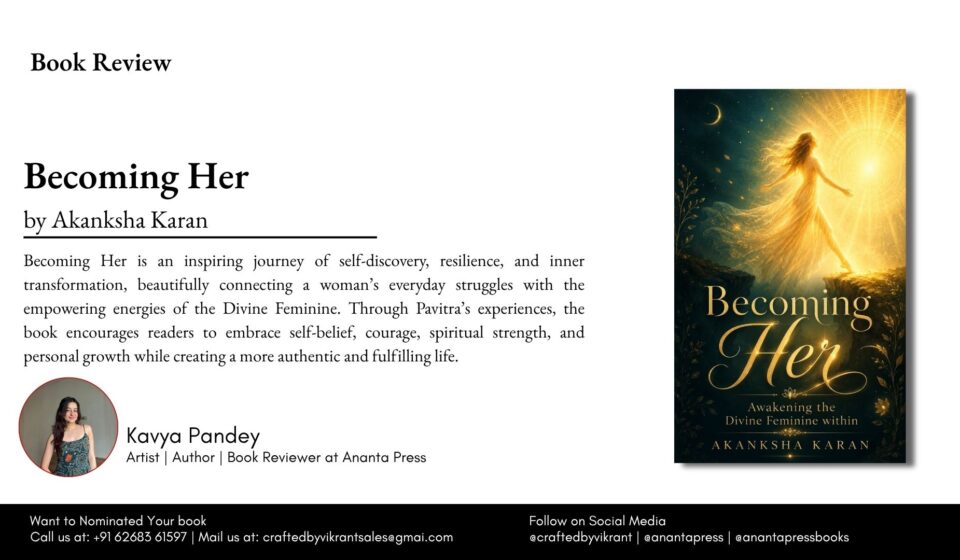

Becoming Her: Awakening the Divine Feminine Within by Akanksha Karan is much more than the story of one woman trying to rebuild her life. It is a thoughtful exploration of womanhood, identity, spirituality, relationships, motherhood, professional ambition, self-love, and the quiet strength that often remains hidden beneath everyday responsibilities. What makes the book particularly distinctive is its creative connection between a modern woman’s journey and the nine forms of Goddess Durga. Through this framework, the author transforms spiritual symbolism into lessons that can be understood and applied to contemporary life.
At the centre of the book is Pavitra, a woman with ambitions that are much larger than her circumstances. Growing up in a middle-class family, she dreams of creating a meaningful life, inspiring people and becoming a successful life coach. However, dreams are much easier to imagine than to pursue. When Pavitra leaves a more conventional career path to follow her calling, she encounters financial difficulties, doubt from people around her, pressure from her family, challenges in her marriage and the exhausting responsibility of balancing work with home and children.
This makes Pavitra immediately relatable. She is not introduced as a perfectly confident woman who already possesses all the answers. In fact, when we first truly understand her situation, she is struggling almost as much as the people she hopes to guide. Her coaching business is failing to attract clients, her decision is being questioned, and she sometimes feels powerless despite wanting to empower others.
That contradiction becomes one of the most meaningful aspects of the book.
Pavitra slowly discovers that sometimes we understand ourselves by helping another person understand their own life. Every woman who enters her journey teaches her something in return. Her clients therefore do not feel like unrelated examples placed into the story. Their struggles frequently mirror something unresolved within Pavitra herself.
One of the earliest examples is Riya, a young girl struggling with her relationship with her parents. Riya feels misunderstood and restricted by family expectations and wants to discover her own voice. Pavitra guides her through self-reflection, open communication, active listening, empathy and healthy boundaries.
Yet while helping Riya, Pavitra is forced to examine her own relationship with her parents.
This is beautifully connected with Shailputri, the first form of Goddess Durga, representing rootedness, resilience and potential. The lesson is simple but meaningful: personal independence does not necessarily require rejecting our roots. Sometimes growth involves understanding those roots differently and healing our relationship with them.
This pattern becomes the emotional foundation of the book.
The journey then moves towards Brahmacharini, representing discipline, knowledge, patience and perseverance. Here we meet Sanya, a young woman passionate about education but limited by conservative circumstances and a lack of opportunities.
Instead of merely telling Sanya to “believe in herself,” Pavitra helps her create a structured plan. Goal-setting, understanding strengths and weaknesses, developing skills, networking, preparing a resume, improving professional profiles, practising interviews and planning for long-term growth all become part of the process.
This is one of the book’s strongest features.
Many motivational books successfully inspire readers emotionally but leave them wondering what they should actually do next. Becoming Her repeatedly attempts to close that gap between inspiration and action. The spiritual idea is introduced, a real-life struggle demonstrates its relevance, and practical exercises or plans show how transformation can begin.
As Pavitra continues working with different women, the meaning of feminine empowerment also becomes broader.
Through Chandraghanta, the book explores courage, emotional strength and relationships. Meena’s difficulties after marriage introduce questions surrounding expectations, communication, personal space, self-care and mutual understanding. Pavitra guides her towards building a healthier relationship without asking her to completely sacrifice her individuality.
The message is important because the book does not present empowerment as simply choosing career over family or independence over relationships. Instead, it frequently searches for harmony.
A woman can love her family and still have boundaries.
She can care for another person without forgetting herself.
She can be ambitious and nurturing.
She can be gentle without being weak.
She can compromise without completely disappearing.
The section associated with Skandamata adds another deeply emotional dimension to Pavitra’s journey. By this stage, many areas of her life are improving, yet she realizes that professional commitments have created distance between her and her children, Arav and Mahak.
For a mother, the feeling that her own children are becoming emotionally distant is painful. Pavitra’s recognition of the moments she has missed forces her to reconsider what balance really means.
The chapter becomes even more meaningful through her interaction with Ramya, who has been trying to conceive for years. Through this parallel, motherhood is viewed from different perspectives. One woman already has children but fears losing emotional closeness with them; another desperately wishes to experience motherhood.
The book eventually expands motherhood beyond biology and presents it as an energy of nurturing, protection, sacrifice and unconditional care.
This is where the Nav Durga framework works particularly well. Spirituality does not remain separate from ordinary life; it becomes a language through which ordinary emotions can be understood more deeply.
Perhaps one of the most relatable sections for modern women appears with Katyayani, when Pavitra begins questioning her identity.
Her relationships have improved. Her family is doing well. Yet something remains incomplete.
Who is Pavitra when she is not somebody’s daughter?
Who is she beyond being a wife?
Beyond motherhood?
Beyond responsibilities?
This search intersects with Aisha’s postpartum struggles. Aisha is trying to accept the physical and emotional changes that followed childbirth while facing pressure to quickly return to her earlier appearance. Pavitra encourages her to practise self-compassion and understand that her value cannot be measured by how quickly her body conforms to external expectations.
This part gives the title Becoming Her a deeper meaning.
“Her” is not a flawless, socially approved version of a woman. She is not the perfect wife, perfect mother, perfect professional or perfectly beautiful person.
“Her” is the authentic self underneath all those labels.
The woman who finally recognizes her own worth.
The woman who stops requiring constant external validation.
The woman who allows herself to evolve.
The exploration becomes more intense through Kalaratri, representing the fierce power required to confront darkness, fear and transformation. Instead of treating difficult stages of a woman’s life as decline, the book presents transition as another source of wisdom. Its exploration of major internal and external changes, including menopause, widens the conversation around feminine strength.
This is significant because the book refuses to restrict feminine energy to youth, beauty or motherhood. Womanhood is shown as an evolving journey in which different stages reveal different strengths.
Sometimes feminine power nurtures.
Sometimes it creates.
Sometimes it forgives.
And sometimes it must fiercely destroy fear, insecurity and limiting beliefs.
With Mahagauri, the narrative begins moving towards renewal and a new level of self-acceptance. Pavitra is no longer merely trying to survive the crisis with which her story began. She is now expanding her professional identity, entering the digital space and becoming more confident in sharing what she has learned.
Finally, Siddhidatri brings the journey towards fulfillment and integration.
One of the most satisfying moments comes when Pavitra conducts an online webinar with a woman from Thailand who seeks guidance on balancing business and personal life. There is a striking contrast here. The woman who once sat in her office wondering whether even one client would arrive is now confidently guiding someone across geographical boundaries.
But the real victory is not simply professional success.
Pavitra understands that strength does not mean perfection.
Becoming empowered does not mean never struggling again.
It means developing enough self-awareness, wisdom, faith and resilience to move through future struggles without losing oneself.
That realization gives the conclusion its emotional strength.
One of the most original elements of Becoming Her is therefore its hybrid structure. It combines storytelling, spirituality, mythology, life coaching, self-help exercises, affirmations and practical guidance. Readers follow Pavitra’s personal story while also learning about the symbolism and qualities associated with the Nav Durga forms.
The spiritual framework provides coherence to the different experiences.
Shailputri represents foundations and resilience.
Brahmacharini teaches discipline and learning.
Chandraghanta represents courage and strength.
Kushmanda connects with creation and harmony.
Skandamata represents nurturing motherhood.
Katyayani awakens self-worth and identity.
Kalaratri encourages confrontation with darkness.
Mahagauri represents cleansing, renewal and peace.
And Siddhidatri brings wisdom, balance and fulfillment.
Together, these are presented not simply as divine forms to worship but as qualities a woman can recognize within herself.
That is perhaps the most powerful message of the entire book.
Personal growth is not one-dimensional.
Professional success alone does not create fulfillment. Neither does marriage, motherhood, physical beauty, spirituality or independence in isolation. Pavitra has to learn about career, family, communication, parenting, self-respect, discipline, emotional healing, self-care, courage and service before she begins feeling whole.
Her transformation is therefore cumulative. Every challenge adds another layer to her understanding.
The book should particularly appeal to readers interested in women’s empowerment, Indian spirituality, self-development, life coaching and stories about balancing personal responsibilities with individual dreams. Women experiencing transitions related to career, marriage, motherhood, identity or confidence may find several sections especially relatable.
Most importantly, Becoming Her is not ultimately about becoming another person.
It is about awakening to the person who was already there.
Pavitra does not receive her strength magically from somewhere outside herself. She gradually discovers it through failure, faith, relationships, discipline, motherhood, service, self-love and courage. Interestingly, the people she sets out to help become instrumental in her own transformation as well.
That gives the story warmth and humanity.
Akanksha Karan’s Becoming Her: Awakening the Divine Feminine Within is therefore an encouraging and thoughtfully structured exploration of feminine growth. It reminds readers that strength can be both gentle and fierce, ambition can coexist with compassion, spirituality can inspire practical action, and self-love is not selfishness but an essential foundation for a meaningful life.
Above everything else, the book carries one empowering thought: many of the qualities women search for outside themselves—strength, wisdom, courage, acceptance, compassion and resilience—may already exist within them.
They simply need to be awakened.
And that is what makes Pavitra’s journey more than just a story. It becomes an invitation to every reader—to reflect, heal, grow, rediscover herself and, in her own unique way, become her.