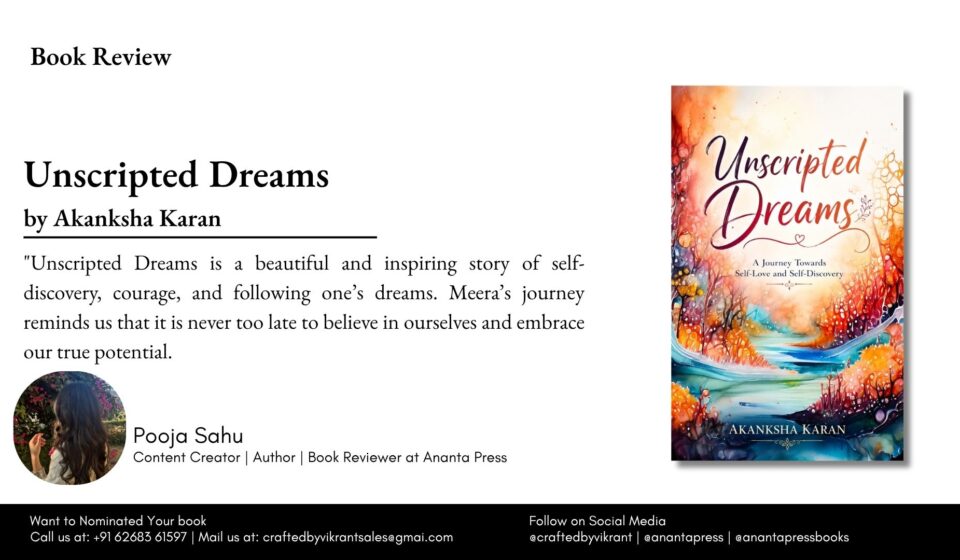

Unscripted Dreams is a heartfelt and inspiring story about rediscovering oneself, confronting self-doubt, and finding the courage to follow dreams that have been buried under the responsibilities of life. At the centre of the story is Meera, a woman who has spent years fulfilling the expectations of family and society while gradually losing touch with her own identity and aspirations. Her journey is not simply about becoming an actor; it is about learning to see herself as an individual with dreams, choices, abilities, and a voice of her own.
What makes Meera’s story particularly relatable is that her struggle does not come from a lack of talent or ambition. Instead, it comes from years of putting herself second. Like many people, she becomes accustomed to defining herself through her responsibilities and relationships. Somewhere along the way, the woman who once had dreams and confidence begins to question her own worth. The book captures this emotional conflict sensitively and shows how easily a person can lose sight of their individuality while trying to meet the expectations of others.
The turning point in Meera’s life comes when she encounters the possibility of returning to acting. A workshop invitation, which initially seems like a small event, becomes the spark that awakens something long dormant within her. The invitation makes her remember the person she once was and the passions she had gradually abandoned. It gives her a reason to question whether age, marriage, family responsibilities, or social expectations should really determine what she is allowed to dream about.
One of the strongest aspects of the book is its treatment of age and dreams. Society often creates invisible deadlines for people. We are made to believe that certain dreams belong to a particular age and that after marriage, parenthood, or a certain stage of life, it is too late to begin again. Unscripted Dreams challenges this idea through Meera’s experience. Her decision to participate in an acting workshop becomes a quiet act of rebellion against these limitations.
The book does not present this transformation as something effortless. Meera struggles with fear, insecurity, and the possibility of being judged. When her family laughs at the idea of her joining an acting workshop, the moment is both painful and realistic. She joins their laughter outwardly, but internally she continues to wrestle with the question of whether she is capable of pursuing something for herself. Later, while looking at her reflection in the mirror, she begins to confront the negative image she has developed of herself. Memories of her younger days and the appreciation she once received for her talents gradually help her reconnect with a forgotten part of herself.
This emotional transformation is perhaps the heart of the novel. Meera does not simply change her appearance or surroundings; she begins changing the way she thinks about herself. The workshop becomes a space where she can experiment, make mistakes, learn, and discover new possibilities. Her growing confidence is portrayed as an internal process rather than merely an external makeover. When she begins to see herself with pride and respect, it becomes clear that the real transformation has already begun within her.
The character of Rishi also plays an important role in Meera’s journey. His presence provides encouragement and perspective at a time when Meera is struggling with self-doubt. His understanding comes partly from his own experiences, allowing him to recognize the fears she is experiencing. His message that failure is part of the journey and that other people’s opinions should not determine one’s worth becomes an important lesson for Meera.
The relationship between Meera and Rishi is interesting because it is connected to something larger than simple companionship. Their conversations encourage Meera to think about her own choices, ambitions, and identity. Rishi becomes one of the people who helps her understand that confidence is not the absence of fear; rather, it is the willingness to move forward despite fear.
Another appealing element of Unscripted Dreams is the depiction of the acting workshop. The workshop is not treated merely as a place where participants learn acting techniques. It becomes a metaphorical space for self-exploration. Through exercises involving voice, character creation, observation, and performance, the participants are encouraged to look beyond appearances and understand different dimensions of personality. Meera discovers that acting can reveal truths about the person behind the character as much as it can create a fictional personality.
The character-creation exercises are especially meaningful. Participants are asked to consider how their characters see themselves, how their friends and family perceive them, and how strangers might see them. This process encourages Meera to think about the difference between the person she believes herself to be and the person others see. It also reinforces one of the book’s central ideas: every individual carries a unique story, and every person has the ability to shape that story.
The voice-projection sessions provide another important layer to Meera’s transformation. Earlier, she struggles to hear herself, both literally and metaphorically. As she learns to project her voice across the theatre, the improvement in her acting also reflects her growing confidence. Her voice becomes a symbol of finding the courage to express herself. The connection between voice and identity is particularly effective because the story suggests that finding one’s voice is not only an artistic skill but also a deeply personal achievement.
The book also succeeds in raising questions about women’s autonomy and societal expectations. Meera begins questioning the restrictions placed upon married women and the assumption that their choices must always be shaped by what society considers appropriate. Her decision to explore Mumbai and participate in the workshop represents her attempt to take responsibility for her own choices. She understands that freedom does not mean escaping responsibility; it means having the right to make meaningful decisions about one’s own life.
This makes the novel relevant beyond the story of one woman. Many readers may recognize themselves in Meera’s struggle. People often postpone their dreams because of family, work, finances, social expectations, or simply the belief that they have missed their chance. Unscripted Dreams challenges that belief and asks an important question: What if it is not too late?
Another strong theme is self-love. The book does not present self-love as vanity or selfishness. Instead, it presents it as the ability to recognize one’s own worth. Meera’s changing relationship with her reflection becomes symbolic of this process. At first, she sees herself through the lens of criticism and disappointment. Gradually, she begins to recognize her strengths and appreciate the woman she has become. The transformation of her appearance is therefore less important than the transformation of her perception of herself.
The story also communicates an important message about failure. Meera worries about what will happen if she fails or if people laugh at her. Rishi’s response emphasizes that failure is not the opposite of growth; it is often part of it. This is a valuable message because the fear of failure is one of the biggest reasons people abandon their dreams. By showing Meera confronting that fear, the novel encourages readers to focus more on the experience of trying than on the possibility of being judged.
What I particularly appreciate about Unscripted Dreams is that its central conflict is not presented as a simple battle between good and bad people. Instead, it explores the complicated ways in which social expectations, family relationships, personal insecurities, and years of conditioning can influence an individual. Meera’s journey is therefore more emotional than dramatic. Her greatest battle is with the limitations she has internalized.
The title Unscripted Dreams is also appropriate. Dreams are often imagined as something carefully planned, but Meera’s journey shows that life rarely follows a fixed script. Her path changes unexpectedly when an opportunity appears. She does not know exactly where the journey will take her, but she chooses to step forward anyway. In that sense, the title represents both uncertainty and freedom.
The journey to Mumbai is particularly symbolic. Leaving her familiar surroundings and travelling toward a new environment represents Meera’s willingness to leave behind an older version of herself. The train journey becomes the beginning of a transformative phase in which she hopes to rediscover her identity and immerse herself in acting. At the same time, her departure also forces others around her to reconsider their understanding of her.
The book’s message can be summed up in a simple but powerful idea: we should not allow age, fear, or the expectations of others to decide the limits of our lives. Everyone has a story, and everyone deserves the opportunity to explore what makes them feel alive.
Overall, Unscripted Dreams is an uplifting and thought-provoking read. Its greatest strength lies in its emotional message rather than in dramatic twists. Meera’s transformation from a woman who doubts herself into someone willing to take a chance on her dreams is both encouraging and relatable. The acting workshop, the new friendships, the lessons about character and voice, and the challenges posed by societal expectations all contribute to a larger story about finding oneself.
The book is especially likely to resonate with readers who have ever felt that they sacrificed their dreams for responsibilities or who have wondered whether it is too late to begin again. It reminds us that dreams do not necessarily disappear simply because life becomes complicated. Sometimes they remain quietly within us, waiting for the right moment to be heard again.
In the end, Unscripted Dreams is more than a story about acting. It is a story about identity, courage, self-respect, freedom, and second chances. Meera’s journey encourages readers to look inward and ask whether there are dreams they have forgotten or parts of themselves they have neglected. Most importantly, it leaves behind a hopeful message: life does not have to follow a predetermined script. Sometimes, the most meaningful chapter begins when we finally decide to write it ourselves.