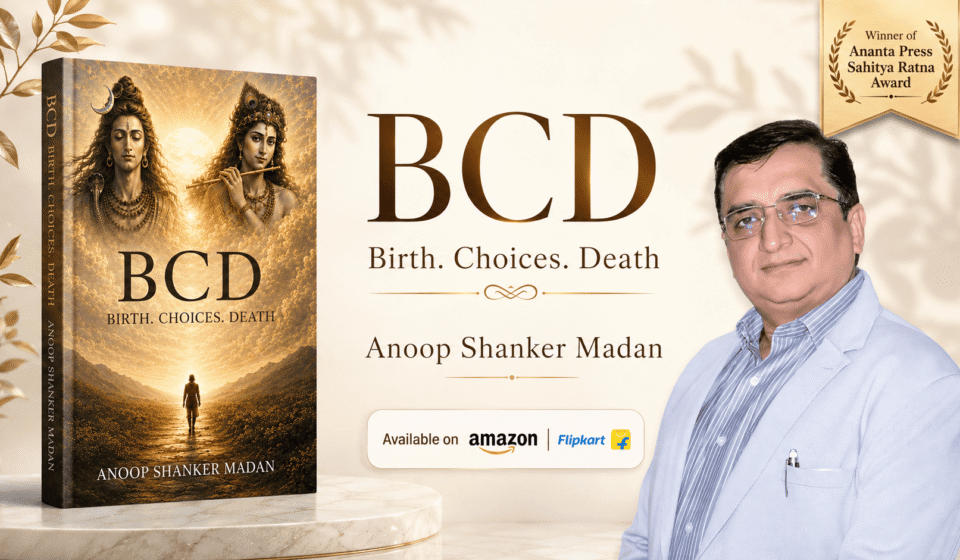

There are philosophical books that try to solve life, and there are others that do something more useful: they give the reader a clear way to look at life. B.C.D – Birth, Choices, Death: The Story of Life Between Two Certainties by Anoop Shanker Madan belongs to the second category. Its central framework is striking because of its simplicity. Birth is the beginning that arrives without our consent. Death is the certainty that waits at the other end. Between those two fixed points lies the territory in which a human being actually lives, and Madan names that territory Choices. In three words, the book creates a lens through which questions of responsibility, freedom, habit, fear, relationships, discipline, ego, spirituality and personal growth can be examined without turning philosophy into something distant or academic.
The book’s greatest strength is that it begins with limits rather than fantasies of control. Modern self-help often tells readers that they can create any life they want if they think correctly, work hard enough or remain positive. B.C.D takes a more grounded position. We do not choose our birth, our family, our starting circumstances or many of the events that interrupt our plans. Life contains chance, limitation and uncertainty. Yet the recognition of what cannot be controlled does not become an excuse for passivity. Instead, it makes the space of choice more meaningful. If the beginning is given and the end is certain, then the question becomes: what will we do with the part that is still open to us?
That question gives the book its practical energy. Choices are not treated only as dramatic turning points such as changing a career, ending a relationship or making a major financial decision. The book brings attention to the repeated, ordinary decisions through which a person gradually becomes who he or she is. How do we respond when someone disappoints us? Do we react immediately or create a pause before speaking? Do we blame circumstances or accept responsibility for what is still within our influence? Do we choose comfort repeatedly even when it prevents growth? Do we allow fear to dictate action, or do we move with awareness despite fear? These are not glamorous questions, but they are the ones that shape a life.
This focus on repetition is particularly valuable. One isolated choice may not appear important, but repeated choices become patterns. Patterns become habits. Habits affect the body, mind, emotions and relationships. Over time, they influence character and direction. B.C.D therefore makes personal responsibility feel less like a moral lecture and more like a process of observation. The reader is encouraged to notice what is being repeated. That shift from judging oneself to observing oneself is important because meaningful change usually begins with accurate awareness.
The book also gives reflection a central role. Stillness by itself can be comforting, but Madan is interested in what happens after the quiet moment ends. A person may meditate, feel calm, and then return to anger, anxiety, blame or ego-driven reactions as soon as ordinary life resumes. B.C.D asks whether peace has truly become understanding if it does not influence behaviour. This is a subtle but powerful distinction. The book does not dismiss meditation or spiritual practice; rather, it places reflection beside them. Quiet may create space. Reflection helps us examine what appears in that space. Conscious choice then determines how the understanding is carried into action.
This three-step movement – stillness, reflection and conscious action – is one of the book’s most thoughtful dimensions. It is also where the symbolic presence of Shiva and Krishna becomes meaningful. Shiva is used as a symbol of inner stillness and awareness, while Krishna represents conscious action in the midst of responsibility. These ideas are presented not as religious instruction but as philosophical symbols that can illuminate modern life. The contrast is useful because many people separate spirituality from action: peace belongs to meditation, while work, conflict, ambition and responsibility belong to the outside world. B.C.D suggests that the test of inner understanding is precisely what happens in that outside world.
The book’s language and conceptual structure make it accessible to readers who may be interested in philosophy but intimidated by dense theoretical writing. The BCD framework does not require prior knowledge of Indian philosophy, psychology or spiritual literature. The central idea can be understood immediately, and the chapters then deepen it through familiar subjects: body, mind, emotions, relationships, discipline, fear, courage, ego, responsibility and awareness. This accessibility is not the same as simplification. The book keeps returning to questions that become more demanding the longer one considers them. What does it mean to take responsibility without pretending we control everything? What does courage look like when fear does not disappear? How do we know whether a decision comes from awareness rather than ego? How much of our daily life is truly chosen, and how much is automatic repetition?
Mortality gives these questions urgency. Death in B.C.D is not used to create fear or pessimism. It functions as a boundary that makes the middle of life matter. If time were unlimited, postponement would have no cost. Because it is not, priorities become ethical and personal choices. The certainty of death asks the reader to consider relationships that are being neglected, apologies being delayed, habits being tolerated, ambitions being pursued without reflection, and meaningful actions being postponed for a future that is never guaranteed. In this way, death becomes less a subject of ending and more a tool for clarifying the present.
Another important quality is the book’s refusal to offer a single dramatic formula for transformation. It does not suggest that one insight will permanently solve fear, ego or confusion. Its philosophy is more incremental. Change happens through repeated awareness and repeated choice. That approach makes the book especially relevant to contemporary readers living in environments of speed, comparison, distraction and constant external influence. When attention is continually pulled outward, even the act of noticing one’s own reactions becomes significant. B.C.D brings attention back to that small inner space where response can be chosen.
Anoop Shanker Madan’s entrepreneurial background also gives the book an interesting foundation. His reflections grow from decision-making, uncertainty, responsibility and working with people rather than from a purely academic philosophical setting. That does not make the book a business text, but it helps explain its practical orientation. The ideas are repeatedly brought back to consequences, patterns and lived behaviour. The reader is not asked merely to agree with a concept; the reader is invited to test it against daily life.
What makes B.C.D unique is therefore not that it introduces an entirely unknown subject. Human beings have always asked about fate, freedom, mortality and meaning. Its originality lies in the clarity of the framework and the way that framework organizes familiar questions. Birth, Choices and Death form a memorable mental map. Birth represents what is given. Death represents the limit. Choices represent the active space in between. Reflection becomes the method through which those choices can be understood more deeply. This makes the book both philosophical and usable.
Readers who enjoy reflective nonfiction, practical philosophy, personal growth and spiritually informed self-inquiry are likely to find much to appreciate here. It is a book that can be read quickly at the level of its central idea, but it rewards slower reading because its questions become personal. The most valuable moments may not be the ones in which the reader learns something new, but the ones in which a familiar truth is seen more clearly. We all know that our choices matter. B.C.D asks us to examine which choices are actually being made, why they are being made, and whether they are building the life we intend to live.
Ultimately, the book’s message is both sobering and empowering. We begin from circumstances we did not select, and we move toward an ending we cannot avoid. Complete control is impossible. Yet meaning does not require complete control. It requires attention to the part that remains ours: the capacity to pause, reflect, respond, take responsibility and choose again. B.C.D turns that capacity into the heart of its philosophy, reminding readers that the life between two certainties is not empty space. It is the place where character is formed, relationships are shaped, awareness deepens and meaning is created.
Amazon Purchase Link: https://amzn.in/d/0136zluj