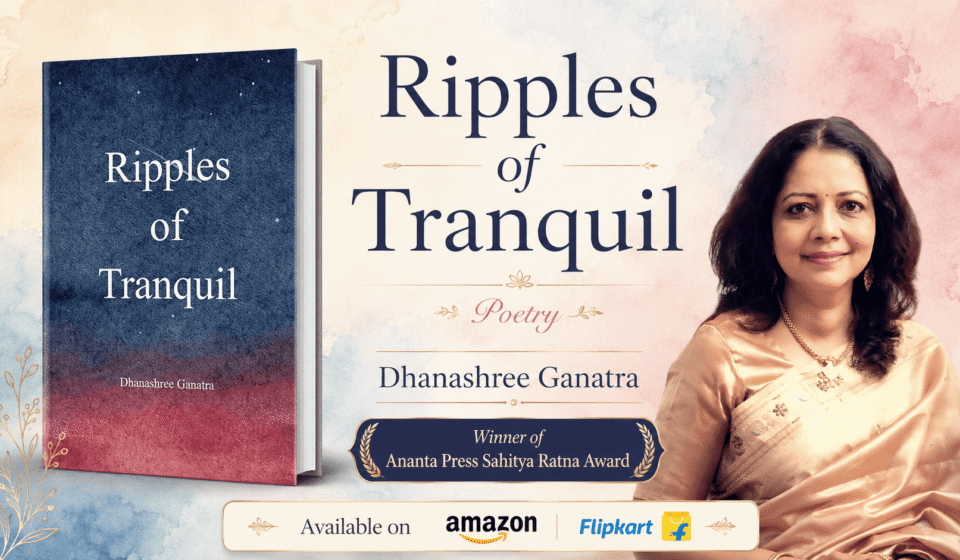

There are poetry books that ask to be admired for their language, and there are poetry books that ask to be lived with. Ripples of Tranquil belongs firmly to the second kind. Dhanashree Ganatra’s collection does not approach the reader with spectacle, argument, or emotional excess. Instead, it creates a quieter invitation: slow down, listen inwardly, and notice what remains when the outer world becomes less insistent. That simple invitation gives the collection its identity and also explains why it feels especially meaningful in a time when attention is constantly divided. The book’s central achievement is not that it tries to provide answers to every human question, but that it restores value to the reflective pause in which better questions can emerge.
The title itself is an effective doorway into the collection. A ripple is small, almost delicate, yet it moves outward from a point of contact and alters the surface around it. Tranquility, by contrast, suggests stillness. Bringing these two images together creates a productive tension: stillness is not presented as emptiness, but as a living state capable of sending subtle movements through consciousness. The poems, as described through the collection’s themes, arise from love, dreams, silence, self-realisation, and the changing colours of the mind. Their power lies in the way they treat these familiar human experiences not as dramatic events alone, but as inner movements. A thought, a memory, a moment of hope, or a sudden recognition can become a ripple, changing the emotional landscape long after the poem has been read.
One of the most appealing qualities of Ripples of Tranquil is its refusal to confuse quietness with weakness. Contemporary writing often rewards intensity: louder emotions, sharper declarations, stronger positions. Ganatra’s poetic world takes another route. Softness becomes a form of strength because it allows emotional complexity to remain intact. The poems are presented as reflections rather than proclamations, and this gives readers space to bring their own histories into the work. Instead of instructing us what to feel, the collection seems to create conditions in which feeling can unfold naturally. That openness is important in poetry. The most lasting poems are rarely closed systems; they are places readers return to with different experiences and find a slightly altered meaning each time.
The book also stands out for its inward direction. Self-realisation can easily become an abstract or overly philosophical subject, but here it is connected to ordinary emotional life. Love, dreams, thought, silence, and hope are not treated as separate categories. They form a continuous interior landscape. This gives the collection a sense of unity even when individual poems may arise from different moods. The reader is encouraged to notice how the mind changes colour from moment to moment and how a quiet observation may carry spiritual significance. The result is a poetry collection that feels contemplative without becoming inaccessible. Its philosophical dimension emerges through lived feeling rather than through heavy terminology.
That accessibility matters because the language of inner peace can sometimes become formulaic. Ripples of Tranquil avoids the tone of a conventional self-help manual. It does not reduce emotional life to steps, slogans, or quick solutions. Poetry allows Ganatra to preserve mystery, ambiguity, and tenderness. A poem can suggest without explaining completely; it can leave a silence around its central image. For a book concerned with tranquility, that silence is not merely a theme but an artistic method. The reader is invited to pause between lines, to stay with an image, and to notice personal associations. In this way, reading becomes participatory. The book does not simply describe inwardness; it asks the reader to practise it.
Ganatra’s background as a singer, songwriter, music composer, and filmmaker adds another compelling dimension to the collection. Even without turning poetry into performance, an artist trained in music is naturally sensitive to cadence, breath, repetition, and emotional timing. The connection becomes especially significant through “Life is Beautiful,” the opening poem that was later transformed into an original song written, composed, and sung by Ganatra herself. This movement from poem to song illustrates the permeability of her creative practice. For her, words are not isolated from sound. They can travel into melody and reach an audience through another sensory path. That creative continuity strengthens the impression that Ripples of Tranquil is not simply a set of written pieces but part of a larger artistic philosophy.
The reported international recognition received by the collection and its associated creative work also helps explain its broader appeal. The book has been connected with honours including the 21st Century Emily Dickinson Award and the Tagore International Cultural Award, while the song inspired by “Life is Beautiful” has received appreciation at international film festivals in several countries. Awards are never a substitute for a reader’s personal response, but they can indicate that a work’s emotional language crosses cultural boundaries. The themes at the heart of this collection—hope, inwardness, love, uncertainty, self-discovery, and the search for peace—do not belong to one geography. They are recognisable human concerns, which makes the collection accessible to readers well beyond the author’s immediate cultural context.
Another strength is the book’s suitability for slow and repeated reading. Some collections are best consumed in sequence, almost like a narrative. Ripples of Tranquil seems better suited to a more reflective rhythm. A reader may choose one poem, stay with it, and return later. This is not a weakness of structure; it is aligned with the book’s subject. Tranquility cannot be rushed. The act of reading a single poem attentively may be more faithful to the collection than moving quickly through many pages. For readers who keep books beside a bed, in a work bag, or near a favourite chair, this kind of poetry can become companion literature: something to open during a difficult day, a thoughtful morning, or a quiet evening.
The uniqueness of Ripples of Tranquil lies in this companionable quality. It is philosophical but not remote, spiritual but not doctrinaire, emotional but not melodramatic. It treats the mind as a changing field and the soul as something that can still be heard beneath daily noise. The poems do not need to shout because their intended effect is cumulative. Like ripples, they extend beyond their starting point. A line may prompt a memory; a reflection may change the reader’s mood; a quiet image may reopen a part of the self that had been neglected.
For readers of contemporary poetry, the collection offers a valuable alternative to the culture of immediacy. It reminds us that depth does not always arrive through complexity and that emotional truth may appear most clearly when language is given room to breathe. For readers who do not regularly read poetry, it offers a welcoming path into the form because its central concerns are universal and its spirit is inviting rather than intimidating. For spiritually inclined readers, it offers contemplation without demanding adherence to a rigid system. And for creative readers, Ganatra’s multidisciplinary journey shows how a poem can become music, image, memory, or personal meditation.
Ultimately, Ripples of Tranquil is a book about returning—returning to attention, to feeling, to self-knowledge, and to the quiet centre that is easily forgotten in a crowded world. Its beauty rests in understatement. It asks the reader to notice rather than to conquer, to listen rather than to react, and to recognise that peace may not always arrive as a dramatic transformation. Sometimes it begins as a small movement in consciousness: a ripple. That is the collection’s most persuasive idea and its greatest strength. Dhanashree Ganatra has created a body of poetry that seeks not merely to be read but to create an atmosphere in which the reader can meet the self with greater gentleness. In an age of noise, that is both an artistic choice and a meaningful gift.
Buy / View on Amazon: https://amzn.in/d/0doJNpxh