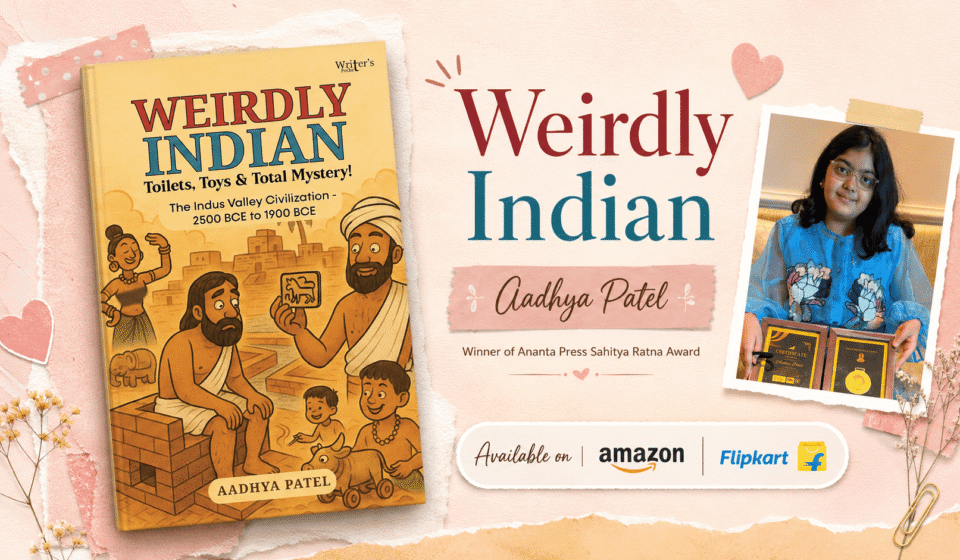

There is a particular challenge in writing history for children: the writer has to respect the intelligence of young readers without making the subject feel like a school exercise. Weirdly Indian – Toilets, Toys & Total Mystery! succeeds because it understands that children do not need history to be simplified into bland facts; they need it to be made alive. Aadhya Patel approaches the Indus Valley Civilization not as a completed chapter with every answer neatly written down, but as a giant detective case. That decision gives the book its personality, its educational strength, and much of its charm.
The most immediately appealing quality of the book is the way it changes the reader’s point of entry. Many introductions to ancient civilizations begin with dates, geographical boundaries, rulers, or broad civilizational labels. Weirdly Indian begins where curiosity actually begins: with strange things. Ancient toilets. Underground drains. Toys with moving parts. Tiny seals. Bricks that railway workers once used without understanding what they were destroying. A script that remains undeciphered thousands of years later. These are not side notes here; they are the doorway into the past. For a young reader, that difference matters enormously. The civilization is no longer an abstract name in a textbook. It becomes a place where real people built homes, managed waste, traded goods, entertained children, made jewellery, and left behind clues that modern researchers are still trying to interpret.
One of the book’s best choices is its emphasis on how historians know what they know. Instead of merely announcing conclusions, the narrative encourages readers to think about evidence. A drain tells us something about city planning. A toy suggests something about childhood. Seals point toward trade, identity, administration, belief, or communication, even when their exact meanings remain uncertain. Archaeological discoveries become pieces of a puzzle. This approach quietly introduces young readers to historical reasoning without turning the book into a lesson in methodology. Children absorb the idea that knowledge is built by examining evidence, comparing possibilities, and admitting when certainty is impossible.
That last point is especially valuable. Weirdly Indian does not pretend that every question about the Indus Valley Civilization has already been answered. Who governed its cities? What exactly do the symbols on the seals say? Why did such an organised civilization decline? A weaker educational book might try to make the past seem more definite than it really is. Patel does the opposite. She allows mystery to remain mystery. In doing so, she gives children permission to wonder. The unanswered questions are not presented as failures of knowledge; they are invitations. A young reader is encouraged to imagine explanations, test ideas, and understand that scholarship can remain open-ended.
The humour also serves a serious purpose. The title itself—Toilets, Toys & Total Mystery!—signals that the book will not speak in the formal voice of a conventional history textbook. It recognises that sanitation may sound more interesting to a twelve-year-old than an administrative system, and that a toy with moving parts may create a stronger emotional connection than a paragraph about urban development. Yet the playful framing does not trivialise the civilization. On the contrary, it makes its sophistication easier to appreciate. When readers discover that people living more than four millennia ago developed planned settlements, drains, bathing spaces, systems of trade, and carefully produced objects, the contrast between “ancient” and “advanced” becomes surprising in exactly the right way.
Another strength is the focus on ordinary life. History for children is often dominated by kings, battles, monuments, and heroic personalities. The Indus Valley Civilization is particularly suitable for a different kind of telling because so much of what we know comes from cities and objects rather than from a readable royal chronicle. Patel uses this to her advantage. Homes, food, jewellery, games, tools, sanitation, farming, trade, and urban organisation become the main characters. This allows readers to ask one of the most powerful historical questions: what would it actually have felt like to live there? That question creates empathy across time. A child who sees an ancient toy can recognise that children in the distant past also played. A family’s domestic space becomes easier to imagine than a distant list of archaeological terms.
The rediscovery of Harappa provides another excellent narrative thread. The image of railway workers using old bricks without realising they belonged to a lost civilization is memorable because it contains irony, accident, loss, and discovery all at once. It reminds readers that the past does not arrive in perfect museum cases. Sometimes it is buried under fields, reused in new construction, overlooked, misunderstood, and only later recognised. Archaeology therefore appears not as a dusty academic subject but as a process of recovering stories from fragments.
The book’s young authorial voice is central to its uniqueness. Aadhya Patel writes from the perspective of someone close to the intended audience rather than from the distance of an adult explaining children to themselves. Her curiosity feels genuine because the questions she asks are precisely the questions many children would ask if they were allowed to guide the lesson: Did they have bathrooms? What did children play with? Who was in charge? Why can no one read that script? What happened to everyone? This creates a conversational relationship with the reader. It feels less like being instructed and more like joining a bright, enthusiastic friend who has found something extraordinary and cannot wait to show it to you.
This voice is supported by a structure that combines historical information, illustrations, unusual details, and direct questions. Such variety helps the material breathe. Instead of receiving one uninterrupted stream of explanation, readers move between fact, image, speculation, surprise, and reflection. For reluctant history readers, that rhythm can make a major difference. For already curious readers, it gives them multiple reasons to keep going.
The deeper educational value of Weirdly Indian lies in the habits of mind it encourages. It says that history can begin with everyday objects. It says that evidence matters. It says that not knowing is acceptable. It says that questions are not interruptions to learning; they are the engine of learning. These are lessons that extend beyond the Indus Valley Civilization. A child who learns to ask how we know something, what evidence supports it, and what remains uncertain is learning a form of critical thinking that applies to science, current affairs, literature, and life.
The book also has a meaningful cultural dimension. By making an ancient civilization from the Indian subcontinent approachable and exciting, it helps young readers connect with heritage without reducing that heritage to slogans or pride alone. The civilization becomes impressive because of its actual material achievements and enduring mysteries. Readers are invited to admire, investigate, and question at the same time. That is a healthier and more intellectually satisfying relationship with the past than either rote memorisation or empty celebration.
Weirdly Indian – Toilets, Toys & Total Mystery! stands out because it understands what makes children turn a page: surprise, humour, a sense of discovery, and the feeling that the answer might not yet be complete. It treats young readers as participants in the investigation. It makes ancient sanitation fascinating, toys historically meaningful, and undeciphered symbols irresistible. Most importantly, it demonstrates that a history book does not have to choose between being informative and being fun. When curiosity leads, the two can become the same thing.
For parents, teachers, and young readers looking for an introduction to the Indus Valley Civilization that feels lively rather than compulsory, this is a distinctive and thoughtful choice. It may begin with toilets and toys, but it ends by offering something far bigger: a way of looking at the past with alertness, imagination, and the courage to keep asking questions.
Amazon Purchase Link: https://amzn.in/d/0aBM1ljI