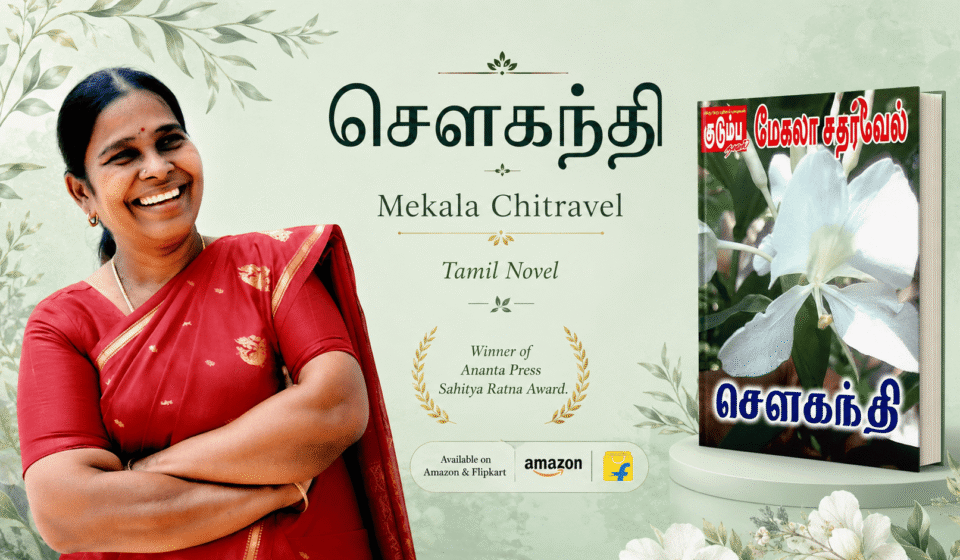

Some novels try to impress the reader with a complicated plot, a large cast, or dramatic twists. Sowganthi takes a different route. Its emotional foundation is something almost everyone understands without explanation: the bond between a mother and her son. That simplicity is not a weakness; it is the book’s greatest strength. At the heart of the novel is Sowganthi, a mother who receives the affection, attention, and care that so many mothers quietly hope to receive from their children. Her son, Rishi, is presented as a young man who does not treat his mother’s love as something automatic or invisible. He responds to it. He cares for her, values her, and gives her the emotional security that makes the relationship feel meaningful. In a time when family relationships are often portrayed through conflict, distance, or misunderstanding, this central idea gives the novel a warm and reassuring identity.
What stayed with me most about the premise is the way it turns an ordinary expectation into the subject of a complete emotional story. A mother loving her child is usually taken for granted. Society almost expects mothers to sacrifice without counting the cost. Their patience, anxiety, labour, and emotional involvement are often treated as part of the natural order of things. Sowganthi shifts attention to the other side of that relationship. It asks, in effect, what happens when a son recognizes that love and gives something back. That makes Rishi’s affection important not because it is extraordinary in a theatrical sense, but because it is the kind of goodness that should be ordinary and yet is not always expressed openly. The novel therefore has a moral gentleness to it. It does not need to preach loudly. The relationship itself becomes the message.
The title adds another layer of beauty. Sowganthi is explained as the name of a divine flower associated with the Mahabharata, the heavenly flower that Bhima brings for Panchali. This connection gives the name a poetic resonance beyond the character. A flower can represent fragrance, tenderness, beauty, rarity, and something worth seeking. When a mother is named after such a flower, the symbolism feels especially suitable. Mothers are often the quiet fragrance of a home: present in daily routines, remembered in small details, and deeply missed when absent. The epic reference also gives the novel a distinctly Indian cultural texture. It connects a contemporary emotional theme with a memory from one of India’s great epics without requiring the story itself to become mythological. That balance makes the title memorable.
I also appreciate the fact that the book’s emotional promise is clear. This is a novel for readers who are willing to engage with affection, family responsibility, and gratitude. It speaks especially well to people who believe that love is shown in behaviour rather than merely declared in words. Rishi’s role becomes meaningful because care is active. To care for a parent is to notice, to respond, to be present, and to make them feel that their place in one’s life has not diminished with time. That idea can touch readers of different ages in different ways. A young reader may see Rishi as an example of how to value a mother. A parent may read Sowganthi’s experience with a mixture of happiness and longing. An older reader may connect the story to memories of their own family. The same central relationship can therefore create several kinds of emotional response.
Another quality of the novel is its accessibility. A story built around the mother-son relationship does not require specialized knowledge or a particular social background to understand. The emotions are immediate. Tamil readers in particular may find the theme familiar because family bonds, respect for parents, sacrifice, and intergenerational responsibility have long occupied an important place in Tamil social and literary life. Yet the book is not limited to one cultural environment. The desire to be loved by one’s children is universal. That is why the novel can work on two levels at once: culturally specific in its language and symbolism, but universal in its emotional core.
Knowing something about the author, Mekala Chitravel, also changes the way one approaches this novel. She is not a writer who has entered literature through a single narrow subject. Her body of work spans novels, children’s books, cookery, folk stories, spiritual writing, biography, kolam-related work, and multiple books on MGR. She has completed one hundred books in Tamil, an achievement that speaks to extraordinary discipline and sustained engagement with readers. Her background as an educator, school administrator, stage debater, and storyteller suggests a life spent observing people, communicating ideas, and understanding how different audiences respond to language. Sowganthi benefits from that broader experience because its theme depends less on novelty for novelty’s sake and more on emotional recognition.
The author’s long connection with education is particularly relevant. Someone who has taught and guided hundreds of students sees family, growth, responsibility, and character from more than one angle. A teacher watches children become adults. A school founder sees parents’ hopes and anxieties. A storyteller learns which emotions cross the distance between speaker and listener. Those experiences can give a family novel a grounded quality. Even without turning the book into an autobiography, the author’s life experience lends credibility to her interest in care, gratitude, and human relationships. The fact that three university researchers have completed Ph.D. work on her novels further indicates that her writing has attracted sustained academic attention, not only casual readership.
What makes Sowganthi unique, then, is not that no other novel has ever discussed a mother and son. Literature has explored that relationship countless times. Its uniqueness lies in its choice of emotional emphasis. Instead of making maternal love merely a background force that supports the hero, the novel gives that bond the centre of the stage. It treats a son’s care for his mother as something worthy of literary attention. That is important. Popular culture often celebrates romantic love as the most dramatic form of love, while parental affection is expected to remain in the background. Sowganthi reminds us that the relationships that shape us from childhood can be just as emotionally rich and just as deserving of reflection.
The novel can also encourage self-examination. A reader does not have to be a son to feel challenged by it. The larger question is whether we return care to the people who have cared for us. Do we assume they already know we love them, or do our actions make that love visible? Do we give parents time only when convenient? Do we listen to them as individuals with feelings, fears, and needs of their own? A book becomes valuable when its story continues in the reader’s mind after the page is closed. Sowganthi has the potential to do that because its central question is so close to everyday life. It can make the reader think of a phone call not made, a visit postponed, a word of gratitude left unsaid, or a small act of care that could easily be offered.
There is also something refreshing about a novel that allows goodness to be emotionally interesting. Modern storytelling sometimes assumes that flawed, destructive, or morally ambiguous relationships are automatically deeper than healthy ones. Sowganthi offers another possibility: affection, loyalty, and care can themselves carry emotional weight. Rishi does not need to be fascinating because he fails his mother; he can be meaningful because he values her. Sowganthi does not need to suffer endlessly to justify the reader’s attention; her good fortune in receiving her son’s love can itself become moving. That positive emotional direction may be one of the book’s strongest appeals for readers looking for literature that leaves them with warmth rather than exhaustion.
For me, Sowganthi is best understood as a tribute to reciprocal love within a family. Mothers often give first, give repeatedly, and give without keeping a record. The novel’s emotional satisfaction comes from imagining a son who understands that love should not flow in only one direction. Its title, with the image of a divine flower from the Mahabharata, gives this simple idea a graceful symbolic frame. Mekala Chitravel’s long literary and educational journey adds further interest to the work. Readers who enjoy Tamil fiction rooted in family values, emotional sincerity, cultural memory, and humane relationships are likely to find something meaningful here. It is a book that gently asks us to value the people whose love has shaped us, and that is a message worth returning to.