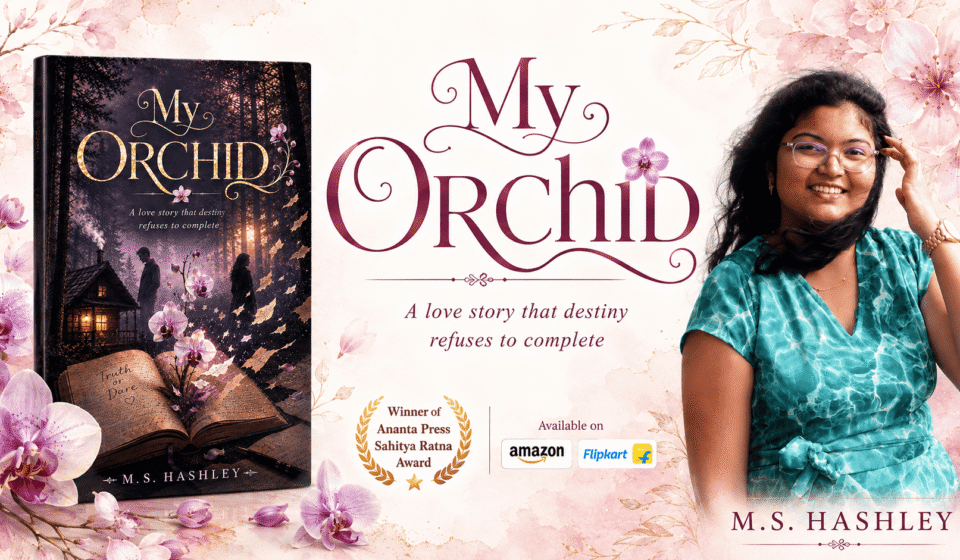

There are romance novels that begin with a glance, a chance meeting, or an instant spark. My Orchid chooses a more intimate route: it lets two people fall for each other through words before appearances can take over. That choice gives M.S. Hashley’s debut novella its most distinctive quality. At the center of the story is Hardhik, a young man recovering from a breakup and trying to make sense of what love actually means. He retreats to a cabin in the woods because he wants space, peace, and enough mental clarity to begin writing seriously. Instead, he finds a mysterious diary titled Truth or Dare. What looks like a playful object soon becomes an unusual bridge between him and an anonymous stranger, and the entire emotional direction of his life changes from there.
The diary device is what immediately made the book feel fresh to me. Hardhik and the mysterious girl do not simply exchange messages. Their interaction develops through clues, dares, puzzles, confessions, gifts, drawings, and small acts of attention. The result is a romance based on observation rather than display. Hardhik learns to notice what the other person values. The anonymous writer, who comes to call herself Orchid, begins to trust him because he responds to what she says instead of trying to force her into a conventional relationship. Their communication has the energy of a game, but underneath that playfulness is a gradual lowering of emotional defenses. The diary becomes a safe place where both can say things they might not say face to face.
This is especially meaningful because both characters arrive with emotional baggage. Hardhik begins the story after his relationship with Sana has collapsed. He is angry, hurt, and initially convinced that he has been the only one making an effort. His uncle Rohan, whom he affectionately calls Ro, challenges that thinking by asking him whether he truly loved Sana or simply loved the idea of the relationship. That question becomes an important starting point for Hardhik’s growth. He has to move from a very youthful, ego-driven understanding of love toward something more patient and self-aware. His time in the cabin is therefore not only an escape from heartbreak; it is a transition from one emotional version of himself to another.
Orchid, on the other hand, is guarded for different reasons. Her vulnerability emerges slowly through the diary. She is talented, sensitive, creative, and deeply affected by feeling overlooked by the people closest to her. Her own unpublished novel, Drifting Away, becomes a symbol of that insecurity. She wants validation from her parents, but she has not received the attention she needs. She also carries the pain of a broken friendship that left her afraid of attachment. The book handles this fear in a recognizably modern way: Orchid is not frightened of love because she is cold; she is frightened because she knows how badly loss can destabilize her. That distinction gives her reluctance emotional credibility.
One of the book’s strongest ideas is that intimacy is built through remembering details. Hardhik does not win Orchid over with one dramatic gesture. He notices patterns, follows her clues, remembers what she has shared, and gradually begins to understand the emotional meaning behind her choices. Even the title “My Orchid” emerges from a sequence of letters and gifts, which turns the name into something earned rather than merely decorative. The orchid itself works well as a romantic symbol: delicate, rare, beautiful, but also something that needs the right conditions to bloom. The anonymous girl is not presented as a prize to be claimed. She is someone who opens up only when she feels emotionally safe.
The relationship between Hardhik and Ro adds another layer that makes the novella more than a straightforward boy-meets-girl story. Ro is uncle, guardian, best friend, mentor, and emotional anchor. His own history with Lavanya becomes a parallel love story inside Hardhik’s story. In the beginning, Hardhik believes he knows Ro completely, yet the older man has hidden an entire chapter of his life. As that history comes out, the reader sees a different model of love: one shaped by endurance, restraint, sacrifice, and memory. Ro’s experience quietly teaches Hardhik that love is not always measured by possession or by whether two people end up together.
That parallel matters because My Orchid repeatedly asks what remains when a relationship cannot continue in the form we wanted. Does love become meaningless if people are separated? Does a memory become a wound, or can it become something we carry with gratitude? The book’s later chapters push these questions far beyond the flirtatious diary exchanges of the first half. The emotional stakes rise when Hardhik discovers that Orchid’s family is connected to Ro’s unresolved past. Suddenly, two generations of love, regret, misunderstanding, and sacrifice overlap. What first seemed like a private romance becomes part of a much larger emotional history.
I also appreciated the book’s conversational tone. Hardhik’s narration is casual, impulsive, humorous, and sometimes immature, which suits the age and personality being portrayed. His banter with Ro gives the story warmth, while the diary passages create a softer and more reflective rhythm. The language does not try to sound overly literary. Instead, it aims for immediacy. This makes the novella accessible to readers who enjoy contemporary Indian romance written in a direct, youthful voice. There are moments where the dialogue feels deliberately everyday, and that informality helps the characters feel less polished and more like people speaking from the middle of their lives.
The final movement of the story is emotionally intense and changes the meaning of many earlier scenes. Without reducing the book to its ending, I would say that the promise in the subtitle—A Love Story That Destiny Refuses to Complete—is taken seriously. The romance is allowed to become joyful enough that the later pain has weight. The book does not treat love as valuable only if it reaches marriage, permanence, or a conventional happily-ever-after. Instead, it argues that a relationship can transform a person even when fate refuses to let that relationship continue. Hardhik’s growth as a writer is inseparable from what he learns through Orchid. His ability to move forward does not require forgetting her.
What stayed with me most was the novel’s distinction between memory and punishment. Several characters are trapped by what happened in the past. Some hold on to guilt, some to fear, some to unfinished love. Orchid’s presence forces them to reconsider whether remembering someone must mean remaining emotionally frozen. This theme gives the title a tenderness that lasts beyond the plot. Hardhik’s Orchid becomes not only the person he loves but also the person who changes the way he understands love, writing, family, and grief.
For readers who enjoy emotional romance with mystery, anonymous communication, family bonds, second chances, and a bittersweet edge, My Orchid has a lot to offer. Its originality lies less in trying to reinvent romance as a genre and more in the way it combines a diary game with intergenerational emotional history. The book begins with heartbreak, turns into a playful puzzle, deepens into confession, and ends as a meditation on what we do with love after life has changed the plan. It is tender, dramatic, and openly sentimental, but that openness is part of its identity. I finished it feeling that the story’s most important relationship was not simply between two people—it was between love and memory, and the difficult choice to keep living without pretending that what was lost did not matter.
Amazon Purchase Link