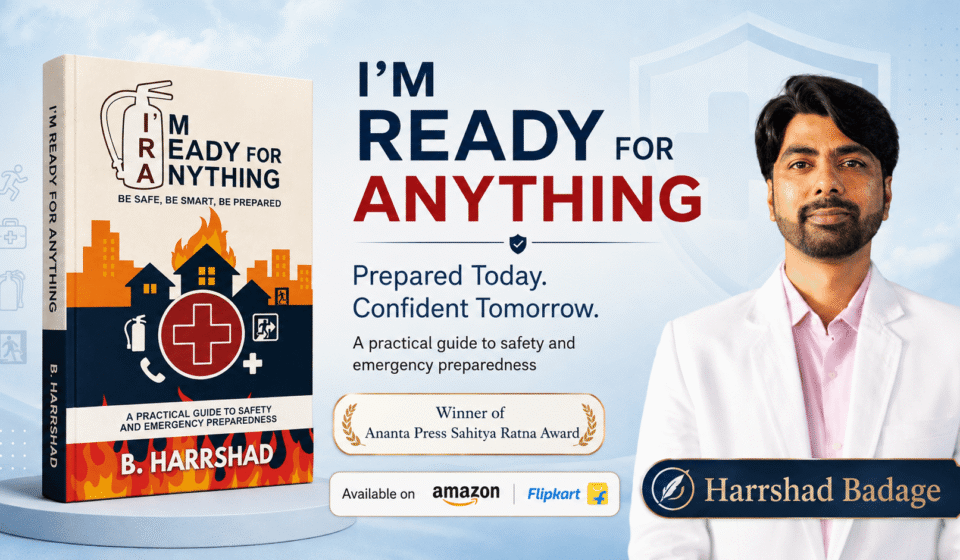

Practicality, clarity, and the confidence that comes from knowing what to do
There are many books that tell readers how to survive extraordinary circumstances, but far fewer that begin with a much more useful question: what are the emergencies an ordinary person is actually likely to face? I’m Ready for Anything (IRA) stands out because it treats preparedness as an everyday life skill rather than as a specialist interest. Its focus is not on dramatic wilderness adventures or highly technical rescue situations. Instead, it turns toward the realities that can interrupt daily life in India – a fire in a home or office, a road accident, an LPG leak, a flood during the monsoon, an earthquake, a prolonged blackout, a cyber scam, a workplace emergency, or a moment of public disorder. That choice immediately gives the book a practical identity. It is designed for people who may never call themselves “survivalists” but who still want to know how to protect themselves and the people around them.
The strongest quality of the book is the way it reframes safety. Preparedness is often misunderstood as worry: if you plan for emergencies, some people assume you must be expecting disaster. IRA challenges that idea. Its central message is that preparation reduces fear because it replaces uncertainty with a plan. A person who knows where the first-aid kit is, how to respond to smoke, what to do during a gas leak, whom to contact during an emergency, or how to recognize a suspicious digital message is not necessarily more anxious than anyone else. In fact, that person may be calmer because the first few decisions have already been considered. This shift from panic to confidence gives the book an encouraging tone. It invites readers to prepare without becoming fearful and to develop alertness without living in constant alarm.
Another important strength is accessibility. Safety information can become complicated very quickly. Technical terms, equipment specifications, regulatory language, and emergency-response procedures can make readers feel that the subject belongs only to trained professionals. Harrshad Badage approaches the material from the opposite direction. The book is described as conversational, practical, and step-by-step, using relatable stories, Indian case studies, checklists, first-aid techniques, and emergency planning strategies. That matters because information is useful only when it can be remembered and applied under stress. A checklist that can be reviewed with a family, a simple sequence that can be recalled during a fire, or an easy-to-understand first-aid principle may be more valuable in an actual emergency than pages of jargon.
The author’s professional background strengthens this practical approach. According to the supplied author profile, Badage has more than a decade of experience across fire safety, first aid, emergency response, workplace safety, and disaster preparedness. He has trained thousands of participants in settings ranging from industries and educational institutions to residential communities, hospitals, and corporate organizations. This experience is significant because it places the book close to real human behavior. Emergency guidance is not only about knowing the correct procedure; it is also about understanding how people react when frightened, confused, rushed, or surrounded by others who are equally uncertain. A trainer who repeatedly sees where people hesitate, what they forget, and which explanations they remember is well positioned to turn formal safety knowledge into usable guidance.
One story from the author’s profile illustrates the book’s philosophy particularly well. During a first-aid workshop in Pune, Badage demonstrated how an improvised collar bandage could be made with ordinary newspaper and cloth. Years later, a participant told him that he had remembered and used the same technique to stabilize a road-accident victim until professional help arrived. The power of that story is not in the improvisation alone. It shows what practical education can achieve: one clear lesson, remembered at the right moment, can become meaningful action. IRA seems built around that principle. It is not trying to make every reader an emergency professional. It is trying to give ordinary people enough awareness and usable knowledge to make better decisions before trained help arrives.
The breadth of situations covered is another reason the book feels relevant. Physical emergencies such as fires, floods, earthquakes, gas leaks, road accidents, and workplace incidents sit alongside modern risks such as cyber scams and extended power failures. This broader definition of safety is valuable. Contemporary preparedness is no longer limited to a fire extinguisher or a first-aid box. Families use digital banking, depend on mobile communication, live in dense urban areas, travel on crowded roads, and may face infrastructure failures during severe weather. By placing these different risks within one preparedness framework, the book encourages readers to think in systems: communication, planning, prevention, response, recovery, and shared responsibility all matter.
The book also appears well suited for collective reading. A safety guide becomes more effective when the knowledge is not held by only one person in a household or workplace. IRA’s use of checklists and emergency planning strategies makes it possible to turn reading into conversation. Families can discuss meeting points, emergency contacts, medicines, gas shut-off procedures, or what children should do if separated. Schools can use the ideas to reinforce evacuation awareness. Workplaces can connect the material to drills and first-aid readiness. Residential communities can think about vulnerable residents, access routes, and communication. The book therefore has value not only as a personal guide but as a starting point for group preparedness.
What makes I’m Ready for Anything unique is its India-first perspective. Many general survival books are written around environments, services, weather conditions, or public systems that may not match Indian life. Badage’s motivation for writing the book reportedly came from noticing this gap during years of training. Participants wanted material they could consult after sessions, yet much of what was available emphasized snowstorms, wilderness expeditions, wildlife encounters, and other scenarios that felt distant from the routine hazards Indian families asked him about. IRA responds directly to that mismatch. Its subject matter – LPG incidents, monsoon flooding, road accidents, building fires, stampedes, cyber fraud, blackouts, and related situations – makes preparedness feel local rather than imported.
The reader value of the book lies in this combination of relevance and action. A useful safety book should change behavior. It should make someone check whether an extinguisher is accessible, save emergency contacts, review a family plan, learn a first-aid response, notice a risky electrical habit, or think twice before responding to a suspicious message. The book’s practical format is designed to encourage exactly that kind of small but meaningful action. Preparedness rarely depends on one heroic decision. More often, resilience is built from ordinary choices made before the crisis: knowing, checking, practicing, organizing, and communicating.
IRA is therefore best understood not simply as a survival manual, but as a handbook for practical confidence. It treats safety as a form of care – care for oneself, for family members, colleagues, neighbors, and the wider community. It respects the seriousness of emergencies without using fear as its main teaching tool. It respects the reader by translating professional safety experience into a language meant for everyday use. And it respects the Indian context by focusing on the risks people actually recognize around them.
For readers who have often thought, “I should probably know what to do in an emergency,” this book offers a constructive place to begin. Its greatest contribution may be the simple idea contained in its title: readiness is not a personality type or a profession; it is something that can be learned. By turning awareness into manageable steps, I’m Ready for Anything encourages readers to become calmer, smarter, and more capable before a difficult moment arrives. That makes it a timely, practical, and socially valuable work of nonfiction.
Amazon Purchase Link: https://amzn.in/d/01LeypC9