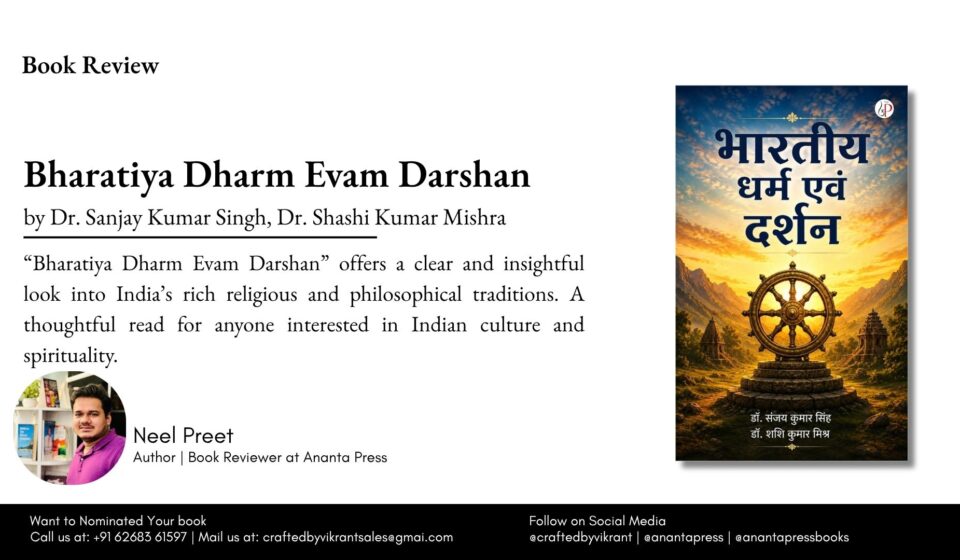

Bharatiya Dharm Evam Darshan is an insightful and thought-provoking exploration of India’s vast religious, philosophical, and intellectual heritage. The book presents a wide range of traditions, beliefs, schools of philosophy, and spiritual ideas that have shaped Indian civilization over centuries. What makes the book particularly valuable is its attempt to bring together different streams of Indian thought and present them as part of a larger intellectual and cultural journey.
The book begins with familiar and deeply rooted religious traditions and gradually moves toward more analytical and philosophical discussions. It covers subjects ranging from the worship of Lord Ganesha and the Skanda tradition to the Sun and the Saura tradition, and then takes the reader into the major philosophical systems of India. The inclusion of Sankhya, Yoga, Nyaya, Vaisheshika, Mimamsa, and Vedanta gives the book a broad philosophical foundation. It further explores Advaita Vedanta through Shankaracharya, Vishishtadvaita through Ramanujacharya, and also introduces readers to non-theistic and materialist perspectives such as Charvaka, along with Jain and Buddhist philosophy.
One of the strengths of the book is that it does not restrict Indian philosophy to abstract theories alone. Instead, philosophical ideas are connected with everyday human experiences and questions. The discussion of Sankhya, for example, revolves around fundamental questions such as human identity, the nature of the world, the causes of suffering, and the possibility of liberation. The distinction between Purusha and Prakriti provides a framework for understanding consciousness and the changing nature of existence. Such discussions encourage readers to look beyond the surface of life and reflect upon their own experiences.
The chapter on Yoga is equally meaningful because it presents Yoga as something deeper than physical exercise. The book explains Yoga in relation to the mind, discipline, thoughts, desires, memories, fears, and inner conflicts. This approach is especially relevant in the modern world, where people often associate Yoga primarily with physical fitness. By emphasizing its psychological and spiritual dimensions, the book encourages readers to understand Yoga as a path of inner discipline and self-awareness.
The discussions of Nyaya and Vaisheshika add another important dimension to the book. These traditions demonstrate the analytical and logical character of Indian philosophical thought. Questions of reasoning, evidence, knowledge, matter, and the structure of reality show that Indian philosophy has never been limited to devotional or spiritual concerns. It has also developed sophisticated methods of inquiry and intellectual analysis. The inclusion of these traditions makes the book useful for readers who want to understand the diversity of approaches within Indian philosophy.
The treatment of Vedanta further deepens the philosophical journey. Questions concerning Brahman, Atman, ultimate reality, knowledge, and liberation have occupied a central place in Indian philosophical discussions. The book introduces different interpretations of Vedanta and gives space to both Shankaracharya’s Advaita and Ramanujacharya’s Vishishtadvaita. This comparative presentation helps readers appreciate that even within Vedantic thought, there are different approaches to understanding the relationship between the individual, the universe, and the ultimate reality.
Another commendable aspect is the inclusion of philosophical traditions that challenge or question established religious assumptions. The chapter on Charvaka or Lokayata is particularly interesting in this regard. Charvaka represents a strongly critical and materialist voice within Indian intellectual history. It questions the acceptance of ideas simply on the basis of tradition or belief and emphasizes direct experience and evidence. By including such a perspective, the book demonstrates that Indian philosophical history contains not only spiritual and religious traditions but also skeptical, rational, and critical voices.
The book also gives considerable attention to Jain and Buddhist thought. Jain philosophy is presented through ideas such as non-violence, multiple viewpoints, and the journey toward liberation, while Buddhism is associated with suffering, compassion, and the path toward Nirvana. These traditions broaden the reader’s understanding of Indian religious philosophy and show how different traditions responded to fundamental questions about human suffering, ethics, knowledge, and liberation.
The earlier chapters on Ganesha, Skanda, and the Sun provide an important cultural and religious foundation for the philosophical sections. The discussion of Ganesha, for instance, goes beyond mythology and explores the symbolic meanings associated with wisdom, intellect, obstacles, discipline, and the proper beginning of an undertaking. The book shows how religious symbols can also carry ethical and philosophical messages.
Similarly, the discussion of Skanda or Kartikeya explores themes of courage, youthful energy, leadership, responsibility, and disciplined strength. The character is not presented merely as a warrior figure; the narrative also highlights the relationship between strength and wisdom. This makes the discussion relevant even for contemporary readers because it connects traditional stories with broader lessons about responsibility and purposeful action.
The chapter on the Sun and the Saura tradition is another interesting part of the book. The Sun is discussed not only as a religious symbol but also as a representation of light, energy, time, knowledge, and continuity. The connection between sunlight and knowledge provides a meaningful philosophical metaphor: just as physical light makes the external world visible, knowledge and wisdom can bring clarity to human life. This interpretation allows the reader to see how religious symbolism can contain deeper philosophical meanings.
A major quality of Bharatiya Dharm Evam Darshan is its breadth. Rather than focusing on only one religious tradition or philosophical school, the book introduces readers to multiple perspectives. This is important because Indian thought is not a single, uniform system. It is a vast and diverse intellectual landscape containing different forms of worship, philosophical arguments, spiritual practices, ethical principles, and interpretations of reality.
The organization of the book also contributes to its usefulness. The chapters move through religious traditions and major philosophical systems in a structured manner, allowing readers to gradually develop a broader understanding of the subject. The table of contents itself reflects this diversity, covering religious traditions as well as philosophical systems and their major thinkers.
Another valuable feature is the book’s connection between philosophical thought and human life. Concepts such as knowledge, discipline, liberation, compassion, non-violence, reasoning, self-awareness, and responsibility are not treated merely as historical concepts. They can also be understood as principles that continue to have relevance in contemporary life. This makes the book more than a historical overview; it becomes an invitation to reflect on the ideas that have shaped Indian civilization and their possible meaning today.
For students, researchers, teachers, and general readers interested in Indian culture, religion, or philosophy, the book can serve as a useful introduction to a wide range of subjects. Readers who are already familiar with Indian philosophy may also appreciate the way different traditions are brought together within a single volume. Its broad coverage makes it suitable for anyone wishing to gain an introductory understanding of the intellectual diversity of India.
The book’s greatest contribution lies in encouraging readers to approach Indian religious and philosophical traditions with curiosity. It shows that Indian thought contains devotion as well as reason, spiritual practice as well as intellectual debate, mythology as well as philosophy, and traditional belief as well as critical questioning. The presence of contrasting schools—ranging from Vedanta and Yoga to Charvaka, Jainism, and Buddhism—makes this diversity particularly evident.
Overall, Bharatiya Dharm Evam Darshan is a meaningful and informative work that introduces readers to the richness of India’s religious and philosophical heritage. Its wide-ranging subject matter, emphasis on philosophical inquiry, and inclusion of diverse traditions make it a valuable read for those interested in understanding the intellectual foundations of Indian civilization.
The book ultimately reminds us that the study of religion and philosophy is not simply a study of the past. It is also a way of understanding questions that remain relevant to human beings today—Who are we? What is the nature of reality? Why do we experience suffering? What is knowledge? How should we live? And is liberation possible? By bringing these questions and traditions together, Bharatiya Dharm Evam Darshan offers readers an opportunity to explore India’s philosophical heritage while also encouraging deeper reflection on life, consciousness, ethics, and spirituality.
In conclusion, this is a thoughtful and comprehensive work for readers who wish to explore the many dimensions of Indian religious and philosophical thought. It succeeds in presenting a broad intellectual journey—from devotion and mythology to logic, metaphysics, spirituality, skepticism, compassion, and liberation. The book is therefore not only a study of Indian traditions but also an invitation to think, question, and understand the deeper ideas that have shaped India’s cultural and philosophical identity.