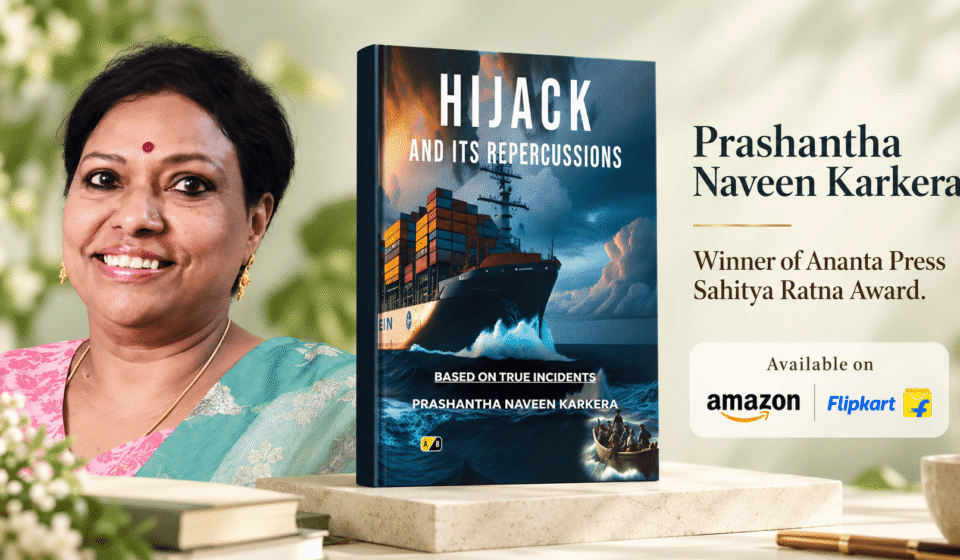

Book: Hijack: And Its Repercussions | Author: Prashantha Naveen Karkera | Category: Non-Fiction (General)
Some works of non-fiction begin with statistics, official records, or the broad sweep of history. Hijack: And Its Repercussions begins, in spirit, with something far more immediate: the shock of a family suddenly discovering that the person at the centre of its world may never return home. That human point of entry is one of the book’s greatest strengths. Prashantha Naveen Karkera takes an event associated with armed conflict, maritime danger, diplomatic pressure, suspicion, and public reporting, and allows the reader to experience it through the eyes of someone for whom the incident was not merely news. It was a personal emergency. The result is a work that gives emotional shape to a frightening historical episode and reminds us that every geopolitical crisis is also made up of individual lives, relationships, and families waiting for answers.
At the centre of the narrative is the cargo vessel Princess Kash and its captain, Bangare Navindra Karkera, the author’s husband. The supporting material describes the vessel being seized in the context of Sri Lanka’s civil war, when the Liberation Tigers of Tamil Eelam controlled parts of the north-eastern coast. The ship came under suspicion, the situation escalated, and the vessel was ultimately destroyed. For the family at home, however, such facts arrived not as an orderly sequence but as alarming fragments. News reports suggested the crew’s fate was unknown and created the terrifying possibility that there might be no survivors. The author’s recollection of reading such news on a morning that had begun in an ordinary, even joyful way gives the book its emotional ignition. One moment is normal; the next is unrecognisable. That abrupt transition captures the uncertainty of crisis more powerfully than a purely chronological account could.
What makes the book especially compelling is the contrast between public information and private experience. A newspaper headline can reduce an event to a few dramatic words: a ship hijacked, a vessel bombed, a crew missing. For the person whose husband is the captain, those words become a flood of questions. Is he alive? Is he injured? Is he being held? Will his actions be misunderstood? Can anyone in authority help? How does one protect a young child from fear while having no certainty oneself? The author’s perspective turns abstraction into consequence. The “repercussions” of the title therefore extend far beyond the destruction of a ship. They include fear, suspicion, family trauma, the threat to professional integrity, the struggle to communicate with officials, and the lasting psychological transformation that follows a brush with irreversible loss.
Another important quality of the book is its depiction of an ordinary person forced into extraordinary action. The author does not present herself as someone trained for diplomatic negotiation or crisis management. Instead, she records how necessity compelled her to act. She searched for contacts, sent repeated faxes, appealed to officials, remained in touch with representatives, and refused to accept helplessness as the only available role. This aspect of the narrative gives the book an unexpected layer of empowerment. It is not only about what happened to a ship at sea; it is also about what happened to a woman on land when she realised that waiting passively was impossible. Her fear did not disappear, but it became accompanied by determination.
That movement from fear to action gives the narrative an emotional arc that many readers will recognise even if they have never experienced anything remotely similar. Crisis often reveals capacities that normal life keeps hidden. The author herself reflects on discovering an inner strength she had not fully known before. This makes the book more than a record of a singular incident. It becomes a study in resilience: how people function when information is incomplete, when institutions appear distant, and when the future depends on decisions made by strangers in places one cannot reach.
The book also benefits from the presence of Shivshankar Menon’s preface. Writing from the perspective of the Indian High Commission in Colombo at the time, he confirms the seriousness and confusion surrounding the incident and describes the mission’s priority as the welfare of the Indians on board. He also notes the difficulty of establishing precise facts in the fog of war and the eventual success in securing the release of the Indian crew and Captain Karkera. This prefatory perspective is valuable because it places the author’s personal testimony beside an institutional memory of the same crisis. The two voices do not feel redundant. Rather, they show the same event at different scales: one from the diplomatic desk and one from the family home.
A further strength lies in the book’s refusal to treat survival as the end of the story. The captain’s physical return is, naturally, a moment of immense relief, but the emotional and reputational consequences do not disappear immediately. The author records anxiety over accusations and suspicion, concern for her husband’s integrity, and the painful process by which he and the crew had to explain what occurred. This attention to aftermath justifies the second half of the title. A hijack is an event; repercussions are what continue after the event has passed. By focusing on both, the book broadens its significance.
The writing is most effective when it preserves the emotional intensity of lived memory. The author’s repeated references to hope, prayer, family, fear, and gratitude may feel deeply personal, but that is precisely the point. This is not detached academic history. It is testimony. It seeks to record what a crisis felt like from inside a household whose future suddenly seemed uncertain. Readers interested in maritime incidents, modern South Asian history, diplomatic response, conflict, or real-life survival narratives will find relevant material here, but the book may be equally meaningful to readers drawn to stories of marriage, endurance, family bonds, and the psychological impact of unexpected catastrophe.
Its uniqueness lies in the combination of several layers that are rarely presented together. There is a maritime emergency. There is a civil conflict in the background. There are questions of state suspicion and military decision-making. There is diplomacy. There is media coverage. There is the struggle of a family to obtain reliable information. There is also a love story in the broadest and most mature sense: not romance as fantasy, but devotion expressed through action, waiting, fear, advocacy, and gratitude for a loved one’s return.
Most importantly, Hijack: And Its Repercussions gives a voice to the human beings who can vanish behind phrases such as “international incident” or “security situation.” It reminds the reader that a ship is not merely cargo and steel; it carries people with families, histories, responsibilities, and unfinished conversations. It also shows that official rescue and diplomatic success are experienced privately as something almost impossible to measure: the restoration of a person to those who feared they had lost him.
For readers who value non-fiction rooted in personal experience, the book offers sincerity, urgency, and historical interest. It preserves a story that could otherwise survive only in scattered reports and family memory. By writing it down, Prashantha Naveen Karkera transforms a period of terror and uncertainty into a record of survival, courage, and gratitude. The book’s enduring message is perhaps simple but powerful: in moments when certainty disappears, hope and determined action can become forms of resistance in their own right.
Amazon: https://amzn.in/d/3x4P3nN