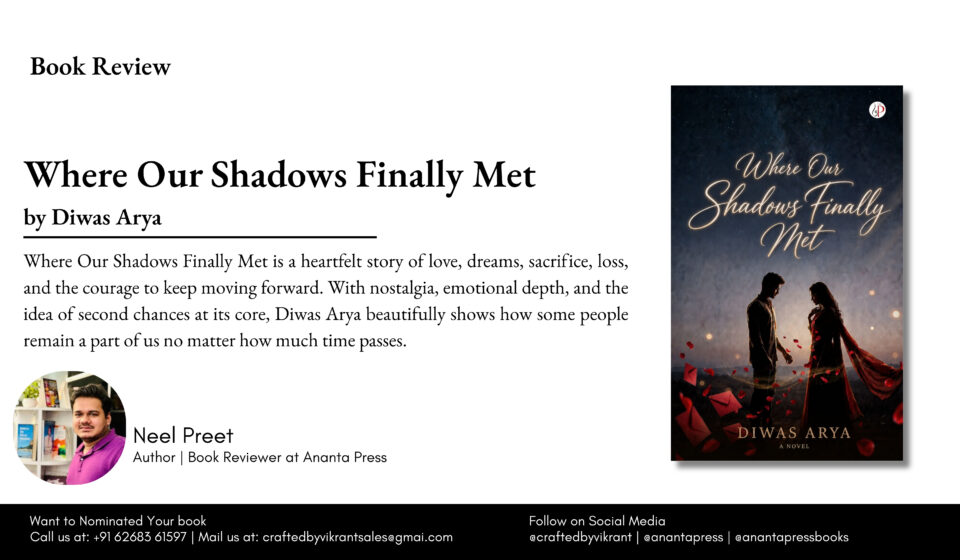

Some love stories are built around grand declarations, dramatic meetings, and impossible coincidences. Others find their strength in quieter things: a glance across a school corridor, a familiar voice on the telephone, a pendant kept close to the heart, an unfinished goodbye, or the simple act of waiting for someone who once changed your life. Diwas Arya’s Where Our Shadows Finally Met belongs firmly to the second category. It is an emotionally driven novel about first love, separation, ambition, sacrifice, memory, family, and the possibility that some relationships can survive even the longest stretches of silence.
At the heart of the novel are Dev and Swati, whose connection begins during their school years in Ranchi. Their first encounters are deliberately ordinary, which is exactly what makes them convincing. Swati does not enter Dev’s life through a highly manufactured romantic situation. She simply arrives as a new student, and a small smile in a school corridor becomes the beginning of something Dev cannot easily name or forget. The early chapters capture the awkwardness and innocence of teenage attraction particularly well: Dev rehearsing conversations in his mind, struggling to speak naturally when Swati is actually standing in front of him, Aditi teasing him, and seemingly insignificant exchanges suddenly becoming important because they involve the person he has started caring about.
One of the most appealing qualities of the novel is the way it allows love to grow through details instead of rushing toward dramatic romance. A bicycle, school bells, rain, telephone calls, laboratory sessions, ice cream during lunch, and familiar places around Ranchi gradually become emotionally charged. These objects and moments would mean very little to outsiders, yet to Dev and Swati they become part of a private emotional world. That is often how real memories work: years later, we may forget entire months of our lives but remember a particular laugh, a classroom window, a road, or the way someone once looked at us.
The school portions of the novel have an especially strong nostalgic quality. Diwas Arya recreates a time when communication was less immediate and therefore sometimes more precious. Dev and Swati cannot simply remain connected every second through social media or endless messaging. A five o’clock phone call can carry enormous emotional importance. Waiting for someone to answer becomes part of the relationship itself. After examinations, when life temporarily becomes freer, Dev continues calling Swati early in the morning because that hour has become something that belongs specifically to them. This makes their bond feel rooted in routine rather than merely romantic fantasy.
The novel also succeeds because Dev is given a life beyond romance. His ambition becomes an important parallel to his emotional journey. The prologue presents him as someone willing to reject a conventional path because he does not want to spend his life building another person’s dream. His decision to return to Ranchi and build something of his own establishes persistence as one of his defining traits. That same persistence later becomes deeply connected to the way he experiences love. Dev is someone who holds on, whether to an entrepreneurial dream or to a memory that refuses to become old.
This connection between professional ambition and emotional memory gives the book greater substance. Where Our Shadows Finally Met is not simply asking whether two former lovers will reunite. It is also interested in what happens to people while they are separated. Who do they become when the person who once understood them is no longer beside them? Does success compensate for emotional absence? Can achievement silence unresolved memories? For Dev, the answer is complicated. He can move forward professionally while remaining emotionally tied to something unfinished.
Swati, meanwhile, brings another dimension to the story because her absence is not presented merely as abandonment. Her disappearance creates pain, but as the novel gradually reveals what she has endured, the reader is asked to reconsider earlier judgments. She leaves Ranchi after devastating changes in her family life, carries responsibility for her mother, and spends years believing that keeping herself away is somehow necessary to protect others. Her suffering is therefore quieter than Dev’s but no less significant. When the truth finally begins to emerge, the novel becomes less about asking who suffered more and more about recognizing that both characters spent years surviving different versions of the same loss.
The separation itself is one of the novel’s most emotionally effective sections. Dev learns that Swati has left, races toward Ranchi Junction, falls from his bicycle, injures himself, continues anyway, and reaches the station only to discover that he is two minutes too late. The departing train becomes more than a physical departure; it represents everything he cannot say and everything neither of them is ready to resolve. His desire is not necessarily to prevent her from leaving, but simply to see her once more and make sure she knows she does not have to carry everything alone. That distinction gives the scene emotional maturity. Love here is not possession. Dev wants Swati to know that somewhere, someone will continue caring about her.
Aditi deserves special mention because she is far more than a convenient supporting character. Throughout the novel, she functions as friend, sister, confidante, mediator, witness, and eventually the bridge between two people separated by circumstances and misunderstanding. In many romances, supporting characters exist primarily for humor or exposition. Aditi has more emotional importance. She understands Dev’s feelings early, carries Swati’s messages when direct communication becomes impossible, and years later plays a crucial role in helping fractured relationships reconnect. When Dev eventually recognizes that Aditi has not merely arranged a reunion but has fought to restore something time seemed to have stolen, the depth of their bond becomes clear.
The use of recurring symbols also strengthens the novel. Most notable is the silver Om pendant, which survives the years of separation and becomes a physical representation of memory, faith, promise, and emotional continuity. When Swati realizes Dev is still wearing the pendant she gave him ten years earlier, it reveals something words have not been able to express: despite anger and silence, the past has never truly disappeared. By the end of the novel, the pendant remains with Dev, now transformed from a reminder of loss into an anchor connecting past suffering with present peace.
Another strength is the novel’s willingness to let its protagonists carry imperfections. Dev does not react to the reunion with effortless forgiveness. Ten years of hurt cannot realistically disappear within minutes. When Swati re-enters his life, hope competes with resentment. The conversation between them therefore matters because it allows the characters to confront the difference between what they assumed and what actually happened. Swati acknowledges that she disappeared and that an explanation cannot simply erase the consequences. Dev, in turn, has to decide whether remaining loyal to his pain is more important than understanding the truth.
That emotional conflict makes the theme of second chances feel earned. The book does not suggest that time automatically heals every wound. In fact, one of its central ideas is almost the opposite: time may teach people how to carry memories without actually removing them. Healing begins only when truth, forgiveness, and vulnerability finally enter the space previously occupied by silence.
The family dimension gives the concluding sections additional emotional weight. Swati’s reunion with Dev is important, but her acceptance into his family becomes equally meaningful because she has spent years thinking she must remain outside it. One particularly moving moment arrives when Dev’s mother recognizes that she had seen only her son’s suffering while failing to understand everything Swati had carried: the death of her father, responsibility for her mother, financial and emotional burdens, and the continuing love she had never truly abandoned. The embrace that follows is not merely approval of a marriage; it represents the end of years of misunderstanding.
The epilogue wisely gives the reader more than a simple reunion. Dev and Swati marry, build a life in Ranchi, and have a son, Karthik. Swati eventually establishes The Hopewell Academy, turning her resilience into something constructive for children. Her mother’s health improves, and the family reaches a form of ordinary happiness that would once have seemed impossible. This ordinariness is important. The reward after years of emotional upheaval is not some extravagant fantasy but breakfast conversations, family teasing, a child preparing for his first day of school, work, responsibility, and the comfort of belonging.
That is perhaps the most meaningful achievement of Where Our Shadows Finally Met. It understands that after extraordinary suffering, ordinary happiness can feel miraculous.
Diwas Arya’s writing is most effective when focusing on memory and emotional observation. Rain-soaked streets, school corridors, crowded railway platforms, early-morning phone calls and quiet rooms are not simply backgrounds; they become extensions of the characters’ emotional states. The narrative repeatedly returns to silence, waiting, distance, and small gestures, creating a romantic atmosphere without depending entirely on conventional declarations of love.
Readers who enjoy emotionally intense romances built around first love, long separation, nostalgia and second chances will find much to appreciate here. At the same time, the novel contains enough material about ambition, friendship, family responsibility, grief and personal growth to move beyond the narrow boundaries of a typical romance.
Ultimately, Where Our Shadows Finally Met is a story about two people who do not remain unchanged while waiting for each other. They grow, struggle, misunderstand, achieve, grieve and endure. Their reunion matters because of everything that has happened in the years between their first meeting and their final return to one another. The ending leaves the reader not with the idea that love magically defeated every difficulty, but with something more believable and emotionally satisfying: love survived long enough for two people to finally become capable of understanding what the other had carried.
The final image of Dev watching Swati and their son walk toward school beautifully completes that journey. Ten years of silence and five years of rebuilding have led not to some spectacular public triumph, but to a peaceful family morning. Dev realizes that the years of waiting and the unsaid goodbyes were not meaningless; they eventually brought them to the life they once could not imagine.
Overall, Where Our Shadows Finally Met is a tender, nostalgic and deeply emotional novel about the people we carry with us even when life forces them far away. It celebrates first love without romanticizing pain, values sacrifice without forgetting its cost, and presents forgiveness as something that requires understanding rather than simple forgetting. Diwas Arya has created a story for readers who believe that some connections may disappear from sight without ever disappearing from the heart.